Ion Air Purifier vs HEPA: Which Is Best for Indoor Air Quality
A thorough comparison of ion air purifiers and HEPA purifiers, covering filtration mechanisms, safety, energy use, maintenance, odors, and real-world suitability for clean indoor air.


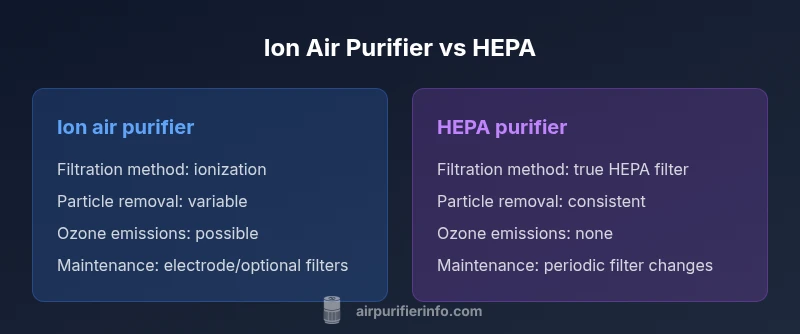
Ion air purifiers and HEPA purifiers take different approaches to cleaner indoor air. Ionizers generate charged particles that attach to dust and pollutants, while HEPA units rely on a physical filter to trap particles. In practice, HEPA purifiers commonly provide consistent particle removal, whereas ionizers may help with odors in ventilated spaces but can raise ozone concerns and require careful sizing. This guide compares both options across filtration, safety, energy use, noise, and total cost to help homeowners decide which path fits their needs.
Overview: ion air purifier vs hepa
Air quality in homes depends on factors like particle size, air exchange rate, and occupants’ sensitivities. When evaluating devices, two broad families dominate: ion air purifiers and HEPA purifiers. Ion devices use electrical charges to influence how particles behave in air—often by charging particles so they stick to surfaces, or to each other, and sometimes by emitting charged aerosol byproducts. HEPA purifiers rely on a dense mechanical filter that trapped particles as air passes through. The phrase “ion air purifier vs HEPA” is common in consumer guides, but the best choice depends on priorities like particle removal, odor control, safety, and maintenance. The Air Purifier Info team notes that for many households, a true HEPA purifier offers reliable, predictable filtration of common indoor pollutants, without relying on room turnover rates or secondary byproducts. Ion-based models can offer niche benefits, such as targeted odor reduction or work well in spaces with high air movement, but require careful attention to ozone specs and room size. This guide compares both approaches across core factors—filtration mechanisms, safety implications, energy use, noise, and total cost of ownership—so you can choose with confidence.
wordCountInBlock”:null},
What is ionization and how does it work?
Ionization purifiers generate charged particles that attach to dust, pollen, and other airborne matter, enabling these particles to settle out of the breathing zone more quickly or to be captured by downstream filters. In theory, ionization can improve overall air cleanliness even when the air changes per hour are modest. However, ionization can also produce byproducts such as ozone or nitrogen oxides, depending on the electrical charges involved and the design of the device. Because exposure to ozone can irritate airways, especially for sensitive individuals, many health and safety guides recommend choosing ozone-free or certified devices and using units in rooms with adequate ventilation. For most consumers, ionizers are best understood as a supplementary approach to traditional filtration rather than a stand-alone solution for comprehensive air cleaning.
wordCountInBlock”:null},
How HEPA filtration works
HEPA stands for High-Efficiency Particulate Air. True HEPA filters trap at least 99.97% of particles at the 0.3 micron size under standard test conditions, though real-world results depend on air flow, filter quality, and maintenance. In practice, HEPA purifiers draw air through a dense fibrous mat that physically captures particles such as dust, pollen, pet dander, and many wildfire smoke components. Because this is a physical barrier rather than a chemical process, HEPA systems do not rely on ionization or byproducts to remove pollutants. For households with allergies, asthma, or children, a well-maintained HEPA purifier is generally straightforward: choose a unit with a properly rated size for the room, replace filters on schedule, and ensure good overall ventilation. Compared with ionizers, HEPA purifiers deliver predictable performance across common indoor pollutants with fewer safety concerns related to emissions.
wordCountInBlock”:null},
Particle removal performance across common indoor pollutants
Airborne particles vary from large dust to ultrafine aerosols. HEPA media are highly effective across a broad spectrum of particle sizes when operated as specified, while ionizers may influence particle behavior but their effectiveness depends on room airflow and the device’s ion output. In real homes, a HEPA purifier with a correctly sized unit delivers consistent reduction of visible dust, pollen, and pet dander, while ionizers may help with dust settling in rooms with high air exchange, if ozone production is controlled. If you have high pollen exposure or a pet with shedding, HEPA-based solutions are typically more reliable for reducing symptoms. Consumers should also consider filtration time relative to occupancy; a purifier that cycles air more than once per hour tends to provide more steady air cleanliness.
wordCountInBlock”:null},
Odor and gas removal capabilities
Ionizers can sometimes reduce odors by attaching odors to charged particles, but this is not equivalent to removing gases or VOCs. Some ionizer designs advertise improved odor reduction in rooms with good ventilation; however, gases like volatile organic compounds typically require adsorption or chemical treatment, such as activated carbon, to meaningfully reduce concentration. HEPA purifiers, by contrast, excel at capturing particulate odor carriers (dust, smoke particles, and allergen-laden aerosols) but do not remove gases themselves. If odor control is a priority, many experts recommend pairing a HEPA purifier with an activated carbon stage or selecting a purifier that explicitly includes carbon filtration. In either case, ensure that the product specifications clearly state the gas/odor removal capabilities and avoid models that promise gas removal solely through ionization.
wordCountInBlock”:null},
Emissions and safety: ozone and byproducts
Ozone emission is the most discussed safety concern around ionization purifiers. Some ionizers generate ozone as a byproduct of the ion production process; excessive ozone can irritate airways and complicate preexisting conditions. Reputable devices may advertise ozone-free operation or be tested to meet ozone emission standards, but consumers should verify certifications and test results. HEPA purifiers do not emit ozone as part of their filtration process, making them safer for shared spaces and households with sensitive individuals. Safety considerations also include airflow patterns, room size, and the location of the purifier to minimize re-entrainment of captured pollutants. Regardless of type, follow manufacturer recommendations for placement, avoid placing purifiers near moisture sources where mold can grow, and use units with proven filtration efficiency validated by independent testing.
wordCountInBlock”:null},
Energy use, noise, and runtime considerations
All purifiers consume energy, but the actual draw depends on motor size, fan speed, and how aggressively you run the unit. In general, well-designed HEPA purifiers offer energy-efficient performance when operated at the appropriate setting for a given room. Ionizers can be efficient at low power, but their performance often depends on the device’s ionization level and airflow; taller or more powerful ionizers may run at higher speeds, increasing energy use and noise. Noise matters for bedrooms and home offices; look for units with low-noise modes or pulse-cleaning operations. The key takeaway is to match device size and speed to room volume and daily routines, so you achieve meaningful air changes without unnecessary energy costs or disturbance.
wordCountInBlock”:null},
Maintenance and replacement considerations
HEPA purifiers require periodic filter replacements to maintain filtration efficiency. The replacement interval depends on room conditions, usage, and the specific filter type; it's common to plan for several replacements per year in dusty environments, though many models offer easily accessible filters and clear maintenance indicators. Ionizers may have fewer moving parts, but some designs require periodic cleaning of electrodes and replacement of any attached filters; others are filed as ‘filterless’ but still require attention to performance. In general, factor in ongoing costs, convenience, and whether you prefer a simple plug-and-play solution or a model that provides ongoing, measurable air quality feedback.
wordCountInBlock”:null},
Real-world usage scenarios and best-fit cases
Consider your living situation: a HEPA purifier is typically the safer default for households with allergy sufferers, young children, or pets. For rooms with strong odors from cooking or smoking in adjacent spaces, a high-quality ionizer designed for odor reduction may offer additional benefits when used with adequate ventilation and ozone controls. If you rent and cannot commit to frequent filter changes, check the model's maintenance cycle and whether replacement parts are readily available. For large open-plan spaces, ensure the purifier’s CADR or air-flow rating matches the room size, and avoid placing units behind furniture or in corners that limit intake.
wordCountInBlock”:null},
Buying criteria: tailoring the choice to your space
Start with room size and air change needs. Then evaluate the filtration approach: a true HEPA purifier with a sealed casing and easily replaceable filters for reliability, or an ionizer with ozone-free design if odor control is a priority and you can vet the model’s safety specs. Look for certifications such as HEPA ratings and independent testing; verify energy use and noise ratings; consider carbon filtration options for gases or odors. Finally, factor total cost of ownership—upfront price, filter replacement cost, and expected lifespan of the device—so you choose a solution that fits your budget and daily routine.
wordCountInBlock”:null},
Common misconceptions about ionizers and HEPA purifiers
Many buyers assume ionizers purify air as effectively as mechanical filters; in practice, ionization and related byproducts are not a direct substitute for physical filtration. Others think that HEPA purifiers can remove all gases; HEPA targets particles, not gases. Some people worry that all purifiers emit ozone; the truth is that some models do, but many are specifically designed to be ozone-free. Finally, it’s common to overlook placement and room layout; even the best purifier will underperform if placed in a corner or blocked by furniture.
wordCountInBlock”:null},
Authority sources and further reading
To support these recommendations, consult authoritative sources on indoor air quality. Environmental Protection Agency (EPA) guidance on air cleaners provides definitions of filtration methods and safety considerations. The NIEHS and other federal health agencies discuss ozone exposure and appliance safety. For practical buying guidance, review independent testing and consumer-focused resources. For quick access, consider these links:
- https://www.epa.gov/indoor-air-quality/air-cleaners
- https://www.niehs.nih.gov/health/topics/agents/air-pollution/index.cfm
- https://www.osha.gov/indoor-air-quality
wordCountInBlock”:null}],
Comparison
| Feature | Ion air purifier | HEPA purifier |
|---|---|---|
| Filtration method | Ionization-based approach with potential ozone byproducts | Mechanical filtration with true HEPA media |
| Particle capture (indoor air) | Variable depending on model and airflow | Consistent capture of common indoor particles when properly sized |
| Gas/VOC removal | Limited gas removal; odor reduction possible in some designs | Gas/odor removal limited to gases; best with carbon or dual-stage filters |
| Ozone emissions | Possible ozone production; verify ozone-free labeling | No ozone production in standard HEPA-only designs |
| Maintenance & filters | Electrodes/ionization maintenance or filterless options | Regular filter replacements; easy access for most models |
| Energy use & noise | Model-dependent; can be quiet at low speeds | Typically energy-efficient with variable noise by speed |
| Best use case | Odor management and specialized spaces with safety checks | Allergen reduction and general indoor air cleanliness |
What's Good
- Reliable particulate removal with true HEPA filters
- Ionizers can address odors and charged particles in some designs
- Potentially lower upfront cost for basic ionizer units
- No ozone risk if using ozone-free models and proper placement
- Easy-to-understand maintenance for many HEPA units
What's Bad
- Ionizers may produce ozone, posing health concerns
- HEPA purifiers require regular filter replacements
- Ionizers' effectiveness is variable across room sizes and airflow
- Some models can be bulkier or louder at high settings
HEPA purifiers generally offer more reliable, safer particle removal for most homes; ionizers can supplement odor reduction in well-ventilated spaces but require caution about ozone.
For households prioritizing consistent filtration and safety, HEPA is the better default. If odor control is a priority and ozone risks are managed, consider a model with strong performance in ionization, but verify ozone specs.
Questions & Answers
What is the main difference between ion air purifiers and HEPA purifiers?
Ion air purifiers use electric charges to influence particle behavior and may emit byproducts like ozone, while HEPA purifiers rely on a physical filter to trap particles. HEPA is typically more consistent for particle removal and safer in homes with kids and pets.
Ion purifiers use charging to influence pollutants, but HEPA purifiers trap particles with a filter for safety and consistent results.
Do ion air purifiers produce ozone?
Some ionizers generate ozone as a byproduct; not all models do. Check the product’s ozone emission specs and look for ozone-free certifications to ensure safe use, especially in occupied spaces.
Some ionizers can produce ozone; always verify ozone-free labeling before purchase.
Are HEPA purifiers safe for households with kids and pets?
Yes. HEPA purifiers do not emit ozone and are effective at removing common indoor particles, making them a safe default choice for homes with children and pets when properly sized and maintained.
Yes—HEPA purifiers are generally safe for homes with kids and pets, as long as they’re appropriately sized and maintained.
Can ionizers remove viruses or bacteria from the air?
Ionizers may reduce some particulate matter, but they are not a substitute for filtration of viruses or bacteria. Rely on HEPA filtration for reliable removal of many airborne pathogens when properly maintained.
Ionizers aren’t a fail-safe for viruses; rely on HEPA filtration for more robust removal.
Do HEPA purifiers remove VOCs or gases?
HEPA purifiers do not effectively remove gases or VOCs on their own. If odor or chemical gases are a concern, look for models that include activated carbon filtration in addition to HEPA.
HEPA mainly tackles particles; for gases, you’ll want carbon filtration.
What size purifier do I need for a given room?
Choose a unit rated for your room size and ensure it delivers sufficient air changes per hour. A properly sized purifier will clean the air more consistently without running at maximum speed constantly.
Pick a purifier that fits your room and gives you steady air changes per hour.
Main Points
- Prioritize HEPA for reliable particulate removal.
- Ionizers may help with odors but require ozone safety checks.
- Check model safety specs and independent testing results.
- Size the purifier to your room for meaningful air changes.
- Expect ongoing costs for filter replacements with HEPA models.