HEPA Air Purifier vs Ionizer: A Data‑Driven Comparison
Compare HEPA air purifiers and ionizers for dust, allergens, odors, ozone safety, and maintenance. Get practical guidance to choose the best option for your home environment.


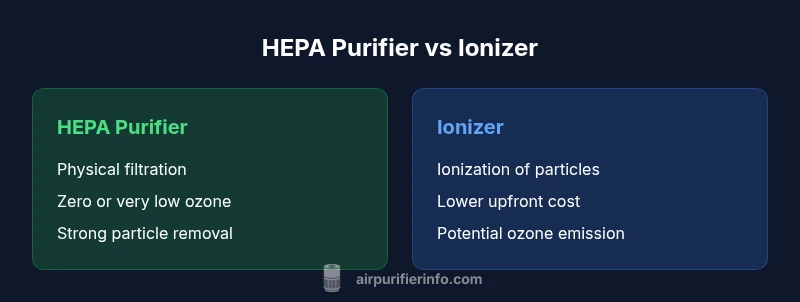
When you compare hepa air purifier vs ionizer, for most homes a true HEPA air purifier is the safer, more effective choice for broad particle removal without ozone. HEPA devices trap 99.97% of particles down to 0.3 microns, while ionizers rely on charged particles and can produce trace ozone in some models. If you want strong dust/allergen control with no ozone, choose a HEPA purifier; ionizers are cheaper but more limited.
What is a HEPA air purifier?
HEPA stands for high-efficiency particulate air. A true HEPA air purifier uses a dense, pleated filter to capture particles as air passes through. In residential models, you typically see a true HEPA filter combined with prefilters and sometimes activated carbon for odors. When you compare hepa air purifier vs ionizer, the HEPA option is designed to physically remove particles from the air rather than rely on ionization. The standard is that a device labeled True HEPA captures at least 99.97% of particles as small as 0.3 microns. Real-world performance depends on airflow, filter condition, and room size. HEPA purifiers are effective for dust, pollen, pet dander, mold spores, and some smoke particles. They are maintenance-heavy in terms of filter replacements, but provide predictable, steady performance without relying on chemical byproducts. For households concerned about allergies, asthma, or general indoor air quality, HEPA cleaners remain a foundational choice.
How ionizers work
Ionizers release negative and sometimes positive ions into the air. These ions attach to particles, causing them to cluster and more readily settle on surfaces or be collected by a nearby plate. This process does not physically remove every particle from the air the way a filter does, and effectiveness depends on air flow and room conditions. Some ionizers are designed to reduce visible dust or improve perceived air quality, but they do not guarantee the same particle capture as a filter. In addition, certain ionizers can emit trace amounts of ozone, especially older or lower-quality models, so many modern, ozone-free units strive to minimize byproduct emissions. When evaluating hepa air purifier vs ionizer, this fundamental difference matters for overall air cleanliness and safety.
Core differences between HEPA purifiers and ionizers
The most important distinction is mechanism: HEPA purifiers physically trap particles with a filter; ionizers rely on charging particles and relying on deposition or collectors. This leads to several practical differences:
- Filtration vs. ionization: HEPA provides detectable removal with a labeled filter, while ionizers depend on electrical charges and air movement.
- Ozone considerations: True HEPA units typically emit negligible ozone; some ionizers may produce ozone, requiring careful model selection and testing.
- Maintenance profile: HEPA systems require regular filter changes; ionizers may have minimal ongoing maintenance beyond cleaning any collectors or deactivating plates.
- Odors and VOCs: Activated carbon in HEPA models can reduce odors; ionizers offer little direct odor removal unless paired with a separate filtration stage.
- Room performance: For shared living spaces and variable occupancy, HEPA purifiers tend to provide more consistent results across a wide range of conditions. If you trace the comparison back to the core question hepa air purifier vs ionizer, HEPA typically wins on reliable particle removal and safety, while ionizers offer a lower-cost, lower-maintenance entry in some cases but with caveats around ozone.
Particle removal: dust, pollen, and pet dander
Particles such as dust, pollen, and pet dander are the most common indoor pollutants. HEPA purifiers are designed to capture these particles as air passes through the filter, delivering a measurable reduction in airborne particulates when appropriately sized for the room. The effectiveness is tied to the unit’s CADR (clean air delivery rate) relative to the room size and to how often the filter is replaced. Ionizers, by contrast, do not consistently remove submicron particles from the air. They may lower the concentration of such particles only indirectly through deposition or surface charging, which can leave remaining particulates in the air and surfaces. For strong, reliable particle control in typical homes, HEPA is the safer bet.
Odors and VOCs: can either help?
Odor control and volatile organic compounds (VOCs) are challenging for ionizers. While ionizers can alter particle chemistry in some contexts, they do not inherently remove gases or odors. HEPA purifiers paired with an activated carbon stage can reduce odors and certain VOCs by adsorption, especially in kitchens, smoking areas, or pet zones. It’s important to check the purifier’s carbon filter capacity if odor removal is a priority. If you expect strong odors as a daily factor, a HEPA model with carbon and proper filtration is generally more capable than a pure ionizer.
Safety and ozone considerations
Safety is a central concern when choosing between these technologies. True HEPA purifiers are widely recognized for safe operation and minimal byproducts. Ionizers, however, have a varying safety profile depending on model design. Some ionizers emit trace ozone, which can irritate airways in sensitive individuals and children. Look for devices with ozone emission ratings that meet or exceed safety standards, and avoid models that lack independent certification. When evaluating hepa air purifier vs ionizer, safety leans strongly toward HEPA in most household scenarios, particularly for families with asthma or allergies.
Maintenance, costs, and reliability
Cost of ownership includes upfront price, filter replacement costs, and energy use. HEPA purifiers typically require periodic filter changes (every 6–12 months for many models, depending on use), which adds to ongoing expenses but offers predictable performance. Ionizers usually boast lower maintenance, as many have few or no replaceable parts; however, the long-term reliability can vary with the quality of electronics and the presence of any ionization plates or collectors. Energy use is generally modest for both, but the fan speed setting and the device’s overall CADR will influence consumption. If you prioritize long-term reliability and consistent air quality, HEPA purifiers with properly sized filters generally deliver steadier, safer performance.
Room size, placement, and air flow
Effective air cleaning depends on the device’s capacity relative to the room. A purifier sized too small for the space will have less impact, while a larger unit can circulate air more quickly and reduce concentrations more effectively. For ionizers, room placement matters less for the technology itself but still affects how well ions interact with airborne particles. Avoid corners and closed areas where airflow is restricted, and ensure there is adequate clearance around the unit for intake and exhaust. For most rooms in typical homes, a mid-range HEPA purifier with a carbon stage provides reliable performance when sized correctly and operated at a suitable setting.
Noise, energy use, and user experience
Noise and energy use are practical concerns for everyday living. HEPA purifiers vary in noise output depending on fan speed, filtration stage, and design; many offer a quiet mode for bedrooms and living areas. Ionizers can be less noisy if they are compact and rely less on high airflow, but any accompanying fan or electronics can still contribute to audible sound. Energy use generally tracks with air movement and CADR; higher-performance purifiers consume more energy but deliver faster air cleansing. In terms of user experience, HEPA purifiers provide predictable behavior and straightforward filter replacement cycles, while ionizers appeal to budget-conscious buyers who prioritize low maintenance but must manage ozone considerations.
Budgeting: price ranges and value
Price ranges for HEPA purifiers span from entry-level units to advanced models with carbon filters and smart controls. Ionizers, especially basic models, tend to be cheaper upfront but may come with trade-offs in long-term performance and ozone considerations. When budgeting, consider the total cost of ownership: initial price, ongoing filter or plate replacements, electricity costs, and the potential need for additional devices for odors or VOCs. An informed comparison between hepa air purifier vs ionizer will show that the best long-term value often comes from a HEPA purifier that matches room size and priority needs, even if the initial price is higher.
Practical decision guide: when to choose which
Use this quick framework to guide your decision:
- If you prioritize broad particle removal with strong allergen control and zero ozone risk, choose a HEPA purifier matched to your room size.
- If you’re budget-constrained, primarily concerned with odors (to a limited extent) and want minimal maintenance, an ionizer might be an option, but verify ozone ratings and safety certifications.
- If you have a mixed needs scenario (dust, odors, and occasional smoke), a HEPA purifier with an activated carbon stage is usually the most versatile and safer long-term choice.
- For households with children, older adults, or asthma, HEPA purifiers are generally the safer, more effective baseline investment.
Authority sources
- EPA: Air Cleaners and Your Indoor Air Quality: https://www.epa.gov/indoor-air-quality-iaq/air-cleaners-and-your-indoor-air-quality
- Harvard Health: Do Air Purifiers Work? https://www.health.harvard.edu/staying-healthy/do-air-purifiers-work
- Acknowledgments: Air Purifier Info Analysis, 2026 (for synthesis and practical guidance)
Comparison
| Feature | HEPA air purifier | Ionizer |
|---|---|---|
| Filtration/Removal Mechanism | Physical filtration via true HEPA filter (captures 99.97% of 0.3 µm particles) | Ionization and/or collectors (charges particles; removal depends on deposition) |
| Ozone Emission | Typically negligible/zero ozone with certified HEPA units | Potential ozone production in some models; check ratings |
| Maintenance Cost | Moderate: filter replacements required (every 6–12 months typical) | Low-to-moderate: fewer consumables; some models have no filters |
| Odor/VOC Control | Carbon stage helps absorb odors and VOCs when present | Limited odor/VOC removal; better with separate carbon setup |
| Best For | Dust, pollen, pet dander, smoke particles; universal use in homes | Budget-minded use; limited particle removal; odor concerns not fully addressed |
| Price Range | $100-$450 (varies by CADR and features) | $50-$250 (often cheaper upfront) |
| Noise/ operation | Varying fan speeds; higher CADR can be louder | Typically quieter if no high airflow; depends on design |
What's Good
- Reliable, proven particle capture with true filtration
- Zero or negligible ozone output in certified HEPA units
- Wide model variety and room-size options
- Generally better for allergy and asthma-prone households
- Carbon filters in HEPA units help with odors and VOCs
What's Bad
- Higher upfront cost compared to many ionizers
- Ongoing filter replacement costs and disposal
- Some models can be bulky for small rooms
- Ionizers may not deliver consistent air quality without additional filtration
HEPA purifiers are the safer, more versatile choice for most homes.
For broad particle removal, zero ozone risk, and reliable performance, a properly sized HEPA purifier beats an ionizer. Ionizers can be cheaper upfront, but safety and effectiveness vary by model. Air quality improves most when you prioritize true filtration with carbon stages for odors.
Questions & Answers
Do HEPA purifiers emit ozone?
Most true HEPA purifiers are designed to have negligible ozone output. If ozone is a concern, look for models with an explicit ozone emission rating and third‑party certification. In practice, HEPA filtration itself does not generate ozone as a byproduct.
Most HEPA purifiers don’t produce ozone. If you’re worried about ozone, check the model’s rating and certification before purchasing.
Can an ionizer really improve air quality?
Ionizers can reduce some airborne particles by charging them so they settle faster or are captured by collectors in the device. However, they do not guarantee the same particle removal as a true HEPA filter and may introduce ozone in some designs. They’re best used with caution and awareness of ozone ratings.
Ionizers can help reduce some particles, but they don’t match HEPA filtration and may emit ozone in some models.
Are ionizers safe for households with pets?
Safety depends on the model. If ozone is a concern or if your pet has respiratory sensitivity, avoid ionizers with higher ozone output. Prefer devices that are ozone-free and validated for indoor use around animals.
Check the ozone rating and look for ozone-free models if you have pets.
Will HEPA purifiers remove odors effectively?
HEPA purifiers with an activated carbon filter can reduce odors and some VOCs by adsorption. Pure HEPA filtration will not remove odors on its own; the carbon stage is key for odor control in many models.
Odors improve best with HEPA plus a carbon filter.
What room size is appropriate for a purifier?
Choose a purifier whose CADR and recommended room size match the space. A unit too small will struggle to clean the air effectively, while an appropriately sized model will circulate air efficiently and reduce particle concentration over time.
Match the unit to your room’s size for best results.
Main Points
- Choose HEPA first for dust/allergen control
- Verify ozone ratings on ionizers before buying
- Pair HEPA with carbon for odor control
- Match purifier size to room for best results
- Expect ongoing filter costs with HEPA devices
- Check noise levels at your typical usage times