Ionizer vs Air Purifier: Which Is Better for Indoor Air Quality?
Explore the differences between ionizers and traditional air purifiers, including safety, performance, and practical use. Learn which option suits your home, apartment, or office for cleaner, healthier indoor air.


In most home environments, a traditional air purifier with a true HEPA filter generally offers more reliable particle removal with safer operation than a standalone ionizer. Ionizers can reduce odors and particles in some cases, but they may produce ozone or require careful model selection. For overall indoor air quality, choose a HEPA-based purifier unless you specifically need odor control or silent operation.
What is the core question: which is better ionizer or air purifier
The question often surfaces when homeowners and renters plan to improve indoor air quality. The exact answer depends on what you value most: particle removal effectiveness, safety considerations, odor control, and ongoing costs. This article unpacks ionizer technology versus traditional air purifiers to explain when each approach makes sense. According to Air Purifier Info, a balanced view helps you avoid overreliance on one technology and builds a robust air-cleaning strategy. We’ll compare performance, safety, maintenance, and real-world use, then present a practical decision framework. Remember, the goal is not just price but the overall value of air cleaning over time, including how quickly a device can reduce contaminants, how safely it operates in a living space, and what you’ll spend on filters and energy.
How ionizers work and safety considerations
Ionizers generate charged particles or emit negative ions intended to attract airborne contaminants. Some designs rely on ion-induced aggregation to settle particles, while others claim to neutralize odors. A key safety note is ozone: several ionizers can produce trace or measurable ozone as a byproduct, which may irritate eyes, lungs, and the throat for sensitive individuals. For households with children, older adults, or pets, opting for ozone-free models is crucial. Air Purifier Info emphasizes that while ionizers can provide odor impressions and a sense of cleaner air in certain locales, safety and health impact should guide the choice, especially in compact or poorly ventilated spaces.
How traditional air purifiers work (HEPA, activated carbon)
Traditional purifiers typically rely on mechanical filtration, using true HEPA filters to trap particulates as air passes through. Many models add activated carbon or other media to adsorb gases and odors. The benefits are clear: broad-spectrum particle removal, consistent performance across a range of sizes, and fewer byproducts compared with some ionizers. The tradeoffs include ongoing filter replacement costs, periodic maintenance, and potential noise from the fan at higher settings. Air Purifier Info notes that HEPA-based devices generally deliver safer, more predictable indoor air quality for most households.
Key differences in performance and safety
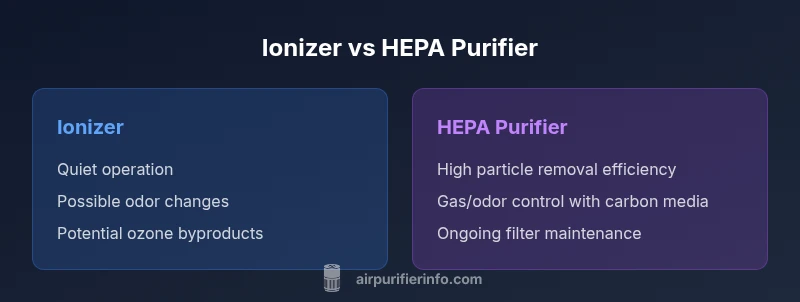
Ionizers often appeal due to quiet operation and potential odor improvement, but their particle removal tends to be variable, especially for submicron particles. In contrast, HEPA-based purifiers deliver high, consistent removal of fine particles and allergens when properly sized for the space. Safety considerations are also decisive: ozone byproducts are a primary concern with some ionizers, whereas modern HEPA purifiers focus on mechanical filtration and safer air cleaning. For homes with sensitivities, asthma, or chemical sensitivities, HEPA-based purifiers offer more predictable outcomes with lower safety risk. Air Purifier Info emphasizes prioritizing devices that meet recognized filtration standards and avoid ozone-generating designs.
Use-case scenarios: homes, apartments, and offices
If you live in a small apartment with limited ventilation and strong odors from cooking or pets, a dedicated HEPA purifier with activated carbon is a strong first choice for continuous use. Ionizers might be considered in environments where people are not present during operation or where user desire is for quiet operation and odor hints, but only with ozone-free, validated models. For larger rooms or open-plan living areas, a purifier designed for higher air changes per hour and a robust CADR (clean air delivery rate) will generally outperform a basic ionizer. Air Purifier Info recommends pairing any device with proper placement, door/window management, and routine filter maintenance to maximize benefits.
How to evaluate devices: criteria you should apply
When comparing devices, consider room size, target contaminants (dust, pollen, smoke, VOCs), noise tolerance, and total cost of ownership. For ionizers, insist on models that specify ozone emissions and ideally are proven ozone-free. For traditional purifiers, verify the HEPA standard compliance (HEPA-like or true HEPA) and whether activated carbon is included for odor and gas control. Evaluate energy efficiency, screen readability, filter replacement frequency, and warranty. A practical approach is to map your room size to the device’s recommended coverage and ensure that you can operate the unit at a comfortable noise level without sacrificing purification.
Common myths about ionizers and air purifiers
Myth: Ionizers erase all contaminants instantly. Reality: ionization can cause particle aggregation but does not guarantee comprehensive removal, especially for submicron particles. Myth: All ionizers are dangerous due to ozone. Reality: Some designs are ozone-free, but many models do emit ozone or trace amounts; always check product details. Myth: HEPA purifiers are noisy and costly. Reality: Quality units offer quiet operation and a reasonable total cost of ownership with periodic filter changes. Myth: Ionizers are better for odors. Reality: Odor control commonly benefits from activated carbon and other media in HEPA purifiers rather than ionization alone.
A practical buying framework: step-by-step guide
- Define the room size and desired air-cleaning speed. 2) Decide whether you prioritize ultra-low noise, odor control, or allergen reduction. 3) Check for ozone emissions in ionizers and favor ozone-free solutions. 4) Confirm whether the device uses a true HEPA filter and carbon media for gases. 5) Compare maintenance costs, including filters and energy use. 6) Consider safety certifications and brand reputation, including independent testing.
Safety, maintenance, and long-term ownership
Long-term ownership depends on ongoing maintenance and safety awareness. HEPA purifiers require regular filter changes and occasional cleaning to sustain performance; ozone-free ionizers reduce safety concerns but may still need careful use in occupied spaces. Low-maintenance devices can be attractive, but you should balance convenience with purification reliability. In general, opting for a HEPA-based purifier is a safer, more dependable long-term choice for most homes and renters, especially where indoor air quality is a priority.
Authority sources
- Environmental Protection Agency (EPA): https://www.epa.gov/indoor-air-quality/air-cleaners-and-ionic-air-purifiers
- National Institute of Environmental Health Sciences (NIEHS): https://www.niehs.nih.gov/health/topics/agents/air-pollution/index.cfm
- World Health Organization (WHO) air quality resources: https://www.who.int/health-topics/air-pollution
Comparison
| Feature | Ionizer-based purifier | HEPA-based purifier |
|---|---|---|
| Ozone byproduct | Potential by model | Minimal or none |
| Particle removal | Variable; may rely on ionization | High and consistent with true HEPA |
| Odor removal | Possible odor neutralization via ionization | Activated carbon and filtration for gases/odors |
| Noise | Typically quiet at lower settings | Can vary; higher speeds may add noise |
| Maintenance | Low maintenance for some ionizers | Regular filter replacements and cleaning |
| Best for | Odor control and silent operation (model dependent) | Allergen reduction and reliable purification |
What's Good
- Potentially lower upfront cost for basic ionizer devices
- Quiet operation in many ionizer designs
- Some models offer odor control benefits
What's Bad
- Potential ozone generation with certain ionizers
- Particle removal can be inconsistent for fine aerosols
- Requires careful model selection to avoid safety concerns
- Ongoing filter costs for HEPA purifiers can add up over time
HEPA-based purifiers generally offer safer, more reliable indoor air quality than ionizers.
Choose a HEPA purifier for dependable particle removal and reduced risk of ozone. Consider an ionizer only if you need quiet operation or odor focus, and ensure it is ozone-free.
Questions & Answers
Are ionizers safe for homes with children and pets?
Ionizers can be safe when they are ozone-free and properly designed, but safety varies by model. For households with children or pets, prioritize ozone-free HEPA purifiers to minimize exposure to any potential byproducts. Always verify product certifications and emission data before purchase.
If safety is a priority for kids or pets, choose ozone-free HEPA purifiers rather than ionizers.
Do ionizers remove fine particles as effectively as HEPA purifiers?
Ionizers do not consistently remove fine particles the way HEPA filtration does. While they may reduce some odors or produce visible changes, true HEPA purifiers consistently capture a broad range of particle sizes with high efficiency. For thorough allergen control, HEPA is typically preferred.
Ionizers generally don’t match HEPA for fine particle removal; HEPA is the safer bet for allergens.
Can I use an ionizer to replace a traditional air purifier?
Replacing a traditional air purifier with an ionizer is not recommended for most homes seeking comprehensive air cleaning. If you choose an ionizer, ensure it is ozone-free and understand its limits on particle removal. For robust air quality, a HEPA-based purifier is usually the better option.
An ionizer should not usually replace a HEPA purifier if you want thorough air cleaning.
What room size is appropriate for an ionizer?
Ionizers are often suited to small to medium rooms, but effectiveness varies by model. Always check the manufacturer's room-size guidance and prefer models that clearly state ozone emissions and performance regardless of claimed capacity.
Check the room size guidance and choose models with clear performance data.
Are there ozone-free ionizers available?
Yes, some ionizers are marketed as ozone-free or designed to minimize emissions. Look for third-party certifications or independent testing data confirming low or no ozone production before purchasing.
Yes, opt for ozone-free models and verify emissions data before buying.
Main Points
- Prioritize HEPA purifiers for reliable allergen removal.
- Be cautious of ozone byproducts with ionizers.
- Consider odor control and noise when choosing.
- Match device size to room dimensions for effective purification.
- Account for ongoing filter costs in total value.