Air Purifier 1000 Sq Ft: Coverage, CADR, and Buying Guide
Learn how to size and compare air purifiers for a 1000 sq ft space, covering CADR, ACH, energy use, maintenance, noise, and practical buying tips for better indoor air.


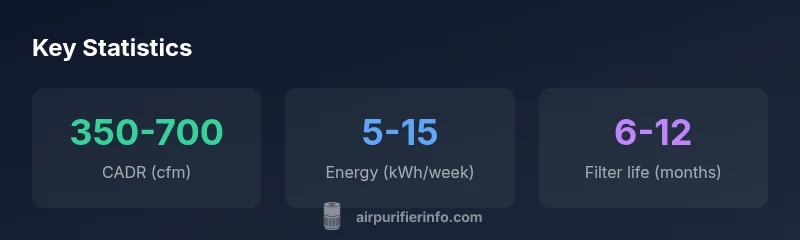
To cover a 1000 sq ft space, look for an air purifier with a CADR in the 350–700 cfm range and a clear room-size rating near 1000 sq ft. In practice, match CADR to volume, consider pollutants, and verify energy use and noise. Check independent reviews for 1000 sq ft coverage claims and compare to your home’s air quality needs.
Understanding the 1000 sq ft target: space, volume, and air changes
When sizing an air purifier for a 1000 sq ft space, you must translate a two‑dimensional area into a three‑dimensional volume. Typical ceilings are around 8 feet, which yields about 8000 cubic feet of air. A practical rule of thumb is to achieve 4–6 air changes per hour (ACH) for general cleanliness, or higher ACH when odors, smoke, or VOCs are present. Use these calculations to estimate the CADR you need: CADR (cfm) ≈ (Room Volume in ft³ × ACH) / 60. For an 8,000 ft³ space, 4 ACH requires roughly 533 cfm; 6 ACH requires about 800 cfm. These are guidelines and will vary with layout, ventilation, and occupancy. In real homes, doorways, open floors, and furnishings create stagnant pockets; place purifiers to optimize airflow and avoid dead zones.
In short, the target value isn’t a single number printed on a box. It’s a range that accounts for your space, your goals (dust control, allergen reduction, odor removal), and how your family uses the room. The Air Purifier Info Team recommends starting with a conservative CADR and testing in practice, then increasing if needed. For a space marketed as “air purifier 1000 sq ft,” expect that the stated coverage is a best-case scenario under ideal conditions, not a guarantee for every layout.
To set expectations, keep in mind: higher ceilings, partitions, and open sightlines can improve or diminish performance. If you’re unsure, use a purifier with a flexible fan speed and a clear filter indicator so you can watch performance as the room fills with activity or seasonal allergens.
descriptionShortertoKeepMarkdown
noteForReaders
pollutantsToTargetNote
Sizing guidance for common purifier form factors
| Model Type | Coverage (sq ft) | CADR (cfm) | Energy use | Filter lifetime |
|---|---|---|---|---|
| HEPA Tower | 800-1200 | 350-500 | 60-90W | 9-12 months |
| Compact Personal | 200-400 | 60-150 | 10-20W | 4-6 months |
| Mid-Size Floor Model | 600-1000 | 200-350 | 40-60W | 6-9 months |
Questions & Answers
What CADR is needed for a 1000 sq ft room?
CADR needs scale with room volume. For an 8,000 ft³ space aiming for about 4–6 ACH, a CADR of roughly 350–700 cfm is a practical target. Consider higher CADR if you have heavy dust, pet dander, or strong odors.
For a 1000 sq ft room, target around 350 to 700 cfm CADR depending on pollutants.
Is a higher CADR always better?
Not always. Higher CADR can mean more noise and potentially higher energy use. The goal is to match CADR to room size and pollution level without over-specifying to the point of discomfort.
Higher CADR isn’t always better; balance performance with noise and energy.
How often should I replace filters in a purifier that covers 1000 sq ft?
Filter life varies by use, pollutants, and filter type. HEPA filters typically last 6–12 months in average homes, but indicator lights and manufacturer guidance should guide replacement.
Expect 6–12 months between HEPA filter changes, depending on use.
Can one purifier handle an open-plan 1000 sq ft space?
Yes, but placement matters. In open floor plans, consider units with higher CADR and place them to optimize cross‑ventilation, avoiding dead zones near corners or walls.
In open spaces, positioning and multiple airflow paths matter for effectiveness.
Do purifiers remove VOCs and odors effectively?
HEPA captures particles; activated carbon or specialty filters address VOCs and odors. For strong odor sources, choose models with dedicated carbon stages and seal integrity.
Activated carbon helps with smells; for VOCs, look for multi‑stage filtration.
Are energy-efficient models worth the extra cost?
Yes. Energy-efficient models save on running costs over time, especially if you run the purifier continuously in a busy home.
Energy efficiency pays off over time when the purifier runs a lot in a busy home.
“A well‑matched air purifier for a 1000 sq ft space hinges on understanding CADR, ACH, and real‑world airflow. Layout matters as much as the spec—read the sheet, test in place, and adjust.”
Main Points
- Define your target CADR for your space.
- Match claimed coverage to your room's real size.
- Consider pollutants and add activated carbon for odors.
- Balance noise with air changes per hour.
- Plan for filter replacement and yearly costs.