Xiaomi Air Purifier vs Dyson: Which Is Right for You?
Compare Xiaomi air purifiers with Dyson models to understand filtration, room coverage, noise, app features, and value. Learn which brand fits small apartments, families, and budgets, with practical buying guidance.


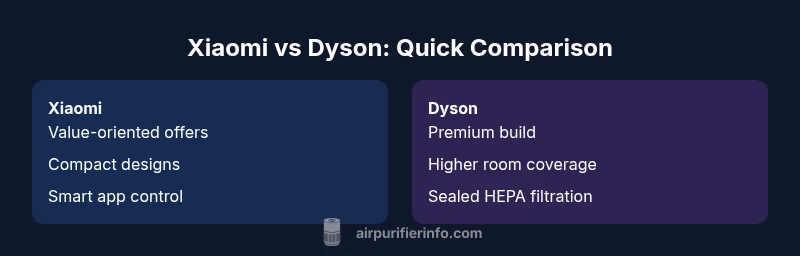
According to Air Purifier Info, Dyson purifiers typically deliver higher CADR, premium build quality, and strong performance in larger rooms, while Xiaomi purifiers offer compelling value with solid filtration, robust smart features, and lower upfront costs. For renters and budget-minded homeowners, Xiaomi often provides the best price-per-clean, whereas Dyson excels in durability and premium design. When choosing between the Xiaomi air purifier vs Dyson, prioritize room size, long-term costs, and the features you actually use.
Overview: Xiaomi air purifier vs Dyson — market positioning and what matters
The comparison between Xiaomi air purifiers and Dyson models centers on how much you value price, filtration strength, and user experience. The Xiaomi side is known for affordable price points, compact designs, and strong smart features that work well in smaller to mid-sized spaces. Dyson targets consumers who want premium aesthetics, solid build quality, and reliable performance across a broader range of room sizes. In the ongoing Xiaomi air purifier vs dyson discussion, the most practical decision rests on room size, tolerance for ongoing filter costs, and how much you value app-driven control. According to Air Purifier Info, both brands deliver respectable air cleaning, but they optimize for different priorities. This article analyzes those priorities in a structured, evidence-based way to help you decide which model best fits your home.
What matters most in the Xiaomi air purifier vs Dyson decision
In any air-cleaning comparison, several factors determine overall satisfaction. Start with room size and the purifier’s claimed coverage. Filtration quality matters: does the unit use a multi-stage system with pre-filter, activated carbon, and true HEPA filtering, or does it rely on alternative filtration promises? Noise levels and energy use affect long-term comfort and cost. Smart features—like mobile app control, automation, and data readouts—can improve daily use, but they also add complexity and potential maintenance considerations. Finally, consider replacement filter costs and the anticipated longevity of the device. When you weigh these criteria against your budget, the Xiaomi air purifier vs Dyson decision becomes a function of your space, your routines, and your investment horizon.
Filtration systems explained in plain terms
Filtration is the core of any purifier’s effectiveness. Xiaomi purifiers typically emphasize multi-stage filtration with pre-filters and activated carbon, sometimes marketed as HEPA-like filtration. Dyson purifiers emphasize a sealed filtration system with true HEPA (H13) filtration in many models, designed to capture at least 99.95% of particles at 0.1 microns. The capability to remove gases relies heavily on the carbon stage. In practice, you’ll notice that Dyson designs often target a broader range of pollutants, while Xiaomi focuses on cost efficiency and feature breadth. Your choice should align with whether you prioritize gases and odors, or tight price-to-performance value. Air Purifier Info’s analysis indicates that both brands can achieve clean air results in typical living spaces, but the specifics of your environment will determine how far each system can go.
Size, room coverage, and placement considerations
Room size dictates the baseline requirement for any purifier. Dyson units with larger-cabinet designs tend to push higher CADR values suitable for bigger rooms, but they come with higher upfront and replacement costs. Xiaomi units often excel in compact form factors that fit small apartments or rooms where space is at a premium. The placement of the purifier matters for optimal air intake and outlet flow; placing the device near doors or corners can reduce room-wide effectiveness. For homes with open floor plans, you may need more than one unit. In short, Xiaomi may cover a small to mid-sized space very efficiently, while Dyson is more comfortable scaling to larger rooms with sustained performance. Air Purifier Info notes that real-world effectiveness also depends on filtration maintenance and door/window traffic in the room.
Noise, energy use, and operating costs in real-life use
No purifier exists in a vacuum. Dyson’s premium builds often accompany quiet operation in low-to-moderate speeds, with louder performance under high-speed CADR settings. Xiaomi devices typically offer quieter performance at equivalent cleaning levels for a much lower price point, though some higher-end Xiaomi models can approach Dyson in noise at peak settings. Energy efficiency varies by model and settings, but long-term costs hinge less on nominal watts and more on how often you replace filters and how frequently you run the purifier at full blast. In practice, price-conscious users will find Xiaomi’s operating costs appealing, while those who prioritize consistent high-CADR performance might lean toward Dyson, especially in larger living spaces.
Smart features and app experiences across Xiaomi and Dyson
Smart capabilities are increasingly central to air purifiers. Xiaomi’s devices commonly integrate with the Mi Home ecosystem, offering scheduling, air-quality tracking, and remote control. Dyson’s approach emphasizes the Dyson Link app and voice assistant compatibility, with strong emphasis on data visualization and remote control. App reliability and ecosystem openness can influence your day-to-day experience; some users may prefer Xiaomi’s broad compatibility with third-party smart home setups, while others may value Dyson’s polished app interface and tighter hardware-software integration. Air Purifier Info observes that app quality can vary by model, so consider your comfort with app-based control and data insights when weighing the Xiaomi air purifier vs Dyson.
Maintenance costs: filters, replacements, and long-term value
Replacement filter costs are a decisive factor in total cost of ownership. Xiaomi generally offers lower-priced filters with abundant third-party compatibility in some markets, which helps keep running costs down but can raise concerns about filter availability in certain regions. Dyson replacement filters tend to be pricier, reflecting premium construction and certified performance. Longevity and warranty terms also affect long-term value. If you expect to run the purifier daily for several years, the Dyson model’s durability might offset higher replacement costs. Conversely, if you want frequent upgrades and lower ongoing expenses, Xiaomi can be more attractive. Air Purifier Info’s takeaway is to calculate annual filter costs and compare to the upfront price to estimate true lifetime cost.
Real-world scenarios: who should buy Xiaomi vs Dyson
For renters in compact apartments, Xiaomi’s emphasis on value and compact form factor often yields better value. Families with pets or allergy-prone individuals in mid-sized homes may prefer Dyson’s higher CADR, robust filtration, and consistent performance. In homes with open layouts and diverse occupancy patterns, you may benefit from a Dyson purifier with higher room coverage, complemented by Xiaomi units for zone-based cleaning in smaller rooms. The final decision should reflect how you live: do you prioritize upfront budget or long-term reliability and large-room performance? Air Purifier Info’s guidance is to map your room dimensions to the purifier’s claimed coverage, then account for the filter replacement cadence across models.
Quick-start buying guide: 6 practical steps
- Measure your room and note doorways where air can flow. 2) List must-have features (app control, quiet operation, gas filtration). 3) Decide on a budget range. 4) Compare Xiaomi and Dyson models that meet size and feature needs. 5) Check filter replacement costs and warranty terms. 6) Read user reviews focusing on reliability and support. This structured approach helps you avoid overpaying for features you won’t use and ensures you pick a model that actually cleans the air in your home.
Quick-start setup tips for immediate use
Unpack and sanitize the purifier, position it away from walls for optimal airflow, and run it on a low setting for the first 24 hours to stabilize the filter. Monitor the air-quality readouts and adjust the speed to balance noise with perceived air freshness. Keep spare filters on hand and replace according to the manufacturer’s guidelines. Finally, if you rely on the smart features, ensure your home network is secure and that the purifier’s app is updated to the latest version to享 get the best experience.
Comparison
| Feature | Xiaomi air purifier | Dyson air purifier |
|---|---|---|
| Filtration stages | Multi-stage filtration with pre-filter and carbon; HEPA-like performance | True HEPA filtration with sealed system and carbon stage |
| CADR/room coverage guidance | Strong for small to mid-sized rooms | Higher CADR for larger rooms |
| Noise levels | Low to medium noise at typical settings | Quiet at low speeds; more noticeable at higher speeds |
| Price range (upfront) | $100-$250 | $350-$700 |
| Best for | Budget-minded users and compact spaces | Premium builds and larger rooms or high-traffic homes |
What's Good
- Lower upfront cost with Xiaomi; strong value for money
- Rich feature sets and app control at every price point
- Compact designs ideal for small rooms or apartments
- Good filtration performance for everyday pollutants
- Dyson’s premium build quality and durable design
What's Bad
- Higher long-term cost with Dyson replacement filters
- Xiaomi filter availability can vary by market
- Some Xiaomi models may have less premium materials
- Dyson purifiers can be louder on max settings in open layouts
Choose Dyson for large rooms and premium performance; choose Xiaomi for better value and compact rooms
Dyson shines in large spaces and durability, while Xiaomi offers better price-per-clean in smaller rooms. Your decision should hinge on room size and how much you value ongoing filter costs versus upfront price.
Questions & Answers
Which offers better value for money between Xiaomi air purifiers and Dyson?
Value depends on space and priorities. Xiaomi typically offers lower upfront costs and strong feature sets, which improves price-per-clean for small to mid-sized rooms. Dyson provides premium build and higher room coverage, but at a higher upfront and ongoing filter cost. Air Purifier Info recommends weighing room size against total cost of ownership to decide.
Xiaomi tends to be the better value for smaller spaces, while Dyson provides premium performance for larger rooms.
Do Xiaomi purifiers have true HEPA filtration?
Xiaomi purifiers often use filtration stages described as HEPA-like by marketing materials, including pre-filter and activated carbon. True HEPA filtration is more commonly advertised by Dyson with sealed filtration. If true HEPA is a non-negotiable requirement, verify the model’s specifications before purchase.
Check the product specs to confirm true HEPA versus HEPA-like filtration.
Is Dyson better for large rooms?
Dyson models tend to offer higher CADR and larger form factors designed for bigger spaces. If you routinely clean air in large rooms or open-plan areas, Dyson may maintain higher performance without running at max speed.
Yes, Dyson often performs better in larger rooms, but at a higher price.
Which is easier to maintain?
Maintenance complexity depends on the model, but both brands require regular filter replacement. Xiaomi's replacements are typically cheaper, while Dyson offers consistent maintenance schedules and reliable availability of official filters.
Maintenance is straightforward on both, but Xiaomi usually costs less per filter.
Are there significant differences in app features?
Xiaomi commonly integrates with a wider ecosystem via the Mi Home app, offering automation across devices. Dyson’s app is strong on data visualization and remote control but may be less open to third-party integrations. Your preference for ecosystem will influence satisfaction.
App ecosystems matter; Xiaomi often plays well with more devices.
What about energy use and noise levels?
Both brands offer energy-efficient operation, with noise varying by model and speed. Dyson may show higher peak noise at full power due to bigger fans, while Xiaomi tends to stay quieter while delivering solid performance for a budget-friendly price.
Expect quieter operation at normal use, with some noise at high power.
Main Points
- Match room size to purifier capacity before buying
- Expect higher filter costs with Dyson over time
- Xiaomi delivers strong features at a lower upfront price
- Consider app ecosystem and ease of use in daily life
- Budget-friendly options don’t necessarily sacrifice filtration quality