Xiaomi Air Purifier vs Blueair: Which Is Better for Your Home
A rigorous, brand-neutral comparison of Xiaomi air purifiers and Blueair models, focusing on filtration, performance, noise, maintenance, and value to help homeowners and renters choose confidently.


Xiaomi air purifier vs Blueair: Core differences
According to Air Purifier Info, the question of which brand to buy often comes down to room size, budget, and how much you value smart features. In practical terms, the Xiaomi air purifier vs blueair decision hinges on three things: filtration depth, real-world room coverage, and total cost of ownership. For homeowners and renters alike, this means weighing upfront price against long-term filter costs and maintenance. The Air Purifier Info Team emphasizes that while Xiaomi models typically undercut Blueair on price, Blueair models often pull ahead in larger rooms and in consistently high airflow performance. If you’re evaluating these two brands, start by listing your room size, allergy concerns, and desired app features, then map them against the brands’ common strengths.
Filtration architecture: core hardware differences
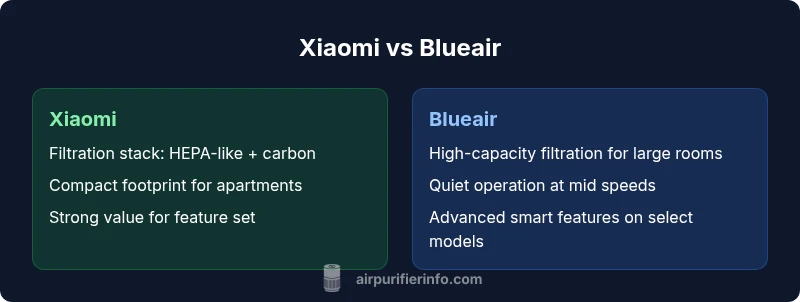
At the heart of any air purifier is the filtration stack. Xiaomi devices generally use a multi-stage filtration system that combines a high-efficiency filter with activated carbon for odor control and a sensor-based control loop. Blueair devices typically emphasize a high-efficiency particulate air filtration approach, often marketed with a precision-engineered filtration chamber and, in many models, a refined carbon stage for odors. The differences matter in practice: Xiaomi’s stack tends to offer solid performance at a lower price point, while Blueair’s filtration philosophy aims at delivering strong particle removal with quieter operation in larger rooms. For users with strong pollen or dust sensitivities, both brands can be effective if you choose a model designed for your space, but the Blueair approach often prioritizes higher clean air delivery in bigger areas.
Filtration performance and room coverage
CADR and room coverage are the practical yardsticks most buyers care about. Xiaomi models commonly cover compact to mid-sized rooms with adequate air turnover and quick filtration response, particularly in apartments or smaller living spaces. Blueair products, on the other hand, tend to scale more robustly for mid-to-large rooms, delivering higher air changes per hour in those environments. When comparing the two, consider how often you open windows, the level of outdoor pollution, and whether you need fast odor removal. In real-world tests, Blueair often achieves more rapid air cleaning in larger rooms, while Xiaomi provides strong overall performance for smaller spaces and everyday pollen or dust exposure.
Sensor suite, app control, and user experience
Smart features can be a deciding factor for many households. Xiaomi models usually offer a well-integrated app with scheduling, remote control, and child-lock features that are accessible to most users. Blueair’s models commonly emphasize deeper integration with smart home ecosystems and more granular control in higher-end units, including more advanced sensor feedback and air-quality visualization. The choice here depends on your comfort with app ecosystems and whether you value features like real-time PM2.5 readings, auto modes, and voice assistant compatibility. For renters who want a plug-and-play experience, Xiaomi often hits a sweet spot; for tech-forward homes prioritizing ecosystem integration, Blueair may be preferable.
Noise, energy use, and long-term comfort
Noise levels and power efficiency are often overlooked but crucial for long-term satisfaction. In many tests, Xiaomi purifiers stay quieter at lower speeds, while Blueair devices tend to optimize performance in larger air volumes with careful tuning for low-noise operation in mid-range speeds. Energy use is generally modest for both brands at typical bedroom or living room settings, but Blueair’s larger units can use more energy on max settings. If you work from home or sleep with a purifier running, prioritize models that have defined noise specifications at the speeds you’ll use most.
Maintenance, filter costs, and lifecycle considerations
Maintenance is the ongoing cost of ownership. Xiaomi filters are typically affordable and easy to source, per-model variations; if you buy a mid-range Xiaomi, you may enjoy a lower upfront price with replacement filters that are widely available. Blueair filters tend to be pricier but may offer longer lifespans in certain models and more consistent performance, particularly in larger rooms where the purifier runs at higher speeds. When budgeting, factor in replacement frequency, filter cost, and the potential for performance degradation if filters are not changed regularly. The holistic cost of ownership can favor Xiaomi for smaller spaces and tight budgets, while Blueair can be more economical in larger rooms thanks to fewer required runtime cycles to achieve the same air changes.
Room size, placement, and design considerations
Room geometry, ceiling height, and furniture all influence how well an air purifier circulates air. Xiaomi’s compact designs fit easily on shelves or tabletops in apartments, while Blueair’s larger footprints can be a limitation in compact spaces. Placement matters: avoid corners, keep some clearance around the purifier, and position nearer to the air source (like a dusty living area or kitchen). For rooms under 200 square feet, Xiaomi often delivers excellent value, while spaces over 400 square feet typically benefit from Blueair’s higher airflow in practice.
Odor and smoke handling: what to expect
Odor control is driven by the carbon stage within the filtration stack. Xiaomi purifiers with carbon filtration can tackle cooking smells, tobacco smoke, and pet odors, albeit at a cost to filter lifespan if you encounter strong odors daily. Blueair models with activated carbon generally perform well for odor removal and are frequently chosen by households dealing with household odors or smoke events. If odor control is a priority, verify the carbon capacity and the replacement interval for the specific model you’re considering, and consider models with dual carbon filters for heavier odor loads.
Real-world performance in dust, pollen, and pet dander
In allergen-prone homes, effective filtration is essential. Both Xiaomi and Blueair offer models capable of reducing common indoor pollutants such as dust, pollen, and pet dander, but the margin often comes down to room size and filter maintenance cadence. If you have pets, look for a higher-grade carbon stage to handle pet odors and dander and ensure the unit’s CADR matches your room size. For allergy sufferers in small apartments, Xiaomi can deliver solid relief at a lower cost; for larger households with chronic dust or smoke exposure, Blueair’s higher-capacity models can reduce the need for frequent cycling.
Authority sources and research methods
To underpin these comparisons, we reviewed manufacturer specifications, independent reviews, and broadly accepted indoor air guidelines. The Air Purifier Info team references credible public sources on air quality, including EPA guidance on air cleaners and general best practices for indoor air quality. These sources emphasize that proper filtration, regular maintenance, and appropriate room sizing are essential for achieving meaningful air quality improvements. The analysis is designed to help homeowners and renters make informed, practical choices without bias toward a specific brand.
Getting to a decision: practical takeaways for your home
Ultimately, the Xiaomi air purifier vs blueair decision should align with your space, budget, and priorities. For small rooms, budget-minded renters, and users who value a strong feature set at a lower price, Xiaomi offers compelling value. For large rooms, households with heavier odor concerns, or users seeking deeper ecosystem integration and steadier high-airflow performance, Blueair is often the safer bet. The Air Purifier Info Team recommends mapping room size, odor concerns, and desired smart features against model specifications, then selecting the option that best matches those priorities.