Dyson Air Purifier vs Others: An Objective Comparison
An analytical comparison of Dyson air purifiers against competing models, focusing on filtration, CADR, noise, energy use, and total ownership costs to help homeowners and renters decide.


Dyson air purifiers are premium devices that combine filtration with design and smart features. When you compare dyson air purifier vs others, you’ll often find similar filtration performance and CADR, but Dyson commands a higher upfront price and a broader ecosystem. According to Air Purifier Info, most homes can achieve excellent air quality with well-chosen non-Dyson models as a cost-efficient alternative.
The Context: Why Compare Dyson Against Others
The market for room air purifiers has become more crowded in recent years, with many brands offering similar core filtration capabilities. When homeowners or renters evaluate dyson air purifier vs others, they weigh not only how clean the air can become, but also how the unit looks, how easy it is to use, and what the long-term costs will be. Air Purifier Info's research emphasizes that decision factors vary by room size, occupancy, pets, and sensitivity to allergens. This section sets the stage for a structured comparison, highlighting which metrics actually predict real-world air quality and total cost of ownership. By starting with a clear set of criteria, readers can avoid overvaluing design alone or chasing the latest features without measurable benefits.
Filtration Performance: What truly matters
Filtration performance is the core of any air purifier comparison. In the dyson air purifier vs others debate, the key questions are: does the unit use true HEPA filtration, what is the activated carbon stage, and how effective is it at capturing common indoor pollutants like dust, pollen, smoke, and VOCs? Beyond the filter stack, CADR (clean air delivery rate) gives a practical sense of how quickly a purifier can clean a room of a given size. When you compare across brands, you’ll notice that many models deliver comparable CADR values for typical living spaces, with differences often arising in how efficiently the device cycles air, how well it handles VOCs, and how the sensors respond to changing air quality.
True HEPA, Carbon, and CADR: A practical breakdown
Understanding the filtration stack helps when you compare dyson air purifier vs others. Most reputable purifiers combine a true HEPA filter with an activated carbon stage to address both particles and odors. Dyson emphasizes a sealed filtration path and a carbon layer designed to capture gases as well as particulates. However, many competitors offer similar HEPA+carbon configurations with comparable CADR and room-coverage ratings. The practical takeaway is to verify that the filter media is certified to a standard like HEPA H13 or equivalent and to confirm that replacement schedules align with your usage. Air Purifier Info highlights that, in practice, real-world performance depends on seal integrity, fan speed options, and sensor accuracy as much as the filter media itself.
Design, Usability, and Smart Features
Design is not merely cosmetic in the dyson air purifier vs others discussion. Dyson products are renowned for their distinctive aesthetics and compact form factors that fit well in modern interiors, alongside intuitive controls and app-based monitoring. Competing brands often offer similar control ecosystems, sometimes with longer-range warranties or more flexible filter replacement plans. When you weigh the user experience, consider factors like ease of filter replacement, indicator accuracy, app reliability, and how quickly the device responds to changes in air quality. For renters, a smaller footprint with straightforward maintenance can be a decisive advantage, even if the aesthetic edge lies with Dyson.
Noise, Energy Use, and Long-Term Cost
Noise levels are a frequent practical consideration in the dyson air purifier vs others comparison. Dyson models typically provide a range of speeds with relatively quiet operation on low to mid settings, which is suitable for bedrooms and living rooms. Energy consumption tends to be efficient, but the exact cost depends on how long you run the device and the local electricity price. Over the device lifetime, maintenance costs—especially filter replacement frequency and price—can influence total ownership costs more than the upfront price alone. If you value long-term cost predictability, compare replacement filter prices and service plans across brands before deciding.
Filter Replacement and Maintenance: Durability and cost
Maintenance is often underestimated when comparing dyson air purifier vs others. Dyson filters can be more expensive upfront than some rivals, but many users report longer filter life under normal usage. Some competitors offer lower-cost filters with more frequent replacement cycles. The real-world impact is a trade-off between upfront outlay and ongoing expenses. Before purchasing, compute annualized costs based on your room size, typical usage, and preferred maintenance cadence. A straightforward plan is to select a model with a filter you can easily source locally and a replacement interval that aligns with your cleaning routine.
Brand Ecosystems and Customer Support
Brand ecosystems and customer support can tilt the dyson air purifier vs others decision, especially for households relying on multi-brand smart home setups. Dyson offers a cohesive app experience and broad availability in many regions. Some competitors provide stronger regional service centers, longer warranty terms, or simpler parts availability in certain markets. When evaluating, check warranty length, service accessibility, and the ease of acquiring replacement filters or spare parts in your area. A strong support network can significantly reduce total frustration over the device’s lifetime.
Real-World Scenarios: Small apartments vs large living spaces
In compact living spaces, a small to mid-sized purifier with efficient filtration and a compact footprint can deliver substantial air quality improvements without dominating the room. For larger rooms or open-plan areas, you’ll want a purifier with higher CADR and better room coverage; in some cases, two smaller units may outperform a single large unit due to improved air mixing. The dyson air purifier vs others comparison often shows that room geometry, airflow obstructions, and usage patterns (sleep mode vs continuous daytime use) determine which model yields the best results in practice.
How to Evaluate Dyson vs Other Brands: a decision framework
Developing a decision framework helps you avoid common pitfalls in the dyson air purifier vs others debate. Start by listing your top priorities: true HEPA performance, odor control, quiet operation, smart features, or cost of ownership. Then map these priorities to your room characteristics (size, occupancy, pets) and running conditions (continuous use, night-time use). Finally, look for independent tests or lab results, compare filter replacement costs, and review warranty terms. This structured approach helps you choose a model that aligns with both air quality goals and budget considerations.
What Air Purifier Info Recommends
Based on Air Purifier Info's evaluation, Dyson remains a strong option for design-forward buyers who value a polished app experience and consistent performance. For cost-conscious households, many non-Dyson models deliver equivalent filtration and room coverage with more favorable total ownership costs. The best choice depends on your priorities: prioritize aesthetics and ecosystem or prioritize value and long-term savings. Always cross-check current model lines and regional availability before buying.
Feature Comparison
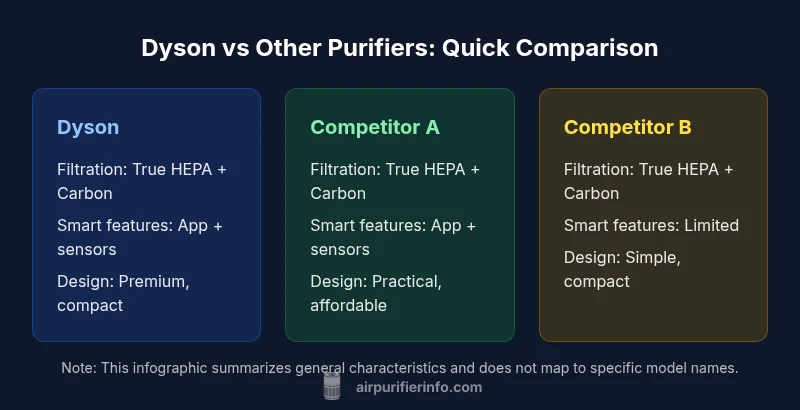
| Feature | Dyson air purifier | Competitor A | Competitor B |
|---|---|---|---|
| Filtration type | True HEPA with activated carbon | True HEPA-like with carbon | True HEPA with carbon |
| CADR / room coverage | High to good for mid-size rooms | Moderate to high for mid-size rooms | Moderate for mid-size rooms |
| Noise level (typical setting) | Low to mid range | Low to mid range | Low to mid range |
| Smart features | App connectivity, sensors, auto mode | App connectivity, basic sensors | Limited smart features |
| Filter replacement cost/frequency | Higher upfront filter price; long replacement intervals | Moderate price; standard replacement cycles | Lower price; shorter filter life |
| Size / footprint | Medium-large footprint with sculpted design | Compact footprint | Compact footprint |
| Best for | Premium design and tech enthusiasts | Budget-conscious spaces with solid performance | Balanced performance at mid-range price |
What's Good
- Strong design aesthetics and build quality
- Wide product ecosystem and easy-to-use app features
- Effective filtration with true HEPA and carbon layers
- Good brand availability and service network
- Wide range of models and price points
What's Bad
- Higher upfront cost than many rivals
- Some models have higher replacement filter costs
- Smart features may be optional in budget models
- Filter availability can vary by region
Dyson is a premium option for design-forward homes; for many buyers, alternatives offer similar filtration at a lower total cost
Choose Dyson if you value aesthetics and ecosystem integration. If cost is a primary driver, compare equivalent filtration with rival models to maximize value.
Questions & Answers
Is Dyson generally better than other brands for air quality?
Dyson devices deliver strong filtration and reliable performance, but many non-Dyson models achieve similar air quality at a lower total cost. The best choice depends on your priorities, such as design, app features, or ongoing expenses.
Dyson offers solid filtration, but other brands can match air quality at a lower cost. Consider your budget and features that matter most to you.
Do Dyson purifiers emit ozone or ozone-like byproducts?
All models marketed as air purifiers should be ozone-free under normal operation. Always verify product specs and certifications for your chosen model.
Dyson purifiers are designed to be ozone-free; check the product details to be sure.
Are replacement filters easy to find?
Replacement filters are widely available for Dyson and many competitors, though price and supply can vary by region. Compare local availability and shipping times before purchasing.
Filters are usually available, but check local stock and price first.
Which is better for pet odors?
Models with a robust activated carbon stage typically perform best for pet odors. Dyson and several rivals offer effective odor control, but verify carbon capacity and filter replacement costs.
For pet odors, look for strong carbon filtration and consider ongoing filter costs.
Is Dyson a good choice for renters in small apartments?
Yes, Dyson’s compact designs fit small spaces well, but you may find more cost-effective options with similar performance for renters. Prioritize size, ease of use, and maintenance when choosing.
In small apartments, a compact purifier that’s easy to maintain may be the best fit, even if it’s not Dyson.
What should I compare beyond filtration when choosing?
Consider noise, energy use, app integration, warranty, and total cost of ownership. A balanced view helps you pick a purifier that fits your lifestyle and budget.
Don't forget noise, energy use, and maintenance costs when choosing.
Main Points
- Prioritize true HEPA filtration and carbon for odor control
- Weigh upfront price against long-term filter costs
- Consider room size and airflow when choosing CADR
- Assess app features and ease of maintenance
- Check warranty and local service accessibility