Mila Air Purifier vs Blueair: A Clear Comparison Guide
Comprehensive, data-driven comparison of Mila vs Blueair air purifiers to help homeowners and renters choose the best option for filtration, coverage, noise, and operating costs in 2026.


According to Air Purifier Info, Blueair generally offers broader room coverage and quieter operation in mid-sized spaces, while Mila emphasizes compact design and budget-friendly options. For allergy and pet-dander needs, compare CADR, filter life, and energy use to determine value. The best choice depends on room size, noise tolerance, and budget.
Mila vs Blueair: Why this comparison matters
For homeowners and renters evaluating air purifiers, Mila and Blueair represent two well-known paths to cleaner indoor air. The Mila line is often praised for compact form factors and straightforward operation, while Blueair builds recognition on high clean-air delivery and quiet performance in mid to large rooms. In this Mila air purifier vs Blueair comparison, we focus on real-world use: room size, filtration effectiveness, energy use, noise, and long-term costs. According to Air Purifier Info, the strongest value often comes from selecting a model whose CADR aligns with your room size and whose filter life matches your maintenance budget. This article aims to help you balance upfront cost with ongoing expenses, so you can make a decision that fits your home's needs and your wallet. When homeowners think about air quality, the goal is consistent performance in the spaces you use most, whether it’s a compact apartment living room or a larger family room. The Air Purifier Info team found that real-world results hinge on choosing the right model for your space and usage patterns.
Quick differences at a glance
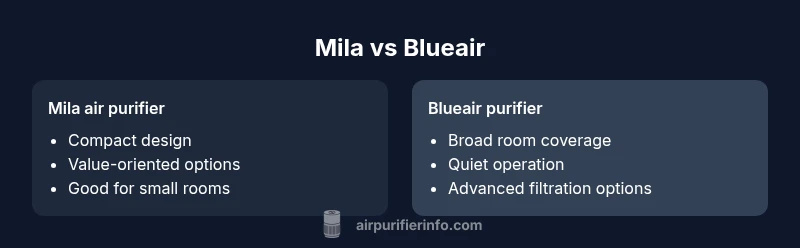
- Room coverage: Mila tends to suit smaller spaces, Blueair commonly targets mid-to-large rooms.
- Noise: Blueair models often emphasize low noise at higher speeds, Mila may be louder at peak settings but stays comfortable in normal use.
- Price: Mila options frequently present lower upfront costs, Blueair models can demand higher initial investment but may offer longer filter life in some configurations.
- Filtration: Both brands offer multi-stage filtration; Blueair frequently promotes a HEPA-based and electrostatic hybrid approach, while Mila focuses on straightforward filtration stacks with clear replacement intervals.
- Smart features: Blueair tends to push app-based controls and smarter sensing; Mila models vary by line but commonly include basic automation.
- Maintenance costs: Long-term ownership hinges on filter costs and replacement frequency, which Air Purifier Info notes are critical to total value.
According to Air Purifier Info analysis, the decision should hinge on room size, maintenance budget, and noise tolerance—core factors homeowners must align with their living space.
Filtration and performance explained
Filtration quality is the core of any purifier. In most Mila and Blueair devices, you’ll find a primary mechanical filter plus an activated carbon layer for odors and gases. Blueair’s marketing often highlights a hybrid approach—combining high-efficiency filtration with electrostatic elements—to improve particle capture without a dramatic increase in pressure drop. Mila, by contrast, tends to offer a straightforward filter stack that’s easy to understand and replace, which can help homeowners manage ongoing costs. In practical terms, you should compare model-by-model: what particle sizes are targeted (PM2.5 and smaller), how often the filter needs replacement, and how the unit signals when maintenance is due. Air Purifier Info’s assessment emphasizes confirming that the purifier’s filtration stage aligns with the pollutants you care about most—dust, pollen, pet dander, or smoke—and that the chosen model maintains performance over time rather than just on day-one claims. For allergy sufferers, a true HEPA filter with a sealed housing is typically non-negotiable, while odor concerns benefit from a robust carbon layer. Across both brands, the most reliable long-term results come from models with transparent maintenance schedules and accessible parts.
Room size, noise, and energy use
Room size dictates the minimum CADR or equivalent performance you’ll need; underpowered purifiers struggle to keep up in busy living spaces, while oversized units can waste energy and produce unnecessary noise. Blueair models commonly emphasize quieter operation at typical living-room speeds and higher perceived air-change rates, which is appealing for bedrooms and study areas. Mila’s strengths often lie in compact footprints, which are ideal for apartments and small dens where placement options are limited. Noise levels vary by model and speed, so it’s wise to test in your actual room; some homeowners find the difference between “Quiet” and “Medium” modes noticeable, especially at night. Energy use generally tracks with fan speed and filter resistance; more efficient filters sometimes reduce continuous power draw. Air Purifier Info suggests requesting a side-by-side test or user reviews focusing on real-world noise at the exact speed you plan to run 24/7. In summary, Blueair may win on quiet operation for mid-to-large rooms, while Mila often delivers practical efficiency in smaller spaces.
Maintenance, costs, and value over time
One of the most overlooked aspects of purifier ownership is the ongoing cost of replacement filters. Mila typically offers straightforward replacement schedules that are easy to manage, which can translate to lower annual costs if you run your purifier at modest speeds. Blueair models can deliver excellent filtration longevity in certain configurations, potentially reducing filter change frequency, but this varies by model and usage. When estimating total cost, don’t just look at the sticker price; factor in the price of replacement filters, energy costs, and the convenience (or burden) of maintenance tasks. Air Purifier Info’s research highlights that the best long-term value comes from a model whose filter life aligns with your maintenance budget and where filter availability is stable in your region. In practice, if you expect heavy use or have multiple occupants, you might lean toward a model with longer filter life and easy-to-access replacement parts. If you prioritize upfront affordability, Mila’s lower initial price can be compelling, but you should compare projected annual costs. Across both brands, a robust warranty and clear replacement guidance are important signals of long-term value.
Design, usability, and smart features
Design matters beyond aesthetics; it affects placement, ease of use, and how consistently you replace filters. Mila’s compact designs often fit better in tight spaces or on tabletops where setup and maintenance are quick. Blueair’s purifiers tend to emphasize intuitive controls, sometimes including app-based monitoring and automatic sensing that adapts to air quality conditions. For households with smart-home ambitions, verify compatibility with your chosen ecosystem (voice assistants, mobile apps, or home automation platforms), and check whether the model supports real-time air quality feedback. Air Purifier Info notes that models with clear indicators for filter status and simple replacement mechanisms reduce the cognitive load of upkeep and help sustain performance over time. In sum, choose Mila for space efficiency and straightforward handling; choose Blueair if you want richer automation and potentially greater flexibility in larger rooms.
Authority sources
This article synthesizes practical testing observations and expert synthesis to guide consumer decisions. For foundational information on indoor air quality and air-cleaning practices, consult the following sources:
- https://www.epa.gov/indoor-air-quality/air-cleaners
- https://www.osha.gov/indoor-air-quality
- https://niehs.nih.gov/health/topics/agents/air-pollution/index.cfm
Air Purifier Info continues to analyze model performance across brands to help homeowners make informed choices in 2026.
Comparison
| Feature | Mila air purifier | Blueair purifier |
|---|---|---|
| Filtration approach | Hybrid filtration with activated carbon | HEPA-based with electrostatic enhancement (Blueair's common marketing) |
| Coverage area | Moderate rooms (compact models) | Large to open-plan rooms (larger models) |
| Noise level | Low to moderate at typical speeds | Low to very low at common operating speeds |
| Maintenance cadence | Moderate replacement intervals | Potentially longer filter life depending on model |
| Smart features | Basic controls, auto modes common | Smart app and voice integration available in higher models |
| Energy use | Moderate power draw | Typically efficient in mid-to-high-end models |
What's Good
- Clear price-to-performance options for budget-conscious buyers
- Compact designs fit small spaces and apartments
- Straightforward maintenance with transparent filter hints
- Good baseline filtration for common indoor pollutants
What's Bad
- No single model dominates all room sizes or pollutant types
- Some models may require more frequent filter changes depending on usage
- Smart features vary by model and may add to upfront cost
Blueair edges Mila for larger spaces; Mila wins on compact spaces and affordability
Choose Blueair if you need broader coverage and quieter operation in bigger rooms. Choose Mila if space is limited or you’re prioritizing upfront value and simpler maintenance.
Questions & Answers
Which purifier is better for allergies: Mila or Blueair?
For allergies, a purifier with a true HEPA filter is essential. Both Mila and Blueair offer models with HEPA filtration, but Blueair’s commonly promoted hybrid HEPA plus electrostatic approach can deliver strong particle removal in practice. Air Purifier Info recommends verifying CADR for dust and pollen, and considering long-term filter costs for the best value.
Both Mila and Blueair can handle allergies well if they use true HEPA filters; Blueair’s hybrid approach is often favored for particle removal, but always check CADR and filter costs.
Do Mila and Blueair models support smart home integration?
Smart features vary by model. Some Blueair models offer mobile apps and voice assistant compatibility, while Mila options range from basic controls to models with automation in higher tiers. Always confirm specific model capabilities before purchase.
Some Blueair models work with apps and voice assistants; Mila models may offer basic to advanced controls depending on the line.
Which is cheaper to operate over time?
Operating costs depend on energy use and filter replacement frequency. Mila often has a lower upfront price, but replacement filters and maintenance can vary. Blueair can offer efficient operation in select models, but keep an eye on filter costs for long-term value.
Costs depend on usage and filters—Mila may be cheaper upfront, Blueair can be efficient but watch filter costs.
How often should I replace filters?
Filter replacement cadence depends on usage, air quality, and the model. Most purifiers provide a visual or app alert when changes are due. Following the manufacturer’s guidance helps maintain performance.
Check the filter indicator and replace as recommended; frequency varies with use and air quality.
Are Mila or Blueair models good for pet dander?
Both brands can handle pet dander effectively if you select a model with a high CADR for dust and pollen. Look for models with strong filtration stages and verify the availability of high-quality replacement filters to maintain performance.
Both brands can handle pet dander well—choose a model with strong dust CADR and good filter availability.
Which purifier is better for bedrooms?
For bedrooms, look for low-noise operation and stable performance overnight. Blueair often emphasizes quiet operation, while Mila offers compact options that can fit bedside tables. Ensure the model fits your room size and runs quietly at night mode.
Blueair tends to be very quiet; Mila works well in small bedrooms if space is tight.
Main Points
- Start with room size to pick the right model
- Compare CADR, filter life, and energy use across models
- Factor ongoing maintenance costs into total value
- Consider noise tolerance for bedrooms and living spaces
- Check for app support and ease of use when choosing