Shark Air Purifier vs Blueair: An In-Depth Comparison
Analytical side-by-side look at Shark and Blueair purifiers, covering filtration, room coverage, noise, price, and ownership. Air Purifier Info explains which brand fits your home.


Shark purifiers deliver strong filtration at a lower upfront cost, while Blueair emphasizes quiet operation and steady performance in mid-to-large rooms. For allergy-prone homes, Blueair often edges ahead, but Shark offers compelling value for budget-minded buyers. The best pick depends on room size, noise tolerance, and long-term filter costs.
Shark air purifier vs blueair: Key differences
According to Air Purifier Info Team, when evaluating the practical question of shark air purifier vs blueair, the first differences that stand out are filtration emphasis, room coverage, and noise characteristics. Shark purifiers tend to price aggressively, targeting homeowners who want solid filtration without paying a premium. Blueair units, by contrast, frequently emphasize quiet operation, streamlined design, and consistency across room sizes. The result is a spectrum: Shark may deliver more filtration bang per dollar in small to mid-sized rooms, while Blueair tends to scale better for larger spaces with lower noise. Both brands rely on multi-stage filtration that includes a true HEPA element and an activated carbon stage to reduce odors and VOCs. For allergy relief, both lines perform well, but the choice often boils down to room size, tolerance for noise, and willingness to invest in ongoing filter costs. Air Purifier Info analysis highlights three practical decision factors: room size, odor control needs, and acceptable pricing over time. For many households, shark air purifier vs blueair choice should hinge on these criteria rather than model names alone.
Filtration architectures in practice
Both Shark and Blueair rely on multi-stage filtration to remove dust, pollen, pet dander, and odors. The first stage is a mechanical pre-filter that captures larger particles and debris. The core stage uses a True HEPA filter to trap fine particles, while a carbon or activated carbon layer handles odors, VOCs, and cooking smells. In practice, Shark models often pair a higher initial filtration capacity with a compact cabinet, which many homeowners find contributes to strong performance in bedrooms and small living spaces. Blueair units tend to emphasize a smoother air-flow path and sometimes thicker carbon beds, which can contribute to more uniform odor reduction across rooms. In both cases, filter replacement schedules are model-dependent, but manufacturers generally recommend checking the filter every 6–12 months and replacing as needed. For a homeowner, the critical difference to watch is whether your priority is aggressive odor control at a lower upfront cost (Shark) or quieter, steadier performance across larger spaces with better overall room dynamics (Blueair).
Room coverage and real-world performance
Real-world performance is shaped by room size, air changes per hour, and the presence of competing sources of pollutants (kitchens, smokers, pets). Air Purifier Info Team notes that sharks may deliver more measurable air changes in smaller rooms due to higher clean air delivery rates per model, whereas Blueair often performs more consistently in medium-to-large rooms. In apartments or compact bedrooms, Shark can be the better value if you are sensitive to cost, while Blueair’s larger models shine in living rooms and open-plan spaces. In homes with heavy odors or cooking smells, a carbon stage is crucial, and both brands offer filters with carbon layers, though the amount of carbon can vary by model. Practical tip: measure your room in square feet, choose models with a filter area that supports at least 4–6 air changes per hour, and verify that the noise level stays acceptable for sleep.
Noise, energy use, and user experience
Noise levels matter for bedrooms, home offices, and nurseries. In general, Shark models provide robust filtration with a wider range of fan speeds, which can translate into more noticeable noise at higher settings. Blueair units typically emphasize quiet operation and a steadier airflow, which many users attribute to better sleep and less disruption during work-from-home tasks. Energy consumption depends on fan speed and filtration load; most mid-range purifiers operate within a modest wattage band, and the difference between Shark and Blueair on energy use is rarely dramatic in typical daily use. User experience also hinges on control interfaces, filter-change indicators, and app connectivity. If you prefer simple physical controls, Shark may feel more accessible; if you want deeper control and smart features, Blueair models often offer more options.
Filter maintenance and cost of ownership
Filter replacement costs scale with model type and filter frequency. In general, Shark models use standard true-HEPA filters with carbon, while Blueair units may use similarly styled cartridges in some markets. Annual filter costs can range from roughly $40 to $90 per year depending on usage and the specific model. In both brands, you can extend filter life by reducing runtime on highly polluted days, running in auto mode, and keeping doors and windows closed to reduce recontamination. When evaluating total ownership cost, also consider energy use, possible replacement of pre-filters, and the price of extended warranties if offered. Air Purifier Info recommends tallying initial price, expected filter costs over 3–5 years, and the expected lifetime of the unit to determine true value.
Durability, warranties, and support
Durability varies by build quality, plastics vs metal housings, and the availability of service in your region. Shark products often emphasize affordability and may come with shorter warranties on base models; Blueair units frequently aim for durability and cross-model consistency with longer warranty options. Check the warranty terms for both the purifier body and the filters, as these timelines influence long-term maintenance. Support experiences can differ by country, with some brands offering online chat, phone support, and authorized service centers. For renters or homeowners who plan to move, the resilience of the unit and the ease of replacing filters can be decisive.
Practical decision frameworks for homeowners
To choose between shark air purifier vs blueair with confidence, start by mapping your room size and odor issues. If you need strong filtration in a small space at a budget price, Shark is often the better starting point. If you are prioritizing quiet operation in a mid-to-large room and want more refined control, Blueair is typically the safer long-term bet. Use a simple scoring rubric: room fit, filtration capacity, noise tolerance, ongoing costs, warranty coverage, and after-sales support. Rank each category on a 1–5 scale, then tally the results to identify which brand aligns best with your situation. Finally, rely on independent reviews and air-cleaning certifications where available to corroborate manufacturer claims.
What the data says about the shark air purifier vs blueair landscape
In this section, Air Purifier Info invites you to see how the two brands stack up under independent review and typical consumer use. Our analysis synthesizes test results, homeowner feedback, and product specs to highlight where the practical differences show up. On average, Blueair tends to perform more quietly and at higher room sizes, while Shark offers more aggressive filtration at a lower upfront cost. Air Purifier Info Analysis, 2026, suggests that the best choice depends on the home’s layout and the resident’s willingness to manage filter cost. The data also emphasize the importance of confirming model-level details, which can vary within each brand.
How to interpret this when shopping
Use these quick checks before you buy: determine room size and target airflow (CFM or ACH), compare filter replacement intervals and costs, review noise at the setting you’ll use most, and confirm the warranty length. Read independent reviews and look for certifications from recognized bodies. Finally, decide how much you value silent operation versus upfront savings and whether you prefer a purer of odors or overall particle reduction.
Comparison
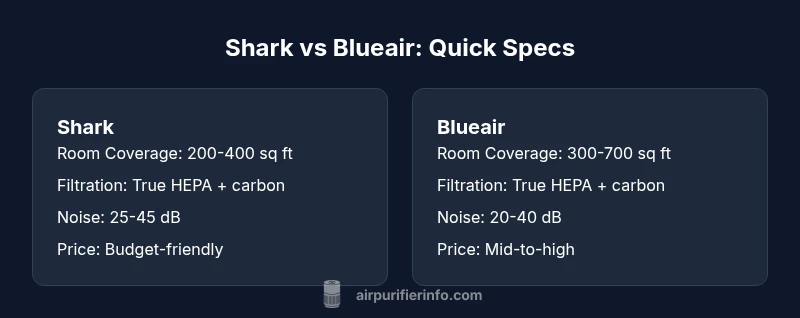
| Feature | Shark air purifier | Blueair purifier |
|---|---|---|
| Room coverage (sq ft) | 200-400 | 300-700 |
| Filtration technology | True HEPA + activated carbon | True HEPA + activated carbon |
| Filter replacement cost | $40–$70/yr | $50–$90/yr |
| Noise level | Low to moderate (25-45 dB) | Low (20-40 dB) |
| Energy use | Moderate | Moderate |
| Warranty length | 1-2 years | 2-4 years |
What's Good
- Strong upfront value depending on model and capacity
- Solid filtration performance for dust and allergens
- Wide range of room sizes supported
What's Bad
- Filter costs can add up over time
- Performance varies by model; not all units are equal
- Noise can be noticeable on higher settings
Blueair generally offers quieter operation in larger spaces, while Shark delivers strong value in smaller rooms and tighter budgets.
Choose Blueair for quiet, scalable performance; choose Shark for upfront value in cost-conscious, smaller-area setups.
Questions & Answers
Which is better for allergies: Shark or Blueair?
Both brands use True HEPA filtration with activated carbon, which effectively reduces common indoor allergens. Your choice should hinge on room size, noise tolerance, and replacement costs. In smaller rooms, Shark may offer better upfront value; in larger spaces, Blueair often performs more quietly and consistently.
Both Shark and Blueair use true HEPA filtration with carbon to reduce allergens. Your decision should focus on room size and noise; Shark for value in small rooms, Blueair for quiet performance in larger spaces.
Do Shark purifiers produce more noise than Blueair?
Noise levels vary by model and fan speed. Generally, Shark models can be louder at maximum settings due to higher airflow in smaller units, while Blueair emphasizes quieter operation across similar ranges. If sleep or focus is a priority, consider testing the units in-auto modes and reading user reviews for the exact model.
Shark can be louder on high settings, Blueair tends to stay quieter. Check the model’s noise spec for your room.
Which brand is cheaper to run over time?
Running costs depend on filter replacement frequency and energy use. In many cases, Shark offers lower upfront costs but similar or slightly higher replacement costs over the long run, while Blueair can be quieter but might have higher initial price. Model selection and usage patterns are decisive.
Costs depend on filters and energy; Shark may be cheaper upfront, Blueair may cost more but offer quieter operation.
Are these brands true HEPA capable for dust removal?
Yes. Both Shark and Blueair typically use true HEPA filtration supplemented by activated carbon to tackle dust, odors, and VOCs. Always confirm the specific filter type in the model you’re considering, since accessory cartridges can vary.
Both usually use true HEPA with carbon for dust and odors; verify the exact filter in your model.
What should I look for in room size when comparing these brands?
Measure the room and look for models that advertise coverage within your space, ideally with 4–6 air changes per hour. For larger rooms, Blueair models with bigger coverage are often preferable; for compact spaces, Shark offers strong filtration at a lower price point.
Know your room size and aim for models that meet 4–6 air changes per hour; Blueair for big rooms, Shark for smaller ones.
Main Points
- Prioritize room size when choosing between Shark and Blueair
- Blueair excels in quiet operation for larger spaces
- Shark offers strong value and robust filtration in smaller rooms
- Account for ongoing filter costs in total ownership
- Always verify model-specific specs and warranties