Humidifier vs Air Purifier: How to Decide for IAQ Today
Discover whether you need a humidifier or air purifier. Learn how humidity, IAQ, room size, and maintenance influence your choice for healthier indoor air.


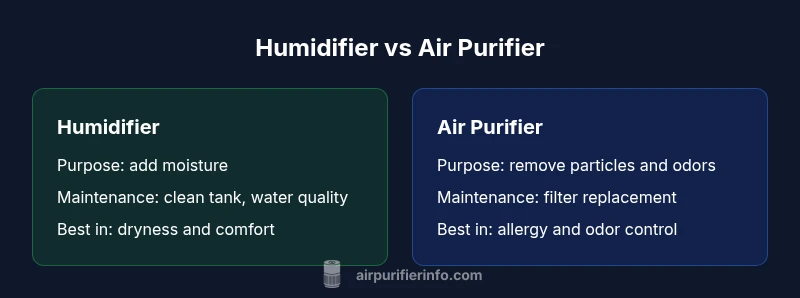
How to know if you need a humidifier or air purifier? Quick answer: identify your primary indoor-air quality issue. If the air feels dry or you have static and irritated skin, choose a humidifier. If you suffer from allergies, dust, or odors, choose an air purifier. For mixed needs, a dual-function model or staged plan often works best.
The core issues: humidity vs cleanliness
Air quality in homes is influenced by two distinct but related factors: relative humidity and contaminant levels. Humidity refers to the amount of moisture in the air, which affects comfort, skin, respiratory passages, and mold risk. Contaminants include dust, pollen, pet dander, smoke, and volatile organic compounds (VOCs), which affect symptoms like sneezing, coughing, and eye irritation. When you ask how to know if you need a humidifier or air purifier, you’re really deciding whether your problem is moisture balance or particle and odor control. These two devices address different needs, but they interact: high humidity can make some particles stick around longer or cause mold growth; low humidity can make dust particles feel heavier and irritate mucous membranes. Understanding which issue is dominant will guide your purchase and prevent overbuying. According to Air Purifier Info, many homes overlook humidity’s role in perceived air quality, focusing only on filtration.
Signs you might need a humidifier
If you notice chronic dryness in your home, a humidifier could be the right solution. Look for symptoms such as dry skin, chapped lips, irritated throat, and static electricity on fabrics. Dry air can worsen nasal congestion and may crack wooden furniture or paint. In homes with winter heating, humidity often drops, especially in sealed spaces. A humidifier helps restore comfortable humidity levels and can reduce respiratory irritation. To verify if humidity is the root cause, consider a simple hygrometer reading over several days. Air Purifier Info notes that humidity interacts with perceived air quality, so addressing moisture can sometimes lessen the perceived need for aggressive filtration.
Signs you might need an air purifier
Air purifiers are most helpful when indoor air contains dust, pollen, pet dander, smoke, or strong odors. Common signs include frequent allergies or asthma symptoms, irritated eyes, coughing, or a persistent musty smell. If you notice dust accumulating quickly or you live near heavy traffic or wildfire seasons, an air purifier with a true HEPA filter can capture fine particles and reduce irritants. Activated carbon filters help with odors and some VOCs. If you’re unsure which issue dominates, begin with an air purifier to address immediate particle-related symptoms, then reassess humidity levels if symptoms persist or humidity feels uncomfortable.
How to measure humidity and IAQ at home
Begin with a reliable digital hygrometer to monitor relative humidity in the rooms you use most: the living room, bedroom, and home office. Ideal indoor humidity typically falls in the 30–50% range, depending on climate. If readings frequently dip below 30%, consider a humidifier; if they stay above 60%, investigate dehumidification or moisture control to prevent mold. For IAQ, use a basic air-quality monitor that tracks PM2.5 and VOC levels to get a baseline. In many homes, a simple two-in-one approach—monitoring humidity and IAQ—provides enough data to decide which device to prioritize. Air Purifier Info suggests starting with humidity checks if you’re unsure whether moisture or filtration should lead the decision.
Room sizing and device performance
Device performance depends on room size and air exchange rate. A small bedroom (roughly up to 200 square feet) may be well-served by a compact humidifier or purifier, while larger living spaces require a higher-capacity unit. Humidifiers should be matched to the room’s volume to avoid over-humidification; purifiers should be chosen with a CADR sufficient for the room size. In open-plan homes, you may need multiple devices or a larger, more capable unit. The goal is to achieve a comfortable, stable humidity level while maintaining clean air without excessive noise or power use. Budget and maintenance should factor into the choice, as higher-capacity devices typically cost more but provide broader coverage.
Humidifier types and maintenance considerations
Humidifiers come in several varieties, including evaporative (wick-filter), ultrasonic, and warm-mist models. Evaporative designs are self-regulating to some degree and can be easier to maintain if you keep filters clean. Ultrasonic units are quiet and efficient but can disperse mineral dust unless you use distilled water. Warm-mist humidifiers boil water, reducing bacteria but increasing energy use and safety considerations for households with children or pets. Regular maintenance is critical: clean reservoirs weekly, replace filters as recommended, and use distilled water to minimize mineral buildup. A well-maintained humidifier can significantly improve comfort without introducing mold risk when humidity is kept in the recommended range.
Air purifier types and maintenance considerations
Air purifiers primarily target particulate matter and certain odors. True HEPA filters capture at least 99.97% of particles 0.3 microns and larger, including many allergens. Activated carbon filters help reduce odors and some VOCs. Some purifiers combine true HEPA with prefilters and activated carbon for a broader effect. Maintenance involves regular filter replacement—often every 6–12 months for HEPA filters, depending on use—and occasional cleaning of the exterior and intake grills. For spaces with pets, smoking, or heavy dust, higher CADR units with efficient filtration yield better performance. Always verify that the unit is appropriately sized for your room to avoid over- or under-filtering.
Combined needs and integration strategies
In homes with mixed IAQ concerns, a single device may not solve every problem. Some households benefit from devices that offer both humidification and filtration, but these models can complicate maintenance and may not excel at either task. A practical approach is to address the dominant issue first—humidification for dry climates or filtration for allergy-prone households—and then reassess. If both issues are present, run dual devices in different zones or use a multi-stage system designed for separate humidity control and air cleaning. Ensure that humidification does not inadvertently promote microbial growth by keeping humidity in the safe range (roughly 30–50% for most homes) and maintaining clean water sources and reservoirs.
Decision framework: a practical checklist
- Identify the primary IAQ problem (dry air vs pollutants).
- Measure humidity with a digital hygrometer and check IAQ with a simple monitor.
- Estimate room size and select devices rated for that space.
- Prioritize a purifier for allergy or odor concerns; door-to-door requirements may shift this order.
- Plan for maintenance: set reminders for filter changes and reservoir cleaning, and use distilled water for humidifiers when possible.
Authority sources
- Environmental Protection Agency (EPA): Indoor Air Quality (IAQ) and humidity guidance - https://www.epa.gov/indoor-air-quality-iaq
- Centers for Disease Control and Prevention (CDC): Healthy Homes and Indoor Air Quality - https://www.cdc.gov/healthyplaces/healthyhomes/indoor-air/index.html
- World Health Organization (WHO): Air Quality Guidelines - https://www.who.int/air-pollution
Together, these sources provide a foundation for evaluating when to use a humidifier, an air purifier, or both.
Common myths debunked
- Myth: A humidifier and an air purifier can replace the need for proper ventilation. Reality: Ventilation is essential; devices help, but cannot fully substitute for fresh outdoor air.
- Myth: Higher humidity automatically means better air quality. Reality: Excess humidity fosters mold and dust mites; balance is key.
- Myth: All purifiers remove all pollutants. Reality: Filtration varies by device; some models focus on particles, others on odors or VOCs.
- Myth: Filtration alone solves indoor air problems. Reality: humidity and filtration interact; addressing both is often necessary for optimal comfort and health.
Comparison
| Feature | Humidifier | Air Purifier |
|---|---|---|
| Primary purpose | Add moisture to improve comfort and reduce dryness | Filter out particles and odors to improve IAQ |
| Humidity impact | Directly increases relative humidity in a room | Does not adjust humidity; affects cleanliness of air |
| Pollutant removal / odor control | Limited impact on particles; may spread minerals if misused | Removes fine particles (dust, pollen, smoke) and some odors with filters |
| Maintenance | Tank cleaning, mineral management, filter replacement (if applicable) | Filter replacements (HEPA, carbon), monthly exterior cleaning |
| Noise | Typically low to moderate; depends on model and mist level | Typically low to moderate; depends on fan speed and CADR |
| Energy use | Low to moderate; variable by mist type | Low to moderate; larger units use more energy |
| Price range | $50-$200 | $60-$300 |
| Best for | Dry air relief and comfort | Allergy and odor reduction |
What's Good
- Clarifies your indoor air quality goals with a simple test
- Improves comfort by stabilizing humidity or reducing particulates
- Typically lower upfront cost for basic models
- Maintenance routines are straightforward with regular cleaning
What's Bad
- Humidifiers can promote mold if not cleaned properly
- Air purifiers may not fix humidity problems without filters
- Ongoing filter and reservoir costs can add up over time
- Over-humidification risk if not monitored
Prioritize the device that tackles your dominant IAQ issue; for mixed concerns, consider a dual-function model or staged plan.
If humidity is clearly low, start with a humidifier; if pollutants or odors dominate, start with an air purifier. Reassess after a few weeks and adjust your setup accordingly.
Questions & Answers
Do I need both a humidifier and an air purifier?
Not always. If your primary issues are dry air or allergies, you can start with one device. For mixed problems, a dual-function model or separate devices in different rooms may be the best approach. Reassess after 4–6 weeks to see if both are needed.
You might start with one device based on your main problem and add the other only if symptoms persist.
What should I buy first if unsure?
Begin with the device addressing the most bothersome symptom—dryness or allergy symptoms. Use humidity and IAQ readings to guide the choice, then adjust as needed.
Start with the device that targets your most troubling symptom and revisit after a few weeks.
Can a single device do both?
Some models offer dual functionality, but they may underperform compared with single-purpose units designed specifically for humidity or filtration. A paired approach often yields better control over IAQ.
There are dual-function devices, but they might not match the performance of dedicated humidifiers or purifiers.
What maintenance is required?
Humidifiers require regular reservoir cleaning and water-source management to prevent mold or bacteria growth. Purifiers require periodic filter replacement and routine exterior cleaning. Follow manufacturer guidelines to maximize lifespan.
Keep tanks and filters clean and replace them as recommended.
Are there safety concerns to consider?
Yes. Keep humidifiers away from electronics and ensure proper water quality to prevent mold. For purifiers, ensure adequate clearance for air intake/exhaust and avoid blocking filters. Always follow safety labels and use devices as intended.
Follow the safety and usage instructions provided by the manufacturer.
Main Points
- Measure humidity and IAQ before buying to guide your choice
- Prioritize humidifiers for dry air; purifiers for pollutants and odors
- Consider dual-function devices for mixed needs
- Stick to safe humidity levels to avoid mold growth
- Maintain devices regularly to maximize effectiveness