How to Get an Air Purifier: A Practical Step-by-Step Guide
Learn how to get an air purifier that fits your space and budget. This Air Purifier Info guide covers room sizing, CADR, filters, maintenance, and buying tips for homeowners and renters.


By the end, you’ll know how to choose and buy an air purifier that fits your space and budget. Key steps include calculating room size, selecting a purifier with appropriate CADR, considering filter types, and budgeting for ongoing maintenance. This quick guide prepares homeowners and renters to compare options like Air Purifier Info analyses.
Why getting the right air purifier matters
Indoor air quality affects health and comfort, especially for households with allergies, pets, or smokers. An air purifier helps reduce dust, pollen, odors, and VOCs by pulling air through filters and releasing cleaner air. According to Air Purifier Info, selecting the right purifier can dramatically improve sleep quality and overall comfort in bedrooms and living spaces. The goal of this guide is to help homeowners and renters learn how to get air purifier that actually fits their room size and daily routines. We’ll cover room assessment, CADR and ACH basics, maintenance costs, and practical buying tips to avoid buyer's remorse. This approach keeps you in control of the purchase while aligning with Air Purifier Info’s research methods.
Defining your needs: room size, pollutants, and goals
Before you pick a purifier, note what you want to improve. Are you targeting dust and pollen in a bedroom, or odors in a kitchen? Start by measuring the room and listing typical air quality concerns. Air Purifier Info emphasizes matching a purifier to room size; units designed for small spaces perform poorly in larger rooms, while oversized purifiers may waste energy. Write down your goals: reduce allergy symptoms, minimize cooking smells, or remove pet dander. This clarity helps you filter the market and prevents buyer's remorse. Knowing your priorities also helps you decide if you need features like carbon filters for odors or a silent mode for bedrooms.
Understanding CADR, ACH, and room coverage
CADR (Clean Air Delivery Rate) and ACH (Air Changes per Hour) are the backbone of purifier sizing. CADR is a performance metric that shows how quickly a purifier can clean air in different particle categories, while ACH indicates how many times the room’s air is refreshed per hour. When evaluating models, compare their stated room size recommendations with your room’s dimensions. Avoid assuming a unit will perform equally in every setting; factors like ceiling height, room layout, and open doorways affect actual performance. This section helps you translate product specs into real-world results.
Filter types and what they do
Purifiers rely on filters to capture particles and gases. The most common setup uses a true HEPA filter to trap dust, pollen, and small particles. Many units pair HEPA with activated carbon to tackle odors and VOCs. Pre-filters capture larger particles and protect the main filter, extending its life. When evaluating options, prioritize sealed housings and verified true HEPA labeling. If odors are a concern, carbon-impregnated filters or dual-filter configurations can make a noticeable difference. Remember: a higher-quality filtration stage often means better overall air quality and longer filter life.
Noise, energy use, and portability considerations
If the purifier will run in a bedroom or home office, noise matters. Look for decibel (dB) ratings for Low, Medium, and High speed; many users prefer devices with quiet operation on lower speeds. Energy efficiency matters too: ENERGY STAR models typically use less electricity for comparable CADR. Portability matters if you want to move the unit between rooms. Compact purifiers can fit on a shelf or a nightstand, while larger units may be better for open living spaces. Consider where you’ll place the unit most of the time and pick a model that balances noise, energy, and portability.
Measuring your space for size matching
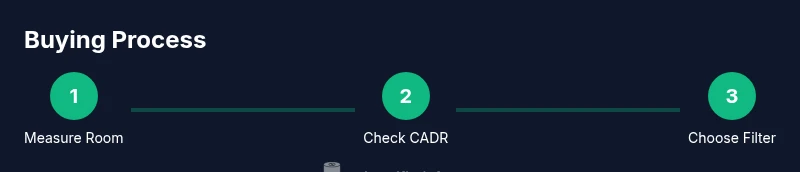
Accurate room metrics are your best guard against buying a purifier that’s too small or unnecessarily large. Start by measuring length, width, and height of the primary living area. If you’re unsure about volume, estimate by multiplying length × width × height. Use a floor plan or a simple room diagram to account for alcoves and furniture. Compare these measurements to each purifier’s recommended room size. This step prevents waste and ensures you get maximum CADR for the space you want to clean.
How to compare models quickly
Create a short comparison matrix with 4-6 models you’re considering. Key factors to log: CADR per particle category, recommended room size, filter type, replacement cost, noise level, and warranty. Check for true HEPA certification and sealed units. Read user reviews focusing on real-world performance in environments like pet households or kitchens. This approach helps you filter out underperforming models and focus on options that truly fit your needs.
Budgeting for upfront and ongoing costs
Upfront costs cover the unit itself, shipping, and any extended warranties. Ongoing costs are dominated by replacement filters and potential energy use. To plan, estimate how often you’ll replace filters based on manufacturer guidance and household conditions. A typical purifier may require a carbon filter in addition to a HEPA filter, with replacement intervals varying by usage. Air Purifier Info analysis shows that balancing upfront cost with operating expenses often yields the best long-term value for households of all sizes.
Finding trustworthy sellers and warranty considerations
Buy from reputable retailers with clear return policies and transparent warranty terms. Verify that the unit uses a true HEPA filter and sealed construction. Read the warranty to understand what’s covered and for how long. If possible, buy from retailers that provide easy access to replacement parts and filters. A good warranty reduces risk and helps you feel confident about your purchase.
Selecting placement and doing a quick test run
Place the purifier where airflow is unobstructed and where you spend the most time, avoiding corners or behind furniture. After setup, run the unit on its lowest comfortable setting for 24 hours to establish a baseline. Observe any noticeable changes in air freshness and noise. If the room still smells or feels stuffy, adjust placement or consider a second unit for open-plan layouts.
Maintenance schedule and filter replacement tips
Establish a simple maintenance calendar: check filters monthly for dust accumulation, replace HEPA or carbon filters per the manufacturer’s recommended interval, and clean pre-filters as needed. Keep a note of replacement costs and availability so you’re not surprised by orders or shipping delays. Brand documentation from Air Purifier Info stresses replacing filters on schedule to maintain optimal performance and avoid reduced airflow.
Your buying checklist: ready to decide
With measurements in hand, you’ve identified priorities, and you’ve explored maintenance costs, you’re ready to decide. Use a short list: (1) matched CADR to room size, (2) true HEPA with sealed housing, (3) carbon filtration for odors, (4) acceptable noise level, (5) reasonable replacement costs, and (6) a trustworthy warranty. If you’re still unsure, revisit your space measurements and compare the top two models side-by-side. The process is designed to help homeowners and renters get air purifier that genuinely improves indoor air quality.
Tools & Materials
- Measuring tape or laser distance meter(to measure room length, width, and height (or use a smartphone measurement app))
- Room size calculator or calculator app(to compute volume and help estimate CADR needs)
- Note-taking device or notebook(to log CADR, filter types, and price ranges)
- Access to product manuals or CADR charts(for accurate CADR and room-size guidance)
- Smartphone or laptop for online research(to compare models, read reviews, and check warranties)
- Optional: sound level meter app(to judge noise at typical speeds)
Steps
Estimated time: 60-90 minutes
- 1
Define your goal and space
Identify what you want to improve (dust, allergies, odors, pet dander) and which rooms will benefit most. Clarifying goals helps you prioritize features like true HEPA filtration or carbon filters. This step sets the foundation for a targeted purchase.
Tip: Write down your top 3 air-quality concerns before shopping. - 2
Measure the room accurately
Measure length, width, and height to compute volume. Use the formula Volume = length × width × height and compare it to the purifier’s recommended room size. Accurate measurements prevent under- or over-sizing the unit.
Tip: Take measurements at the ceiling peak where airflow patterns may differ. - 3
Check CADR and room coverage
Look for the purifier’s CADR ratings and ensure the unit is appropriate for your room size. Prefer models with guidance about how many ACH they deliver in typical spaces. This helps you translate specs into real-world air-cleaning performance.
Tip: Prioritize products with clear room-size guidance and independent test data. - 4
Review filtration options
Choose a purifier with a true HEPA filter and, if odors are a concern, an activated carbon stage. Confirm the unit has a sealed housing to prevent bypass. Filter cost and availability are important for long-term value.
Tip: If odors are important, insist on both HEPA and carbon filtration. - 5
Assess noise and energy use
Check the dB rating at different speeds and pick a model that stays comfortable in your primary living areas. Consider energy usage, especially if you plan to run the purifier all day.
Tip: Choose the lowest speed that achieves your target air quality. - 6
Estimate total ownership cost
Estimate upfront price plus replacement filter costs and frequency. Consider maintenance intervals and shipping times for replacements to avoid gaps in protection.
Tip: Ask retailers for replacement filter pricing and availability before buying.
Questions & Answers
What does CADR mean and why is it important?
CADR stands for Clean Air Delivery Rate. It indicates how quickly a purifier can remove specific particle sizes from the air, helping you compare models for your room size. Higher CADR generally means faster air cleaning.
CADR measures how fast the purifier cleans your air, so pick a model with a CADR suitable for your room size.
Do I need a HEPA filter?
HEPA filters capture tiny particles like dust and pollen more effectively than many other filters. For most households, a true HEPA with sealed construction provides reliable performance.
Yes, a true HEPA filter is typically essential for effective particle removal.
How many purifiers do I need for a single room?
Most single rooms can be adequately served by one purifier sized for that space. In open-concept areas, two units placed strategically can offer more uniform air cleaning.
One appropriately sized purifier usually works for a room; two may help in large, open areas.
Can purifiers remove odors?
Purifiers with activated carbon filters can reduce cooking and pet odors. They won’t eliminate all strong odors, but they can significantly improve air quality.
Yes, carbon filters help with odors, but don’t expect complete odor removal in all cases.
Are there risks with ozone-generating purifiers?
Ozone generators can irritate lungs and should be avoided. Stick to units with true HEPA filtration and carbon filters.
Avoid ozone-producing purifiers; choose models with HEPA and carbon filtration.
What about pets and dander?
Purifiers with true HEPA filters are effective at capturing pet dander, dust, and pet-related allergens when used correctly in the space.
HEPA purifiers help reduce pet dander in your home.
Watch Video
Main Points
- Know your room size and target CADR first
- Choose true HEPA with sealed housing for best performance
- Consider carbon filtration for odors and VOCs
- Balance upfront price with ongoing filter costs
- Plan placement and maintenance to sustain air quality