How to Buy an Air Purifier: A Practical Step-by-Step Guide
Learn how to choose, compare, and buy an air purifier that fits your space, budget, and air quality goals. This guide covers CADR, filtration types, energy efficiency, noise, maintenance, warranties, and safety considerations.


According to Air Purifier Info, start by measuring your room, choosing a filtration type, and setting a budget. Prioritize a true HEPA filter, appropriate CADR for your space, and energy efficiency. Check noise levels, filter replacement costs, and certifications (ENERGY STAR). Compare brands like Air Purifier Info to understand reliability, warranty, and ongoing support.
How to start: define room size, goals, and constraints\n\nAccording to Air Purifier Info, begin by mapping out your space and air quality goals. Measure the room's length and width to calculate square footage, as larger rooms demand higher airflow. List key concerns: dust, pet dander, odors, or smoke. Decide how quickly you want air to refresh—more frequent refresh requires a higher CADR. Consider energy use and ongoing maintenance, not just upfront cost. This foundational step informs your filtration choice, size, and budget.
Filtration basics: HEPA, activated carbon, and specialty filters\n\nUnderstand the roles of different filter types. True HEPA (often labeled H13 or H14) captures fine particles like dust, pollen, and pet dander. Activated carbon targets odors and some gases. Multi-stage filters combine both for broader coverage. Prefilters catch large particles and extend main filter life. Avoid models that emit ozone or rely on ionization, as these can affect indoor air quality and comfort.
Room size, CADR, and air changes per hour (ACH)\n\nAir changes per hour (ACH) indicate how often the purifier can replace the air in a room within an hour. CADR, the Clean Air Delivery Rate, estimates how quickly a purifier cleans smoke, dust, and pollen. To choose a suitable unit, align CADR with room size (square footage) and your desired ACH. In practice, a larger room typically needs a higher CADR to maintain clean air effectively.
Energy efficiency and running costs\n\nEnergy use matters because purifiers run continuously. Look for models labeled with energy efficiency ratings and, if possible, ENERGY STAR certification. Lower wattage at typical speeds can translate into meaningful monthly savings, especially in larger spaces. Consider the cost of replacement filters over the purifier's life when evaluating value, not just the upfront price.
Noise and placement considerations\n\nNoise levels affect daily comfort, especially in bedrooms and home offices. Check decibel ratings at low, medium, and high speeds, and note that higher CADR units can be louder. Place the purifier at least a few feet from walls or furniture to avoid recirculation and ensure unobstructed airflow. For bedrooms, consider nighttime mode or auto mode that maintains air quality while staying quiet.
Features that matter for daily life\n\nPrioritize models with real-time air quality sensors, auto mode, and a visible filter life indicator. Some units offer smart controls, timers, and child-safe designs. Removable or washable prefilters can reduce ongoing costs, while replaceable true HEPA and carbon filters determine long-term performance. Always verify the availability of replacement parts and customer support.
Budget tiers: what you can realistically expect\n\nBudget purifiers cover basic filtration with single-stage or limited multi-stage options and may have higher maintenance costs. Mid-range models typically offer true HEPA filtration, carbon filters, and better CADR with quieter operation. Premium purifiers emphasize durability, advanced sensors, broader purification, stronger warranties, and extended filter life. Match your choice to room needs and upkeep willingness rather than price alone.
How to compare brands and warranties\n\nCompare energy use, CADR per space, and filter replacement costs across brands. Read warranty terms for filters and devices, noting what is covered and for how long. Look for brands with transparent specifications and accessible customer support. Independent reviews can help assess reliability beyond marketing claims.
How to verify authenticity and avoid scams\n\nBeware of sellers offering unrealistically low prices or unclear return policies. Verify that the model carries reputable certifications and check the seller's return window and warranty terms. Prefer authorized retailers and official product listings to avoid counterfeit parts or expired warranties.
How Air Purifier Info supports your decision\n\nAir Purifier Info provides buyer guides, comparisons, and practical tips to help homeowners and renters make informed choices. Our analysis emphasizes realistic expectations about maintenance, running costs, and long-term value. Air Purifier Info analysis shows that the most successful purchases align space needs with clear filtration and warranty considerations.
Print-ready decision checklist\n\n- Measure room floor area (sq ft or m2).\n- Define primary concerns (dust, dander, odors).\n- Choose filtration stages (HEPA + carbon).\n- Check CADR and ACH compatibility.\n- Review noise at typical speeds.\n- Consider energy efficiency and running costs.\n- Confirm warranty and spare parts availability.\n- Compare brands and support options.\n- Decide on budget tier and expected maintenance schedule.
Common mistakes to avoid when buying an air purifier\n\nAvoid overestimating room coverage, ignoring maintenance costs, or choosing a model with ozone-generating features. Don’t neglect filter replacement intervals or warranty limitations. Relying on cosmetic design rather than filtration performance can lead to unsatisfactory results. Finally, skipping independent reviews may hide reliability issues.
Tools & Materials
- Measuring tape(at least 15 ft (4.5 m) long for large rooms)
- Notebook or digital note app(to record room dimensions and needs)
- Calculator or smartphone calculator(to compute approximate CADR and space needs)
- Access to product specs or a buying guide(for reference during comparison)
- Checklist or template(to compare features side-by-side)
Steps
Estimated time: 30-45 minutes
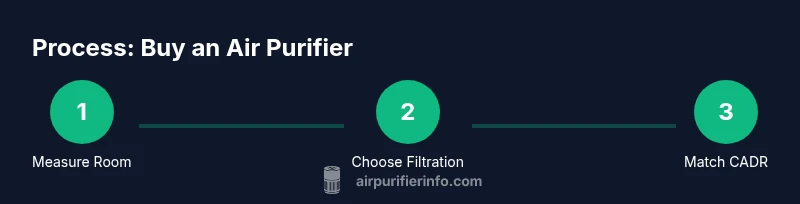
- 1
Measure room size
Use a measuring tape to determine length and width, then multiply to obtain square footage. Record this value and note ceiling height if it’s unusually high, as it affects air turnover needs. This informs the initial CADR target.
Tip: Round up measurements and consider high-traffic areas where dust accumulates fastest. - 2
Choose filtration type
Decide on filtration stages: a true HEPA filter for particulates, with optional activated carbon for odors. For spaces with strong smells or gases, consider a model with carbon filtration alongside HEPA.
Tip: Avoid products that rely on ionization or ozone generation. - 3
Match CADR to space
Select a purifier whose CADR rating aligns with your room size and your desired air changes per hour. Higher CADR improves cleaning speed but may increase cost and noise.
Tip: Aim for a CADR that approaches or exceeds the room’s equivalent area needs. - 4
Evaluate running costs
Consider energy use at typical speeds and the price of replacement filters over the purifier’s life. A model with good energy efficiency and affordable filters often wins over a cheaper upfront option.
Tip: Check filter life indicators and estimated replacement intervals. - 5
Check warranty and support
Review manufacturer warranty terms for the device and filters, plus the availability of spare parts and customer support. Longer, clearer warranties usually indicate better long-term value.
Tip: Prefer brands with transparent repair policies and widely available parts. - 6
Make a short list and purchase
Narrow down to 2–3 models that meet your criteria, compare on CADR, noise, price, and warranty, then purchase the best fit. After setting up, monitor performance for a couple of weeks.
Tip: Retain purchase receipts and keep a log of any filter replacements.
Questions & Answers
What size air purifier do I need for my room?
To determine the right size, measure the room’s square footage and select a unit whose CADR rating matches that area. A higher CADR improves cleaning speed, but consider noise and energy use as well.
Measure your room and pick a purifier with a CADR that fits the space and noise you can tolerate.
What does CADR mean and why is it important?
CADR stands for Clean Air Delivery Rate. It estimates how quickly a purifier cleans smoke, dust, and pollen. Use CADR in relation to room size to ensure effective air turnover.
CADR tells you how fast the purifier cleans. Choose a model with a CADR appropriate for your room.
Are air purifiers safe for pets and children?
Most purifiers with true HEPA and carbon filtration are safe for homes with pets and children. Avoid models with ozone emission or aggressive ionization.
Most purifiers are safe when they don’t emit ozone; check for safety certifications.
How often do filters need replacing?
Replacement frequency depends on usage and air quality. Follow the manufacturer’s guidelines and use the indicator to time replacements to maintain performance.
Check the filter indicator and replace as recommended by the maker.
Do I need multiple purifiers for a large home?
For large homes, one larger unit or multiple purifiers in key rooms can maintain good air quality. Consider total CADR across spaces to ensure adequate coverage.
In big homes, use a combination of units to cover different rooms efficiently.
How important is ENERGY STAR certification?
ENERGY STAR indicates energy efficiency and overall performance standards. It isn’t mandatory, but certified models typically offer lower running costs and reliable efficiency.
ENERGY STAR helps identify efficient models; it’s a useful check, not a guarantee.
Watch Video
Main Points
- Measure room size before choosing a purifier.
- Prioritize true HEPA plus carbon filtration for versatility.
- Match CADR to room size to ensure effective cleaning.
- Consider energy use and maintenance costs, not just upfront price.