How to Dispose Air Purifier: A Practical Guide
Learn how to dispose air purifier responsibly with safe disassembly, proper handling of filters, and finding local e-waste programs. This guide covers safety steps, disposal routes, and eco-friendly options for homeowners and renters.


In this guide you will learn how to dispose air purifier responsibly. You’ll identify local disposal options, safely remove and handle filters, and recycle or donate components when possible. Before you begin, gather gloves, a screwdriver if needed, and your purifier's model number to check manufacturer guidelines and municipal rules.
Why proper disposal matters
Disposing an air purifier responsibly is more than a nod to recycling culture; it prevents releasing dust, metals, or VOCs trapped inside the unit and supports local waste streams. Improper disposal can violate municipal rules and complicate electronic-recycling programs for your community. When you ask how to dispose air purifier, you’re choosing a pathway that protects indoor air quality and the environment. According to Air Purifier Info, most purifiers combine a plastic housing, an electronic control board, a sealed motor, and replaceable media filters. Each component has its own disposal route, which is why a simple trash drop-off rarely suffices. In practice, you’ll separate the non-recyclable shell from the electronic parts, and you’ll treat spent filters according to local guidance. If you’re unsure, start with your city’s waste portal or contact your county’s household hazardous waste program. Safety first: always unplug the device, and handle any dusty filters with gloves and a mask as needed.
Assessing your purifier’s components
Before you begin the disposal process, inventory the parts inside your unit. Most air purifiers contain a plastic shell, a HEPA or replacement media filter, an activated carbon filter, a fan, a small circuit board, and electrical cords. Not all purifiers are created equal: some models use integrated compact batteries or replaceable carbon media that require special handling. To streamline the process, locate the model number and the instruction manual. This information helps you identify whether filters are recyclable, whether the electronics must go to an e-waste facility, and whether any parts are considered hazardous waste. Air Purifier Info emphasizes that checking the manufacturer’s guidelines is the safest starting point, since disposal rules vary by brand and region. If a model includes a non-removable battery, you’ll need to follow specific battery-disposal steps. Remember: never throw electronic components in the curbside trash, and keep a record of your chosen disposal path.
Safety and preparation
Safety starts long before any disassembly. Unplug the purifier and allow it to cool for at least 15 minutes if it has been running. Put on gloves and a dust mask to minimize exposure to collected dust and micro-particles. Work in a well-ventilated area, ideally near a sturdy table or workbench. Have a small container ready for small screws and a bag for each component. If your purifier uses batteries, treat them as a separate item and follow the local guidelines for battery recycling. This planning helps prevent accidental punctures or leakage during disassembly. By preparing properly, you reduce the risk of releasing trapped contaminants into the air and make the subsequent steps simpler and safer. Air Purifier Info recommends keeping the device’s model number handy to verify disposal options in your area.
How to remove and bag the filters safely
First, open the purifier’s housing according to the manual, and carefully remove the filter media. Place each filter in a separate sealable plastic bag to contain dust and odors, then seal the bags securely. If your model includes an activated carbon filter, treat it the same way; carbon can hold onto contaminants, and sealing helps prevent migration during transport. Remove any screws or clips that secure the filter compartment and place them in a small container. If a filter is particularly dusty, consider using a damp cloth to wipe the exterior surfaces before bagging. Label the bags with the model and date to simplify later recycling or disposal decisions. Finally, place the bags with the unit’s non-filter components into a sturdy container or box for transport to the drop-off site. Tip: keep all bags together to avoid misplacing components during a trip to disposal facilities.
Finding disposal options in your area
Options vary widely by location. Many municipalities offer electronics recycling programs that accept air purifiers at drop-off events or permanent facilities. Some retailers and manufacturers run take-back programs for used purifiers and filters; check with local big-box stores and the purifier brand’s recycling page. If your community has a household hazardous waste day, you may be able to drop off batteries, circuit boards, and damaged components there. Start with your city’s official waste portal and search for keywords like “electronics recycling,” “e-waste,” and “Air Purifier disposal.” Air Purifier Info analysis shows that coordinating with licensed recyclers reduces leakage of hazardous substances and supports a circular economy. If you’re unsure, contact your local waste authority to confirm what’s accepted and whether free pickup is available for bulky electronics.
What to do with the filters and media
Used filters have specific disposal rules. Many areas treat them as regular waste after sealing, while others require drop-off at a recycling center because of potentially captured pollutants. Sealing the filters in a bag minimizes odor and dust escape. If your filter media contains chemical adsorbents or activated carbon, confirm whether the material is considered hazardous waste. In some regions, used media can be composted if it is carbon-based and free of heavy metals; in others, it must be treated as electronic waste. Always refer to the manual and your local waste authority for guidance. If recycling isn’t available where you live, you can wrap the filters tightly in multiple bags to prevent odors and store them until the next household hazardous waste collection. Air Purifier Info emphasizes avoiding bag leaks by double-bagging and labeling each bag with a rough description and date.
Reuse, recycling, and donation options
Give your purifier a second life where possible. Some components—like metal housings or certain plastic parts—are widely recyclable. Consider donating a fully functional purifier to a school, charity, or community program. If the unit still works but isn’t energy efficient, reuse the housing for a DIY project or repurpose the filter frame for storage. For unsalvageable units, seek out a licensed electronics recycler that accepts small appliances. If you decide to replace the unit, verify whether the retailer or manufacturer offers a take-back program for old purifiers. Air Purifier Info notes that choosing certified recyclers helps ensure that shredder residues and circuit boards are handled responsibly rather than ending up in landfills.
A quick, practical disposal checklist
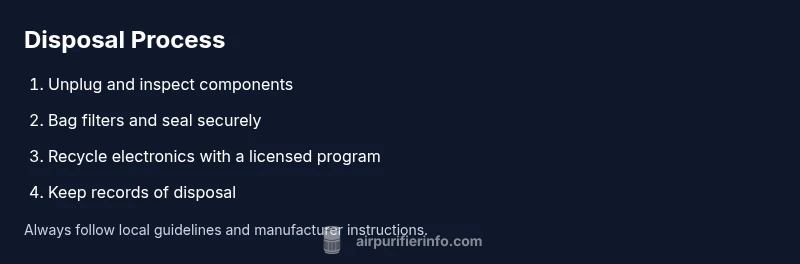
- Unplug and let cool
- Remove filters and bag separately
- Bag and label components
- Check local disposal rules online
- Take to the designated drop-off point or retailer program
- Keep records of your disposal path and dates
Having a simple checklist makes the process less stressful and helps you stay compliant with local rules. If you’re unsure about any step, consult your purifier’s manual or contact your local waste authority for guidance. This approach supports safe, eco-friendly disposal and preserves community health.
Environmental considerations and staying compliant
Environmentally conscious disposal is more than a one-time task; it reflects a broader commitment to healthier indoor air and cleaner communities. By following the steps above, you ensure hazardous components are handled by professionals, the filters are contained to prevent contamination, and reusable materials are redirected to recycling streams. The right disposal path reduces waste and supports a circular economy for home electronics. If you need ongoing guidance, refer back to manufacturer instructions and your municipality’s disposal programs. The Air Purifier Info team recommends adopting a routine review of device end-of-life options whenever you upgrade or replace equipment, to stay aligned with best practices and evolving regulations.
Tools & Materials
- Nitrile gloves(Protect hands from dust and contaminants)
- Screwdriver set (Phillips #2)(Remove screws securing filter housing)
- Seal-able plastic bags(Bag filters and components separately)
- Owner’s manual or model number(Identify disposal instructions and local options)
- Marker or label(Label bags with model and disposal date)
- Small container for screws(Keep screws organized during disassembly)
Steps
Estimated time: 30-60 minutes
- 1
Power down and unplug
Ensure the purifier is completely off and unplugged. Allow any cooling period if the unit felt warm after use. This prevents electrical hazards and reduces the risk of dust exposure during handling.
Tip: Verify there is no residual voltage in any exposed connectors. - 2
Open housing and locate filters
Follow the manual to open the housing. Identify the pre-filter, HEPA or media filter, and the carbon filter. This helps you plan bagging and disposal steps for each component.
Tip: Take a photo of the inside before removing parts to aid reassembly if needed. - 3
Remove and bag filters
Carefully remove each filter and place it in a separate sealable bag. Seal bags to minimize dust escape and label them with the model and date for easy disposal tracking.
Tip: Avoid crushing filters to prevent dust release. - 4
Check for batteries or hazardous components
If the unit has a battery, remove it and store according to local battery recycling guidelines. Dispose of any hazardous components via the appropriate e-waste stream.
Tip: Do not mix batteries with other waste streams. - 5
Identify disposal options
Consult manufacturer take-back programs, local e-waste facilities, or retailer recycling programs to determine where to drop off units and filters.
Tip: Document the chosen path for future reference. - 6
Transport to disposal site
Place all bags and hardware in a sturdy container for transport. Bring a copy of disposal documentation if required by the facility.
Tip: Keep bags secure to prevent leaks during transit.
Questions & Answers
Is it illegal to throw away an air purifier with a filter still inside?
Most places require that electronics be recycled or disposed of through approved programs. Removing and sealing the used filters is typically recommended, and the electronics should be handled by a licensed recycler if required by local rules.
In many areas, you must dispose of electronics through approved programs; remove and seal used filters and follow local regulations for the electronics.
Can I just put the purifier in curbside trash after removing the filters?
Curbside trash is usually not appropriate for purifiers due to electronic components and potential contaminants. Check local e-waste programs or retailer take-back options for responsible disposal.
Curbside trash is usually not suitable for purifiers; use local e-waste programs or retailer take-back options.
What should I do with the activated carbon filter?
Seal the carbon filter in a bag and follow local guidance. In some places it’s treated as general waste after sealing; in others, it requires drop-off at an electronics recycler.
Seal the carbon filter and follow local guidance; some areas treat it as general waste after sealing, others require recycler drop-off.
Are there easy take-back programs for old purifiers?
Many brands offer take-back or recycling programs. Check the manufacturer’s site or ask your retailer about how to return an old purifier for proper recycling.
Many brands have take-back programs; ask the retailer or check the manufacturer’s site for details.
How long does the disposal process typically take?
A typical disposal session can take 30 to 60 minutes, depending on the model and local drop-off options. Prepare in advance to streamline the process.
Expect about 30 to 60 minutes, depending on your model and disposal options.
What if my area has no suitable e-waste facility?
If no facility is nearby, contact the local waste authority for guidance on special collection days or mail-back programs. Some retailers also offer mail-back recycling.
If there’s no nearby facility, contact your local waste authority or the retailer for mail-back options.
Watch Video
Main Points
- Know your local disposal options before acting
- Bag and label used filters to prevent contamination
- Always unplug and wear protection during handling
- Check manufacturer guidelines for safe disposal routes
- Choose licensed recyclers to protect health and environment