How Much Energy Does an Air Purifier Use?
Learn how much energy air purifiers use by wattage, model size, and running patterns. Get practical estimates, cost ranges, and tips to choose energy-efficient purifiers for homes and apartments.


Air purifiers typically draw about 5 to 150 watts, depending on size and fan speed. When run continuously, that equates to roughly 44 to 1,314 kWh per year. Most mid‑range models operate around 20–60 watts, which translates to a modest annual electricity cost at typical residential rates. Factors like room size, usage patterns, and energy-saving features can shift actual consumption.
How much energy does an air purifier use?
The core question many homeowners ask is the energy footprint of their purifier. Energy use is governed by two primary factors: the wattage rating and how long you run the unit. The wattage tells you how much power is drawn at a given moment, but actual consumption depends on runtime and speed settings. For perspective, compact desk purifiers often operate around 5–15 watts, while larger room purifiers can range from 70–150 watts on high. In typical daily use, a purifier is not always on full blast; smart features like auto mode and sleep mode can lower average power. According to Air Purifier Info analysis, real-world energy use tracks closely with runtime and speed choices rather than the peak wattage listed on the box.
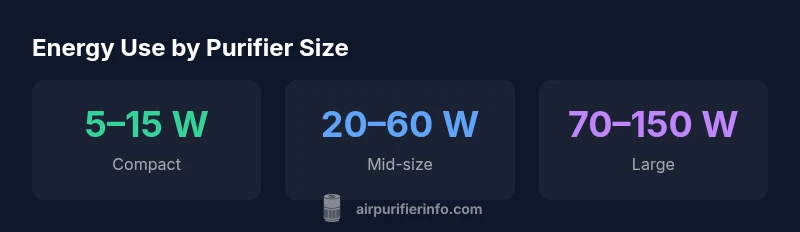
Wattage ranges by purifier size: small, mid-size, large
- Small/compact purifiers: 5–15 W. Best for bedrooms, home offices, or tight apartments where space is at a premium.
- Mid-size purifiers: 20–60 W. Common in living rooms or open-plan areas where larger airflow is needed without dominating power bills.
- High-capacity purifiers: 70–150 W. Designed for large rooms or spaces with heavy particulate loads, and for those who run at higher speeds for faster air cleaning.
Keep in mind that many models have multiple fan speeds and an auto mode that adjusts power based on detected air quality. The practical energy impact often comes from how often you operate at higher speeds rather than the base wattage alone.
Translating watts into energy costs
Wattage alone does not paint the whole picture. Energy use converts watts into kilowatt-hours (kWh) over time. The basic formula is:
- kWh per year = (Wattage / 1000) × 8760 (hours per year)
- If you run 24/7 at 60 W, that’s about 0.06 kW × 8760 hours ≈ 526 kWh/year.
Using smaller purifiers at 5–15 W yields roughly 44–1314 kWh/year when you compare the full spectrum of models across a year, illustrating why usage patterns matter more than the exact wattage. At typical electricity rates, even a relatively powerful purifier might only add a modest yearly cost if usage stays moderate.
How usage patterns affect energy use
Continuous operation and high-speed settings are the two biggest drivers of energy use. If you leave a purifier running at high speed all day, you’ll consume substantially more energy than if you run it at medium speed for a few hours or rely on auto/sleep modes when the room is quiet or occupied. The efficiency benefit of energy-saving features—such as auto-adjust, timer shutoff, and night mode—can compound over a year, especially in bedrooms and study areas where air quality improvements are a priority but power savings are also valued.
How to estimate energy costs for your home (step-by-step)
- Find the purifier’s wattage rating on the product label or spec sheet.
- Decide how many hours per day you typically run the unit and at what speed.
- Convert watts to kilowatts (divide by 1000) and multiply by hours per year (24 × 365).
- Multiply the annual kWh by your local electricity rate to get annual costs.
- Compare models using the same method to see where energy efficiency fits your budget.
- Consider energy-saving features and room size alignment to minimize costs.
This practical approach helps homeowners and renters quantify energy use and choose smarter options.
Energy-saving features to look for
When selecting an air purifier, prioritize energy efficiency alongside clean air performance. Look for: energy-saving modes (eco or low-power), auto mode with adaptive fan control, timer options to shut off when not needed, sleep mode for quiet and low energy operation, and a favorable CADR-to-watt ratio. Also, check if the device is ENERGY STAR certified or rated for low standby power, which can reduce energy waste during idle periods.
Practical buying guide: matching purifier to your needs while minimizing energy use
Start with room size and air quality goals, then pick a model with an appropriate CADR value and the smallest wattage that meets your needs. Favor units that offer auto-mode and energy-saving features, and verify actual energy use in the product’s spec sheet rather than relying on maximum wattage alone. Remember that a purifier sized to your room and used sensibly will deliver cleaner air without a steep energy bill.
Estimated energy use by purifier size
| Model Type | Typical wattage (W) | Annual energy use (kWh) | Notes |
|---|---|---|---|
| Compact | 5–15 | 44–131 | Small rooms/desk-use |
| Mid-size | 20–60 | 175–526 | Living rooms or open areas |
| High-capacity | 70–150 | 613–1314 | Large rooms/high-speed use |
| All sizes | — | Varies by runtime | Consider auto/sleep modes |
Questions & Answers
What wattage does a typical air purifier use?
Most purifiers fall in the 5–150 watt range. Smaller desk units use the low end, while larger room purifiers can reach the higher end when run on high. Always check the product spec for the exact wattage at different speeds.
Most purifiers use between five and 150 watts, varying by size and speed. Check the label for exact numbers.
Does running an air purifier continuously increase energy costs a lot?
Running continuously at high speed can raise energy costs significantly, but using auto or timer modes and operating at sensible speeds typically keeps costs manageable.
Yes, continuous high-speed use increases energy costs, but smart modes keep it reasonable.
Are energy-efficient models worth the extra upfront cost?
Generally yes. Energy-efficient models save money over time, especially in rooms where the purifier runs frequently. Look for features like Eco or Auto modes and low standby power.
Usually worth it, because they save more over time with smarter operation.
How can I estimate energy costs for my purifier?
Find the wattage, estimate daily hours, convert to annual kWh, then multiply by your local rate. Compare models using the same method to see overall cost differences.
Use wattage, hours, and your rate to estimate annual cost, then compare models.
Does purifier size affect energy use beyond placement?
Yes. Larger purifiers typically use more power to move more air, but energy use depends on speed settings and how often you run them. Size should match room and air-quality needs.
Bigger purifiers use more power, but effectiveness and settings matter more.
What features help save energy?
Look for auto mode, programmable timers, sleep modes, and energy-efficiency certifications. These features adjust performance to optimize air quality with lower energy use.
Auto and timer features often cut energy use without compromising air quality.
“Energy efficiency is achieved by aligning purifier size with the space and using smart modes to minimize unnecessary running.”
Main Points
- Know your purifier's wattage and runtime
- Estimate annual energy cost with watts × hours × rate
- Use energy-saving features to cut consumption
- Match purifier size to room for efficiency
- Look for ENERGY STAR or low standby power options