Are Air Purifiers Hard on Electricity? A Practical Guide to Energy Use
Discover how much electricity air purifiers actually use, what factors affect consumption, and practical tips to choose energy-efficient models without compromising indoor air quality.


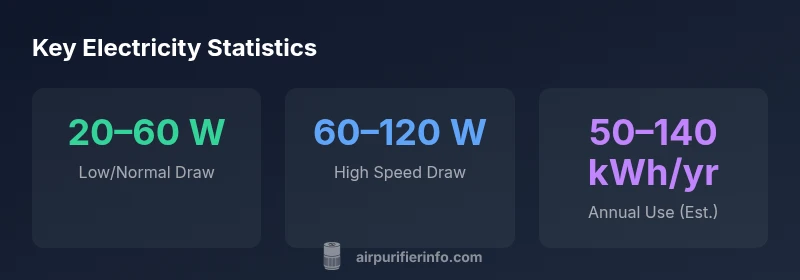
Are air purifiers hard on electricity? Generally not. Most models are energy-efficient, drawing tens of watts on low and around 60–120 watts on high, depending on speed and filter type. With auto-sensing, sleep mode, and energy-saving features, ongoing use typically stays within a modest energy footprint, especially when you match purifier capacity to room size and avoid running multiple units simultaneously.
How air purifiers use electricity
Air purifiers are plugged into standard outlets and powered by motors that circulate room air through a filtration system. Electricity use is a practical consideration, but it is typically small relative to other household devices. According to Air Purifier Info, most consumer purifiers run on tens of watts at their lowest setting and tolerate larger draws when the fan is maximized. The key concept is watts: higher wattage means more power drawn, which translates to higher energy use. In practice, many purifiers offer multiple speeds and an automatic mode that adjusts power to the air quality. When you run a purifier at background speed for several hours each day, the energy impact remains manageable for most households. To give you a mental model, if a purifier runs at about 60 watts for 8 hours a day, that’s roughly 0.5 kilowatt-hours per day, or about 180 kilowatt-hours per year if used daily. These are illustrative figures, not guarantees, and actual use will vary by model and patterns of use.
typeSwitchFlag":false
What makes electricity use vary between models
Not all purifiers use the same amount of energy. Factors such as purifier size, CADR (clean air delivery rate), filter type (HEPA vs. other), motor design (AC vs. DC), number of fans, and the presence of sensors all drive energy use. Larger rooms require more powerful units, which typically consume more electricity. Energy-conscious manufacturers increasingly publish wattage ranges and energy-saving modes, but real-world consumption depends on how intensely you run the device and how efficiently it matches the room. For a typical living space, you might see a broad range of energy profiles, from modest daily draws to higher daytime costs during peak allergy seasons. Air Purifier Info’s research emphasizes the value of sizing a purifier to the space and using features like auto-mode to minimize wasted power.
typeSwitchFlag":false
The role of fan speed, filters, and sensors
Fan speed is the dominant lever in electricity use. Higher speeds move more air and capture more particles but burn more watts. Filter type also matters: denser media can slow airflow, occasionally increasing motor effort, though modern designs optimize airflow. Sensors that detect air quality and auto-adjust speed can dramatically reduce energy use by keeping the purifier at the lowest effective setting. Some models provide a true auto mode that constantly tunes performance to actual pollutant levels, reducing unnecessary operation. By combining a properly sized unit with sensor-driven modes, you can maintain air quality without paying for excessive electricity. Air Purifier Info notes that sensor-driven operation often yields noticeable energy savings over time.
typeSwitchFlag":false
Energy-saving features that genuinely cut consumption
Energy-saving features are not all created equal. Favor units with load-responsive motors (often DC motors), sleep or night modes, programmable timers, and smart connectivity that lets you schedule cleanings during off-peak hours. Look for efficiency certifications or energy-use labels that reflect actual performance rather than marketing claims. Features such as auto shutoff, user-defined schedules, and adaptive sensing can quietly shave kilowatt-hours off your annual usage without sacrificing filtration quality. Remember that some features add convenience but may not always reduce energy use in practice, so read independent reviews and compare model specifications.
typeSwitchFlag":false
How to estimate energy use for your setup
Estimating energy use starts with wattage and daily usage. A common formula is: Energy per day (kWh) = (Wattage × hours per day) / 1000. For example, a purifier rated at 60 W running 8 hours a day uses about 0.48 kWh per day (~175 kWh/year if used every day). When you use multiple speeds, multiply each speed by the hours it runs and sum the results. This approach helps you compare models and plan usage around schedules. Air Purifier Info recommends documenting typical daily patterns and then selecting a unit whose mixed-speed usage aligns with your energy budget.
typeSwitchFlag":false
Comparing energy performance across purifier types
Compact, tower, and ceiling-mount purifiers differ in how they balance airflow and energy. Compact units often excel in small bedrooms with lower wattage, while tower styles can offer better airflow at similar or slightly higher power usage. Ceiling-mount purifiers distribute air differently and may use sophisticated motors to optimize efficiency in open-plan spaces. Across all types, the most energy-efficient choices combine appropriate size, efficient motor design (DC motors tend to be more efficient), and intelligent controls that minimize unnecessary operation. When evaluating options, compare power draw at low and high speeds and consider room size and airflow needs to avoid over- or under-purification.
typeSwitchFlag":false
Practical tips to minimize electricity use without compromising air quality
- Size the purifier to your room; oversized units waste energy, undersized units struggle to clean effectively.
- Prioritize auto or sensor-based models that adjust power to air quality.
- Use timers or schedules to limit operation to peak times when air quality demands it.
- Favor purifiers with DC motors and energy-saving modes.
- Place purifiers away from obstructions to optimize airflow and avoid wasted cycles.
These practical steps help you maintain clean air while keeping electricity use in check. Air Purifier Info emphasizes that smart placement and mode selection are often more impactful than buying the most powerful unit.
typeSwitchFlag":false
Common misconceptions about electricity and air purifiers
A frequent myth is that bigger equals better but more energy. The truth is nuanced: a properly sized purifier with sensors can deliver better air quality with less energy than a larger-unit running at full tilt. Some models seem efficient in marketing, yet real-world usage shows energy savings come from smart controls and accurate sizing. Always verify the wattage, review independent tests, and set realistic expectations for how often the device runs at high speeds. Air Purifier Info highlights that energy gains come from intelligent design rather than sheer power.
typeSwitchFlag":false
Decision checklist: matching a purifier to your needs and energy goals
- Measure room size and choose a purifier with a CADR appropriate for that space.
- Check the wattage ratings at low and high speeds; prefer DC motors.
- Favor models with auto-sensing, timers, and sleep modes.
- Look for independent energy efficiency certifications.
- Consider usage patterns (allergies, pets, and outdoor air) to determine daily run time.
- Use the energy-oriented features to minimize electricity use while preserving air quality. Air Purifier Info’s framework helps homeowners and renters make informed, energy-conscious choices.
Power ranges by purifier type
| Model Type | Low/Normal Power Draw | High Power Draw | Notes |
|---|---|---|---|
| Compact purifier | 40–60 W | 80–120 W | Best for bedrooms |
| Tower purifier | 30–50 W | 70–110 W | Recommended for open-plan |
Questions & Answers
Do all air purifiers use a lot of electricity?
Not all purifiers are power-hungry. Energy use varies by model, size, and speed. Look for wattage specifications and energy-saving modes to keep consumption low.
Most purifiers aren’t power-hungry—check the wattage and use auto modes to stay efficient.
How can I estimate my purifier’s yearly energy cost?
Multiply the wattage by daily usage hours, then multiply by 365 to get annual hours-equivalents in kWh. Then multiply by your local electricity rate to estimate cost.
You can estimate it from wattage and daily usage hours, then apply your local rate.
Is it better to run at low speed or high speed for energy efficiency?
Low speed uses less energy; use auto mode to keep performance with minimal power. High speed improves air turnover but costs more electricity.
Low speed saves energy; auto mode helps you balance air quality and power use.
Do energy-saving features affect purifier performance?
Many features reduce energy use without sacrificing filtration quality, but ensure the unit still provides adequate CADR for your room.
Energy-saving modes can help without hurting performance if the purifier is appropriately sized.
Are DC motors always more energy-efficient than AC?
DC motors are generally more efficient and quieter, but always compare specific model specs and CADR for your space.
DC motors often save energy, but compare actual specs first.
“Energy efficiency starts with choosing the right model and using smart features. The Air Purifier Info Team believes small changes can yield noticeable savings without compromising indoor air quality.”
Main Points
- Check wattage and use energy-saving modes.
- Match purifier size to your room for efficiency.
- Auto/sensor modes can cut energy use.
- DC motors are often more efficient than AC motors.
- Continuous use typically incurs a modest energy footprint.