Air Purifier Electricity Use: A Practical Guide to Energy Consumption
Learn how much electricity air purifiers consume, compare running vs standby power, estimate annual costs, and get practical tips to minimize energy use without sacrificing air quality.


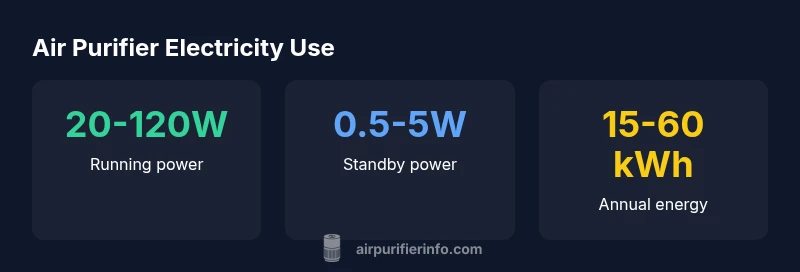
If you’re asking how much air purifier consume electricity, According to Air Purifier Info, here’s the gist: most residential purifiers use roughly 20–120 watts during active operation, and under 5 watts in standby. Annual energy costs typically range from about $10 to $60 depending on settings and usage. Always check the labeled wattage and the manufacturer’s energy estimates for accuracy.
How electricity is consumed by air purifiers
According to Air Purifier Info, electricity use is driven primarily by the fan motor and, to a lesser extent, by any active purification technologies (ionizers, UV-C) and sensors. In practice, power draw scales with the purifier's Clean Air Delivery Rate (CADR) and the selected fan speed. At low to mid-speed settings, many units sit in the 20–60 watt range; at high-speed or when purifying large rooms, power draw often reaches 80–120 watts. Standby or idle power is typically a small fraction of running power, often under 5 watts. The exact numbers depend on motor efficiency, filtration systems, and any added features. Because these devices are fan-driven, energy efficiency is tightly linked to motor efficiency and the CADR-per-watt ratio. If energy bills matter, favor models with higher CADR per watt and check the manufacturer’s energy estimates in product specs.
Factors that influence electricity consumption
- Fan speed and CADR: Higher speeds deliver faster air cleaning but use more power.
- Filter type and condition: HEPA filters with efficient motors reduce resistance; clogged filters force the motor to work harder.
- Room size and placement: A purifier sized for the room will run at lower average speed than an oversized unit.
- Energy-efficiency features: Auto mode, timers, and energy-saving modes can cap running power.
- Additional features: Built-in ionizers or UV-C lights may add to the electricity draw, though the incremental cost is often modest.
Air Purifier Info notes that the best energy performers achieve similar air-cleaning outcomes at lower wattage by optimizing CADR per watt. When evaluating models, review both the running wattage and any claimed yearly energy use.
Estimating energy use for your home
To estimate annual energy use, convert watts into kilowatt-hours and multiply by the hours of operation per day. For example, a purifier rated 60 watts running 8 hours per day would consume about 60 W × 8 h × 365 ≈ 175 kWh per year. At a typical electricity rate, this translates to roughly $25–$50 annually, depending on your local price. If you run the unit at 40 W for 24 hours, your annual use drops to about 351 kWh, roughly $40–$60 depending on rates. These are rough estimates; actual costs vary by model, usage, and price of electricity. Use the manufacturer’s stated annual energy figure when available and factor in your real-world usage patterns. Air Purifier Info emphasizes that real-world usage often stays well within manufacturer estimates for typical home use.
Practical tips to reduce electricity use
- Pick energy-efficient models with lower running wattage and high CADR per watt.
- Use lower fan speeds whenever possible and reserve high-speed cleaning for times of heavy pollution.
- Employ timers and schedules to run only during occupancy or when you’re at home.
- Place purifiers strategically to maximize air exchange without overworking the motor.
- Maintain filters and seals; clean ducts and interiors; a clogged filter increases resistance and energy use.
- Consider models with automatic mode, which can modulate power based on air quality instead of running at full speed continuously.
By combining these strategies, you can maintain strong air quality while keeping electricity consumption reasonable. The Air Purifier Info approach is to balance performance with energy efficiency for a healthier home.
Reading energy labels and choosing an energy-efficient model
When shopping, compare running wattage and any advertised annual energy use. Look for units that emphasize CADR efficiency (high CADR per watt) and check whether the model has energy-saving modes or an ENERGY STAR certification for air purifiers. If the model offers an adjustable Auto mode, test how often it reduces power while maintaining acceptable air quality. Remember, a larger purifier isn't always more energy-hungry if it can clean air quickly at low speeds. The goal is to maximize air quality per watt. The numbers you see on the label give you a baseline, but real-world results depend on room size, occupancy, and how you use the device. The Air Purifier Info team recommends starting with a smaller, efficient model and expanding only if you need higher CADR in larger spaces.
Energy usage by purifier type (Air Purifier Info Analysis, 2026)
| Purifier Type | Typical Power (W) | Estimated Annual Cost (USD) | Notes |
|---|---|---|---|
| Compact desk purifier | 20-40 | 5-15 | Best for small rooms |
| Mid-size tower | 60-90 | 15-40 | Balanced performance |
| High-end large purifier | 90-120 | 40-100 | Powerful CADR for large rooms |
Questions & Answers
What contributes most to an air purifier's electricity use?
The fan motor and speed primarily drive energy use. Higher CADR and faster speeds raise watts; filters and sensors add smaller costs. Choosing models with good CADR-per-watt efficiency helps minimize overall draw.
The biggest factor is the fan speed; higher speeds use more watts, but efficient designs can deliver clean air with less energy.
Is standby power significant for air purifiers?
Standby power is typically small, often a few watts or less. It matters mainly if you leave devices on 24/7, but compared to running power, it’s a minor portion of total energy use.
Standby power is usually low, but you can save more by turning devices off when not in use.
Can I reduce electricity use without sacrificing filtration?
Yes. Choose energy-efficient models, run at lower speeds when possible, use schedules, and maintain filters. Smart modes can adapt power to air quality, preserving clean air while saving energy.
Yes—efficient models and smart scheduling help you save energy without losing air cleaning.
How do energy labels help when shopping?
Energy labels show running wattage and often annual energy use. Look for high CADR per watt and check for any energy-saving modes or certifications to compare efficiency.
Check wattage and yearly energy use on labels to compare efficiency.
What is the cost difference between compact and large purifiers?
Larger purifiers typically consume more watts, but they can clean air faster at lower speeds. Compare per-year energy use rather than just upfront price to gauge true running costs.
Larger purifiers usually cost more to run, so compare yearly energy use, not just price.
“Energy efficiency matters as much as CADR. Even small differences in runtime can add up to noticeable savings over a year.”
Main Points
- Check labeled wattage to compare energy use
- Aim for high CADR per watt to maximize efficiency
- Use timers and lower speeds to cut running costs
- Estimate annual costs using watts, hours, and local rates; adjust for your room size