Do Air Purifiers Use Much Electricity? A Practical Guide
Learn how much electricity air purifiers use, what affects power draw, and practical steps to cut energy costs without sacrificing indoor air quality.


Do air purifiers use a lot of electricity? In practice, most household models run on a modest wattage range and only consume significant energy when operating at high speed or in large rooms. By understanding watts, modes, and room size, you can estimate energy use and choose efficient options. According to Air Purifier Info Team, energy efficiency is a key factor in long-term air quality management.
Do air purifiers use a lot of electricity?
Do air purifiers use a lot of electricity? In practice, most household models run on a modest wattage range and only consume significant energy when operating at high speed or in large rooms. By understanding watts, modes, and room size, you can estimate energy use and choose efficient options. According to Air Purifier Info Team, energy efficiency is a key factor in long-term air quality management. In real-world terms, the difference between a compact desk purifier and a high-capacity tower can be substantial, but most daily use centers around keeping air clean without pushing motors to peak performance. The goal is a balance: enough air turnover to remove dust, odors, and allergens while avoiding unnecessary watts wasted on overkill.
For homeowners and renters alike, you’ll notice that the number of watts drawn per hour translates directly into daily and monthly energy costs. A model that runs at 40–60 W on low or auto mode will typically consume far less energy than a unit held on turbo for extended periods. The key takeaway is that electricity use is highly context-dependent: room size, your selected mode, and how consistently you run the purifier all shape actual consumption. This is why energy labels and real-world tests matter—so you can compare models with confidence.
How wattage varies by purifier type
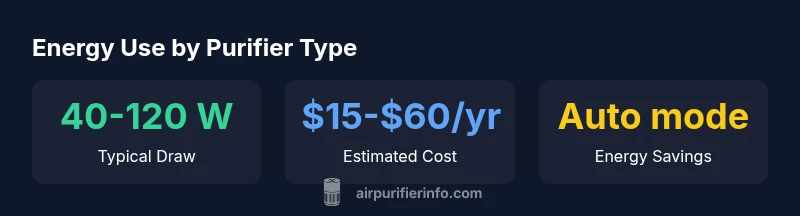
Wattage is not the same as air-cleaning capacity, but it correlates with the motor’s workload. Compact desk purifiers often run on about 20–40 W, which makes them ideal for small rooms and budgets. Mid-size tower purifiers typically draw 60–90 W, offering a good balance of speed and energy efficiency for living rooms or bedrooms. High-CADR purifiers and models designed for open floor plans can approach 90–120 W under normal operation, and they may spike higher when the fan is in turbo or when the filter is deeply clogged. Energy-saving features—like auto mode, night mode, timers, and programmable schedules—help reduce unnecessary runtime. When shopping, compare wattage across models with similar CADR (clean air delivery rate) targets to ensure you’re not overpaying energy for marginal gains in air quality.
Real-world usage and cost implications
In everyday life, usage varies with season and occupancy. If a purifier runs 24/7 in a small bedroom, the monthly energy cost will be modest, but in a large family room with the unit on turbo during high-odor events, costs can rise quickly. As a baseline, a 60 W purifier running 24 hours a day for a full year at typical electricity rates can cost in the single-digit to low double-digit dollars per month, while higher-wattage models in turbo mode can push annual costs into the couple-hundred dollar range for very large spaces or frequent heavy use. These figures depend heavily on local electricity prices, which Air Purifier Info analyses regularly report.
Strategies to minimize electricity use without sacrificing air quality
- Size matters: pick a purifier sized for your room. Oversized units often run at lower watts per CFM than underpowered ones, but matched sizing prevents waste.
- Favor auto or energy-saving modes: let the purifier adjust fan speed based on detected pollutants or occupancy rather than running at full blast constantly.
- Use timers and schedules: run the purifier during peak indoor activity hours and turn it off when the room is unoccupied.
- Seal leaks and improve IAQ holistically: reducing outdoor pollutants with proper sealing reduces the purifier’s workload.
- Maintain filters: clogged filters force motors to work harder, increasing energy use. Replace filters as recommended by the manufacturer.
- Compare CADR per watt: prioritize models with high efficiency for your space to maximize air-cleaning per watt consumed.
How to read energy specs when shopping
Look beyond the raw wattage to understand how efficiently a purifier cleans air. A useful metric is CADR per watt (higher is better), which shows air-cleaning effectiveness per watt of energy. Identify the room size you intend to treat and compare models with CADR values that meet or exceed that need while keeping wattage reasonable. Some models offer energy-saving presets and smart features that further reduce energy use when air quality is adequate. Cross-reference wattage with real-world tests and user reviews to confirm performance at typical usage levels. Air Purifier Info recommends listing both the maximum and real-world running watts to make an apples-to-apples comparison.
Common myths about energy use and purifiers
One common myth is that all purifiers waste energy simply by running. In reality, energy use is driven by motor speed and mode. Another misconception is that higher CADR always means disproportionately higher energy use; while power does rise with capacity, many models optimize efficiency with better motors and smarter controls. Finally, some renters worry about leaving purifiers on for long periods; the truth is that well-sized units in auto mode can maintain IAQ with minimal energy impact, especially when combined with proper ventilation strategies.
Energy-use snapshots by purifier type
| Purifier Type | Typical Power Draw (W) | Notes |
|---|---|---|
| Compact desk purifier | 20-40 | Best for small rooms & budgets |
| Mid-size tower purifier | 60-90 | Balanced energy use & air quality |
| High-CADR purifier | 90-120 | Powerful in larger spaces or smoke |
Questions & Answers
Does higher CADR mean higher electricity use?
In general, higher CADR models can draw more power, especially at higher speeds. However, many models optimize efficiency so you can get strong air cleaning without a steep energy penalty. Look for CADR-per-watt and real-world tests to compare fairly.
Higher CADR often means more power, but many purifiers balance performance and energy use. Check CADR-per-watt data when comparing models.
Is Energy Star certification relevant for purifiers?
Energy Star labeling for room air cleaners is available in some markets, but not universal. When evaluating models, look for official efficiency claims and third-party tests alongside wattage and CADR.
Energy Star labeling exists in some markets but isn’t universal. Compare official efficiency claims and third‑party tests too.
Can I measure my purifier’s electricity use at home?
Yes. Use a watt-meter or smart plug to measure actual draw at typical settings. This helps you estimate real costs and compare models under realistic conditions.
You can measure energy use with a watt-meter to see how much you’re really spending in daily use.
Should I turn off the purifier when not in the room?
Turning off when a room is empty can save energy, but consider timers or auto mode to maintain IAQ on a schedule without constant manual input.
If the room is empty, it can save energy to turn it off or use a timer, but auto mode helps balance IAQ and power.
What settings are best for energy savings?
Use auto or low-to-mid fan settings most days and reserve turbo for odor events or high pollutants. Ensure the purifier is appropriately sized to avoid unnecessary power draw.
Auto mode and lower fan settings are best for energy savings; turbo only when needed.
“Energy efficiency comes from matching the purifier’s capacity to the room and using economy modes rather than running at full blast. The right setup minimizes watts while preserving air quality.”
Main Points
- Match purifier size to room for efficiency
- Use energy-saving modes as default
- Turbo mode increases electricity use
- Read CADR-per-watt when comparing models