How Much Air Cleaner Do You Need? A Practical Guide
Discover how to size an air cleaner for your space. Learn room size, CADR, ACH, and filtration effects, then compare purifiers for better air at home.


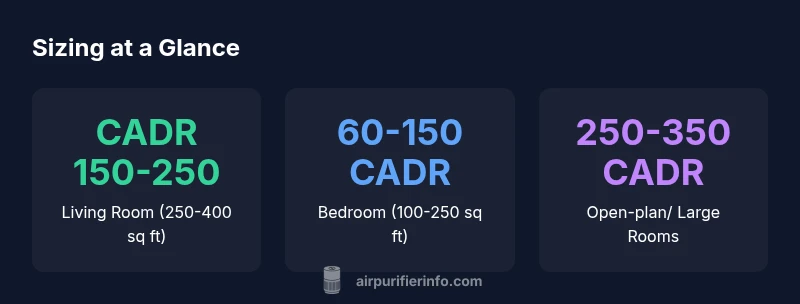
Typical guidance suggests a living room of 250–400 sq ft benefits from a purifier rated around 150–250 CADR. Smaller bedrooms (100–200 sq ft) usually need about 60–100 CADR, while open-plan or larger spaces (400–800 sq ft) call for 250–350 CADR. Aim for 4–6 air changes per hour where dust, cooking, or smoke are concerns. Size by room, not by wattage alone.
How Much Air Cleaner Do You Need: Start with Room Size
Sizing an air cleaner begins with the space you want to treat. For most homes, room size is the dominant factor in determining the right CADR. A general rule of thumb is to pick a purifier with a CADR that matches the rough air volume of the room. Example: a living room around 250–400 sq ft (assuming 8 ft ceilings) has a volume of roughly 2,000–3,200 cubic feet; targeting 4–6 air changes per hour translates to about 135–270 CADR. That range narrows further when you factor in occupancy, cooking, or smokers. Air Purifier Info recommends calculating CADR based on your room volume and desired ACH, rather than chasing a single device wattage.
Understanding CADR, ACH, and Room Volume
CADR measures how much clean air a purifier can deliver per minute, expressed in CFM. ACH (air changes per hour) describes how often the air in a room is replaced in an hour. To estimate CADR from room size, multiply room volume (in cubic feet) by the target ACH, then divide by 60. For a room of 2,400 ft3 and 5 ACH, CADR ≈ (2,400 × 5) / 60 = 200 CFM. Note that CADR varies by pollutant (dust, smoke, pollen), and your needs may differ by scenario such as cooking or smoking.
Sizing Guidelines by Room Type
- Small bedrooms (100–200 sq ft): aim for 60–100 CADR, compact purifiers with good filtration.
- Living rooms (250–400 sq ft): target 150–250 CADR, typically mid-sized purifiers with HEPA and optional carbon.
- Open-plan or large spaces (400+ sq ft): look for 250–350 CADR or higher, larger purifiers or multiple units as needed.
- Ceiling height matters: taller rooms increase volume and CADR needs; adjust upward by roughly 10–15% for rooms above 9 ft ceilings.
These guidelines assume typical occupancy and normal cooking; adjust for heavy smokers or pet odors by selecting higher CADR and a carbon stage.
Special Considerations: Allergies, Odors, Pets, Dust
Allergies and dust do best with true HEPA filtration that captures particles down to 0.3 microns. If odors or cooking fumes are a concern, pair the HEPA stage with an activated carbon filter to adsorb volatile organic compounds (VOCs) and smells. For homes with pets, consider filters rated for pet dander and a higher CADR to counter elevated particle load. In all cases, verify that the purifier’s CADR aligns with the intended pollutant profile (dust vs smoke).
How to Compare Purifiers: Real-World Tests and Reviews
Beyond the spec sheet, assess real-world performance: noise levels at typical operation, energy use over a 24-hour period, and how quickly the unit reduces visible dust in a standard test room. Look for independent lab tests and user reviews that report PM2.5 reductions and odor control in real homes. Remember: CADR is a guideline; real-world airflow depends on placement, room layout, and doorways.
Setup, Placement, and Maintenance for Best Results
Place units away from walls and obstructions, at least 2 feet from corners to maximize intake and output flow. Keep doors and windows in mind—if a door is frequently opened, cycle time may be affected. Replace filters according to manufacturer recommendations, and check for signs of reduced airflow (strange noises, reduced airflow, or increased dust on surfaces). Regular maintenance sustains performance and energy efficiency.
CADR sizing guide by room type
| Room Type | Recommended CADR | Typical purifier size | Recommended ACH |
|---|---|---|---|
| Living Room (250-400 sq ft) | 150-250 CADR | Mid-size purifier | 4-6 ACH |
| Bedroom (100-250 sq ft) | 60-150 CADR | Compact purifier | 4-6 ACH |
| Open-plan/ Large Room (400+ sq ft) | 250-350 CADR | Large purifier | 4-6 ACH |
Questions & Answers
How do I calculate the CADR I need for my room?
To estimate CADR, measure your room volume (length × width × height in feet) to get cubic feet. Choose a target ACH (commonly 4–6). CADR ≈ (volume × ACH) / 60. Remember that activities like cooking or smoking may require higher targets.
Measure your room, pick an air change rate, and estimate CADR with the simple volume formula. Then factor in activities that raise air pollution.
Is a higher CADR always better?
Higher CADR generally improves cleanup speed, but it also increases cost, noise, and energy use. Match CADR to room size and noise tolerance for best results.
Higher CADR isn’t always better—balance speed with noise and energy use for your space.
Do air purifiers help with odors and smoke?
Purifiers with a true HEPA filter remove particulates, while activated carbon helps absorb odors and VOCs. For strong odors or smoke, look for models with both features and a higher CADR.
Yes—HEPA captures particles and carbon filters tackle odors; for smoke, prioritize units with carbon plus high CADR.
Can purifiers reduce pet dander effectively?
Yes. True HEPA filtration captures fine pet dander and dust. For homes with pets, choose a purifier with a higher CADR and a pet-friendly filter design.
Purifiers with HEPA filters reduce pet dander effectively when sized correctly for the room.
What about energy use and noise levels?
Energy use and noise vary by model and speed setting. Look for dB ratings at typical speeds and prefer energy-star or similar efficiency certifications when available.
Check the noise level and energy use ratings to pick a unit you can run comfortably day and night.
“Sizing a purifier around your actual room volume and target air changes delivers real, noticeable results—more than chasing higher wattage.”
Main Points
- Size by room, not wattage alone
- Target 4–6 air changes per hour
- Match CADR to room volume for accuracy
- Add activated carbon for odors and VOCs
- Place purifier for optimal airflow and maintain filters