How Long for an Air Purifier to Clean a Room: Timing Guide
Discover how long it takes for an air purifier to clean a room, including the influence of room size, CADR, ACH, and layout. Learn to estimate timing and speed up results with practical steps.


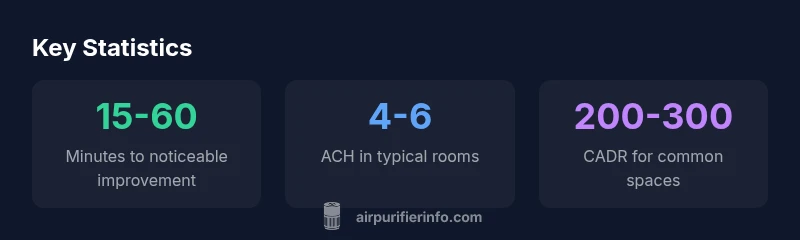
How long does it take for an air purifier to clean a room? In typical residential spaces, a purifier with a CADR of 200–300 cfm can begin noticeably reducing particles within 15–30 minutes and reach substantial air-cleaning levels within 30–60 minutes. For larger rooms or higher pollutant loads, expect longer times, and always consider air changes per hour (ACH) and room volume to estimate exact timing.
Key factors that determine timing
According to Air Purifier Info, several variables determine how quickly a purifier improves air quality: room size, CADR, ceiling height, current pollutant load, and how well the unit circulates air within the space. In practice, the smallest rooms with a high-CADR purifier reach noticeable improvements fastest, while large, open areas or rooms with stagnant corners take longer. In addition to CADR, the air-jet pattern and the presence of sources such as cooking, smoking, or pet dander can extend the time to clear odors. Understanding these factors helps homeowners and renters set realistic expectations and choose a purifier that matches the space.
How to estimate timing for your space
Estimating timing starts with a simple set of calculations you can perform with basic measurements. First, calculate room volume: multiply length by width by height. Next, select a purifier whose CADR suits that volume. A practical rule of thumb is ACH = (CADR × 60) / roomVolume, which translates the purifier’s capacity into an air-change rate for your room. For example, a 12×12×8 ft room (1,152 ft³) with a CADR of 250 cfm yields an approximate ACH of 13, meaning roughly 4–5 minutes per air change in an ideal flow. In practice, expect 4–6 air changes, so noticeable improvement could occur within 20–40 minutes in such a space. This method gives you a transparent, repeatable way to predict timing without relying on guesswork.
CADR, ACH, and room volume: how they interact
CADR indicates how many cubic feet of air the purifier can clean per minute. ACH converts CADR into air changes per hour for a given room volume. A higher CADR relative to room volume means more air changes per hour and faster removal of particles and odors. When the room is larger, or the ceiling height increases, the same CADR yields fewer air changes per hour, slowing the rate of clean air delivery. For more precise planning, calculate the ACH first, then translate that into an expected time for a target number of air changes based on your room’s volume.
Larger rooms and unusual layouts: what changes?
As rooms grow or layouts become irregular, air may circulate unevenly. Corners, alcoves, and closed doors can create pockets where pollutants linger longer. In such cases, a purifier with a higher CADR, strategic placement away from walls, and minimal obstruction improve overall effectiveness. If you cannot place a purifier optimally, consider using two units or a model with a wider jet pattern to enhance cross-room mixing and reduce stagnation. The takeaway: scale CADR to room volume, and optimize placement to maximize airflow.
Odor vs particle removal: timing differences
Particles (dust, pollen, smoke particles) tend to respond faster to filtration than odors, which may cling to fabrics and surfaces. Odor removal often depends on air changes that replace odor-laden air with fresh air and on the purifier’s ability to capture gas-phase compounds (some purifiers include activated carbon filters for this purpose). Expect odors to linger slightly longer than visible particles, especially in spaces with cooking or smoking.
Quick-start checklist to speed up early improvements
- Place the purifier in a central location with open airflow and away from walls.
- Choose a model with a CADR appropriate for the room size and aim for 4–6 ACH.
- Close doors temporarily to prevent fresh air influx that counteracts filtration, then re-open after initial cleansing.
- Run the purifier continuously during active pollutant sources and for 30–60 minutes after sources stop to capture residual contaminants.
- Periodically check and replace filters as recommended by the manufacturer to maintain performance.
Measuring progress: when to retest air quality
A practical method is to observe visual air clarity, dust settling on surfaces, and occupant comfort levels. If available, use an inexpensive particle counter or air quality monitor to track PM2.5 or PM10 levels and note how quickly they decline after turning on the purifier. Re-test after the purifier has operated for a few air-change cycles to gauge improvement. If results lag, reassess CADR, placement, or room sealing.
Practical tips for renters and homeowners
Renters can maximize impact by choosing compact purifiers with strong CADR that fit within rental apartments or bedrooms, and by placing them away from doors to maintain consistent airflow. Homeowners should consider higher-CADR units for living rooms or open-plan spaces, paired with occasional window ventilation to help displace stale air. Regular maintenance, like filter changes and confirming seals, ensures the purifier continues to perform as expected.
Common myths about air purifier timing
Myth: More expensive purifiers always clean room faster. Truth: CADR relative to room volume determines speed, but placement, airflow, and pollutant sources are equally important. Myth: Turning off the purifier between uses saves energy without affecting air quality. Truth: Short gaps in operation can let pollutants accumulate, increasing the time needed for a fresh cleanup when you resume.
How to choose the right purifier for timing
Focus on CADR relative to room volume and target pollutants. If odors are a concern, prefer purifiers with activated carbon filters in addition to HEPA. For households with pets or allergies, consider models with higher CADR and validated clean air delivery rate (CADR) for dust and pollen. Finally, account for noise levels and energy consumption; quiet models may encourage longer, continuous operation, which improves timing consistency.
Maintenance and its impact on timing
A clean, well-maintained purifier filters air more efficiently, reducing the time needed to reach target air quality. Regular filter replacements according to the manufacturer schedule prevent performance declines that extend timing. In addition, ensuring seals on doors and windows are intact minimizes drafts that counteract filtration, helping you achieve cleaner air faster.
A practical framework for estimating your timing
Begin with a room volume estimate and CADR specification. Compute ACH and translate that into expected air-change intervals. Set a target time for a few air changes based on the room’s use and pollutant load, then verify with simple observations (smell, dust, or a monitor). If results are slower than expected, upgrade CADR or refine placement and continuous operation. This framework provides a repeatable approach for homeowners and renters alike.
Estimated timing ranges by room size, based on Air Purifier Info Analysis, 2026
| Room size (m²) | CADR needed (cfm) | Time to 50% reduction | Time to comfortable air |
|---|---|---|---|
| 9 | 150-200 | 15-25 minutes | 30-40 minutes |
| 25 | 350-450 | 25-40 minutes | 50-70 minutes |
Questions & Answers
How does room size affect cleaning time?
Larger rooms require more air changes to reach the same level of cleanliness as smaller rooms. The time to noticeable improvement scales with room volume and the purifier's CADR relative to that volume, so expect longer times in bigger spaces.
Larger rooms need more air changes, so timing increases with room size. CADR relative to room volume matters most.
What CADR is needed for my room?
Estimate CADR by calculating your room’s volume and aiming for several air changes per hour. A common baseline is 4–6 ACH; higher for smoke or strong odors. Choose a purifier with a CADR that achieves that ACH for your space.
Calculate room volume and target 4 to 6 air changes per hour; pick a purifier with CADR to meet that goal.
Odors clear as fast as dust?
Particles often drop faster than odors because filters capture particles quickly. Odors may linger until there are enough air changes to replace contaminated air and, if present, activated carbon helps reduce gas-phase compounds.
Particles clear faster than odors; odors improve with more air changes and, if you have carbon filters, with gas adsorption.
Does ceiling height affect timing?
Yes. Higher ceilings increase room volume, reducing air-change rate unless CADR is increased accordingly or purifier placement optimizes circulation. In tall-ceiling rooms, you may need a higher-CADR unit or multiple units.
Tall ceilings mean more air to clean; you may need bigger CADR or multiple purifiers.
Is continuous operation advisable?
Yes. Running continuously speeds up timing by maintaining steady air changes. If energy use is a concern, you can run at lower speeds when the space isn’t occupied and ramp up during activity.
Keeping it on continuously speeds up cleaning; you can adjust speed to save energy when needed.
Should I use more than one purifier?
Using multiple purifiers can speed up cleansing, especially in larger or open layouts. Place units to avoid creating conflicting airflow, and ensure each unit has proper clearance for optimal intake and discharge.
Multiple purifiers can speed things up if placed properly to avoid airflow clashes.
“Real-world timing depends on room size, layout, and pollutant load. CADR guides you, but actual results require proper airflow and regular filter maintenance.”
Main Points
- Estimate timing using room volume and CADR.
- Choose a purifier with higher CADR for faster results.
- Account for odors and pollutants with different removal rates.
- Optimize placement to improve airflow and speed.
- Verify progress with simple checks or affordable sensors.