Difference Between Air Purifier and AC: A Comprehensive Comparison
Explore the difference between air purifiers and air conditioners, including how each one works, energy use, maintenance, and best-use scenarios for cleaner indoor air and comfortable climate.


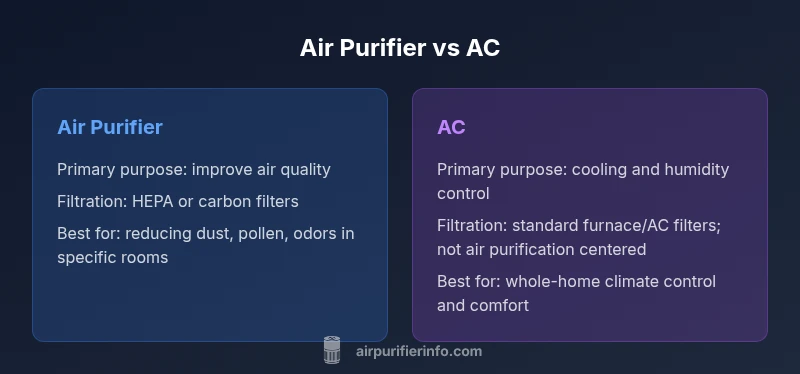
Difference between air purifier and AC: An air purifier is a standalone device that cleans indoor air by filtering out dust, allergens, and odors. An air conditioner cools and recirculates indoor air while controlling humidity. Purifiers focus on air quality and health, usually with lower energy use per unit of air cleaned, whereas ACs are climate-control systems that affect temperature, humidity, and comfort. See our full comparison below.
Overview: the difference between air purifier and ac
According to Air Purifier Info, the difference between air purifier and ac hinges on core purpose, design philosophy, and how users interact with the device. An air purifier is designed to improve air quality by removing particles, gases, and odors from indoor air. An air conditioner, by contrast, focuses on cooling and dehumidifying air to create a comfortable living environment. The two technologies can complement each other, but they are not interchangeable. By clarifying their roles, homeowners can set realistic expectations, budget appropriately, and make smarter buying decisions that benefit health and comfort in equal measure.
How each device works
Air purifiers pull air through filters such as HEPA or high-efficiency filters to trap particles like dust, pollen, pet dander, and smoke particles. Some models also include activated carbon for odors and VOCs. The cleaned air is then circulated back into the room. Air conditioners use refrigerant-based cycles to absorb heat from indoor air and release it outside, while also passively moving air through ducts or fans. Portable purifiers are ideal for rooms, while ACs can be central or split systems serving multiple rooms. The interaction between airflow, filtration, and room size determines effectiveness for both devices, so matching device capacity to real-world space matters.
What they filter and how effectiveness varies
Purifiers excel at removing fine particles and certain odors when paired with appropriate filters. The filtration media's efficiency (like HEPA H13 vs H14) and the CADR rating influence how quickly air cleans. Odor removal depends on activated carbon layers and filter life. ACs filter air too, primarily to protect the system and maintain air quality inside ducts; however, their filtration capacity varies with filter type and system design. In homes with heavy dust or strong odors, a purifier can deliver noticeable improvements, while an AC alone cannot remove all particulate matter. The key is to understand that filtration is not magic; it works best when used in combination with good ventilation and source control.
Energy use, costs, and maintenance
Air purifiers generally consume less energy per hour of clean air produced than cooling systems when measured in terms of air-cleaning output, though high-end units with robust CADR can still draw noticeable power. Costs include upfront purchase price, replacement filters, and periodic repairs or battery changes for certain models. Contrast that with air conditioners, where the energy footprint is tied to cooling load, compressor activity, and the size of the conditioned space. Maintenance for purifiers centers on filter replacement and cleaning; for ACs, it involves filter changes, refrigerant checks, coil cleaning, and possible professional servicing.
Humidity and temperature handling
Purifiers do not regulate humidity; most simply filter the air and let the room’s existing humidity level stay as is. In spaces with high humidity, an air purifier can help reduce dust particles and mold spores that thrive in moist air, but it won't lower humidity itself. ACs, on the other hand, actively cool air and dehumidify it as part of the cooling cycle. In warm, humid climates, ACs can improve comfort; in dry environments or seasons, a purifier may better support sensitive occupants by reducing irritants without altering moisture levels.
Space, placement, and coverage considerations
The effectiveness of air purifiers depends on room size, placement, and air mixing. Portable purifiers work best in rooms where people spend time, like bedrooms or living rooms, but their coverage is limited by square footage and air flow patterns. Central AC systems influence air quality across multiple rooms but rely on duct design and filter quality for effectiveness. When evaluating how to deploy each device, map the space you want to improve and set realistic expectations for what each technology can deliver.
Use-case scenarios and a decision framework
If your primary goal is to reduce irritants like dust, pollen, and smoke in a specific room, a portable air purifier with a high CADR and appropriate filters is often the fastest path to noticeable gains. If your goal is to create a comfortable, climate-controlled home for larger areas or the entire residence, a properly sized central AC system with good filtration is usually the better long-term solution. For many households, a combination approach—using a purifier in bedrooms or work areas while relying on HVAC for temperature control—yields the best overall indoor air quality.
Testing metrics: CADR, ACH, and beyond
Air purifier performance is commonly described with CADR (clean air delivery rate) and filter efficiency, while HVAC performance centers on SEER (seasonal energy efficiency ratio) and ACH (air changes per hour) in a given space. Understanding these metrics helps homeowners compare devices objectively. Real-world results depend on room size, placement, and ventilation: a purifier with a high CADR in a small room may outperform a larger unit that’s undersized, and a central system’s benefits require well-sealed ducts and modern filtration.
HVAC integration, hybrid solutions, and smart controls
Some homes benefit from integrating dedicated purifiers with an HVAC system to improve overall air quality without overburdening the cooling load. Hybrid approaches, such as using a purifier in conjunction with a well-designed central AC, can optimize energy use and comfort. Smart sensors, air-quality monitors, and automatic fan adjustments help align device operation with real-time conditions, making it easier to maintain cleaner air and comfortable temperatures with minimal manual intervention.
Common myths and practical pitfalls
A common misconception is that simply buying a purifier will solve all air-quality problems; in reality, source control (reducing pet dander, avoiding smoke sources, sealing leaks) and ventilation improvements play critical roles. Another pitfall is undersizing: a small purifier in a large room may seem ineffective, leading to frustration and unnecessary costs. Finally, many buyers confuse odor removal with general air quality; while carbon filters help with smells, they do not catch all tiny particles like some pollen or mold spores.
Practical tips for choosing and using these devices
Start with a room-by-room assessment to determine whether a purifier or AC upgrade best fits your goals. For purifiers, prioritize CADR ratings that match the room size, and consider units with true HEPA filters and carbon in multi-stage setups. For ACs, ensure proper sizing and filtration along with regular maintenance. Always pair any filtration device with good source control, regular cleaning, and proper ventilation to maximize benefits and minimize costs. Air Purifier Info suggests evaluating both life-cycle costs and health improvements when making a decision.
Comparison
| Feature | Air Purifier | Air Conditioner (AC) |
|---|---|---|
| Primary purpose | Air purification and allergen reduction | Cooling and humidity control |
| Filtration/media | HEPA/MERV-based filters; optional carbon | Integrated HVAC filters; not dedicated to air purification |
| Coverage/space | One room to small apartments | Whole-home via ducts or multi-room setups |
| Energy use | Generally moderate-to-low per air-cleaned hour | Energy use tied to cooling load and compressor operation |
| Maintenance | Filter changes every 6-12 months; cleaning as needed | HVAC filter changes and seasonal service |
| Noise | Low to moderate; higher speeds may be noticeable | Can be noticeable with fans and compressors |
| Cost range | $60-$700 (portable purifiers) | $2,000-$7,000+ (central systems) |
| Best for | Targeted air quality improvements in specific spaces | Whole-home climate control and comfort |
What's Good
- Targets room-specific air quality improvements quickly
- Portable and easy to deploy in multiple rooms
- Lower upfront cost for basic models
- Low maintenance compared to major HVAC upgrades
What's Bad
- Does not cool spaces or provide full-house humidity control
- Ongoing filter replacement adds recurring costs
- Effectiveness depends on room size and placement
- Limited impact on overall home ventilation without proper design
Air purifiers are the go-to for improving indoor air quality in specific rooms, while AC systems deliver whole-home climate control; choose based on your primary goal.
If clean air is your priority in a defined space, purifiers are cost-effective and quick. For comprehensive comfort across an entire home, prioritize a well-sized AC system with good filtration. In many homes, using both in tandem yields the best indoor environment.
Questions & Answers
Can an air purifier replace an air conditioner for cooling?
No. Air purifiers do not cool air or control humidity; they focus on filtering particles and odors. If you need temperature or humidity management, you’ll still require an air conditioner or other climate-control solution.
No—purifiers clean the air, they don’t cool or dehumidify like an air conditioner does.
Do I need both an air purifier and an AC?
It depends on your goals and space. If you want clean air in specific rooms and overall cooling for the home, a purifier plus a properly sized AC system can provide comprehensive benefits. For small budgets, start with a purifier in the most-used room and upgrade HVAC later if needed.
It depends on your goals. Purifiers for air quality in key rooms, AC for cooling the whole home.
What are CADR and ACH, and why do they matter?
CADR measures how quickly a purifier can clean air in a room, while ACH indicates how many times air in a space is replaced each hour, often used for HVAC. Higher CADR improves room air faster, and higher ACH means more frequent air turnover, both affecting perceived air quality.
CADR shows how fast a purifier cleans air; ACH shows how often air is replaced in a space.
Are there devices that combine purification and cooling?
Some systems blend features, such as HVAC units with advanced filtration or portable units designed to act as both air purifiers and minimal cooling aids in small spaces. However, dedicated purification and dedicated cooling typically perform better when paired separately.
There are combination systems, but dedicated purifier and purifier-cooling options generally work best.
How do I size a purifier for a room?
Measure the room and compare it to the purifier’s CADR rating. Aim for a CADR that enables at least 5-6 air changes per hour for the room size to feel noticeable benefits. Also consider ceiling height and airflow patterns when selecting placement.
Match the purifier’s CADR to your room size and aim for several air changes per hour.
Main Points
- Define your goal: air quality vs climate control
- Purifiers excel at particle/odor reduction in individual rooms
- ACs provide whole-home cooling and humidity control
- Consider a hybrid approach for balanced results
- Size, placement, and ventilation determine real-world effectiveness