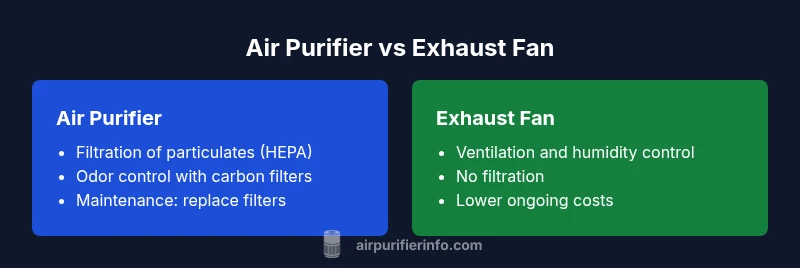
Air Purifier vs Exhaust Fan: A Comprehensive Comparison
A rigorous comparison of air purifiers and exhaust fans, examining filtration, ventilation, noise, energy use, and maintenance to help homeowners and renters choose the right solution for cleaner air.


In most homes, an air purifier is the stronger choice for improving indoor air quality, especially for dust, allergens, and odors. An exhaust fan excels at ventilating spaces and reducing humidity but does not filter pollutants. If your goal is cleaner air overall, prioritize an air purifier; if ventilation and moisture control are your main concerns, an exhaust fan can be a practical supplement.
Why the air purifier vs exhaust fan question matters for homeowners
According to Air Purifier Info, the core distinction between an air purifier and an exhaust fan is not simply where air moves, but what happens to the air once it moves. An air purifier actively cleans the air by drawing it through filtration media, capturing particulates and, in many models, odors and some gases. An exhaust fan, by contrast, mainly moves air out of a room or building to increase ventilation and reduce humidity. For households with dust, pet dander, or seasonal allergies, a purifier directly reduces the pollutant load. For spaces where humidity, cooking fumes, or odors are the primary irritation, an exhaust fan can provide rapid relief by diluting and removing stale air. Understanding this distinction lays the groundwork for evaluating performance, cost, and long-term value.
How the filtration process differs: HEPA, activated carbon, and more
Air purifiers rely on filtration stages to remove contaminants. A true HEPA filter traps at least 99.97% of particles 0.3 microns in size, which includes many dust and pollen particles. Activated carbon filters target odors and some VOCs, though their effectiveness depends on contact time and filter quality. Some models pair HEPA with UV-C light or ionizers, but these features vary in effectiveness and safety. Exhaust fans do not filter air; they rely on air exchange to dilute indoor pollutants with outdoor air. This means an exhaust fan’s impact is highly dependent on the outdoor air quality and the room’s ventilation design. The combined use of both approaches can create a balanced air strategy, particularly in kitchens, bathrooms, and high-traffic living spaces.
Airborne contaminants addressed by each device: what gets removed and what stays behind
Air purifiers are most effective against indoor particulates—dust, pollen, pet dander, and some smoke particles—plus certain odors when carbon filters are present. They also reduce indoor allergen loads, which can help occupants with asthma or allergies. Exhaust fans excel at removing moisture and quickly diluting cooking smells or odors by increasing air turnover, but they do not remove particulates or VOCs from the air. In polluted outdoor environments, exhaust-driven ventilation can introduce pollutants if outdoor air quality is poor. The best outcomes come from aligning device choice with the dominant indoor air quality concerns: filtration for pollutants, ventilation for humidity and odor control.
Room size and airflow: matching device capacity to space
Room size, air changes per hour (ACH), and airflow patterns determine how effective either device is in a given space. An air purifier’s performance hinges on its clean air delivery rate (CADR) and the room’s volume; a mismatch leads to stubborn air quality issues. Exhaust fans require sufficient airflow capacity and often depend on the building’s overall venting strategy to avoid creating pressure imbalances. For small bedrooms, a compact purifier with a suitable CADR is often enough; for larger living areas or kitchens, multiple units or a combined approach may be necessary. Always calculate the target ACH and choose devices whose ratings align with the room’s size and use.
Noise, energy use, and practical daily use
Purifiers vary in noise output, typically measured in decibels (dB). Higher CADR models may produce more noise at peak speeds, so consider placement (away from beds or workspaces) and the speed settings you actually need for your routine. Exhaust fans generally consume less active energy when running at moderate speeds, but their energy footprint scales with how long they operate. The practical decision often hinges on when you need filtration versus when you need rapid air exchange. If you work from home or sleep in a city apartment with high pollen counts, a quieter purifier with a strong CADR might deliver more consistent benefits than a loud venting fan.
Odor control and VOC removal: what to expect from each option
Activated carbon filters in purifiers can reduce odors and some VOCs, but efficacy depends on filter quality and exposure time. Some VOCs are persistent and may require specialized filtration or improved ventilation strategies. Exhaust fans help by removing smelly air quickly but do not neutralize odors at the source. For smokers or kitchens with strong cooking odors, pairing a purifier with an exhaust vent can provide both filtration and dilution, offering a more comprehensive odor-management approach.
Maintenance: cost, replacement schedules, and long-term value
Air purifiers rely on filter replacement cycles, which vary by model and usage. Regular maintenance ensures the purifier continues to perform at peak efficiency and reduces allergen load over time. Exhaust fans require less ongoing maintenance—typically simple cleaning and occasional motor checks—but filters are not involved. Over the long term, a purifier’s running costs can exceed a basic exhaust fan, especially in large rooms or for households requiring frequent filtration. Weigh upfront costs against ongoing filter investments to gauge true ownership costs.
Safety considerations and ozone concerns
Most reputable purifiers on the market are designed to be ozone-free, but some consumer models with ionizers or ozone generators can produce trace ozone. If ozone-sensitive occupants live with you, verify the product’s ozone emission level and seek devices certified as ozone-free. Exhaust fans carry minimal direct safety risks beyond electrical safety and proper installation. Ensure all devices are installed by qualified professionals when required by local codes, particularly for ceiling-mounted or high-velocity systems.
Real-world scenarios: allergies, pets, smoke, dust, and mold
For households with seasonal allergies or persistent dust, air purifiers with HEPA filtration can capture allergens more effectively than passive ventilation. Pet owners may notice reduced pet dander and odors when using a purifier in living or sleeping areas. In homes affected by smoke, a purifier with a high CADR for smoke plus a robust carbon filter can deliver noticeable improvements, while an exhaust fan helps by diluting smoke presence in the room. In spaces with mold concerns, addressing moisture with ventilation is essential, but filtration can still reduce spore exposure in the air.
Placement and layout: how placement affects performance
Effective placement matters for both devices. For purifiers, place the unit to optimize air intake and downstream flow, usually away from walls and obstructions, ideally in central locations or near problem zones. Exhaust fans should be positioned to maximize cross-ventilation, typically near kitchens or bathrooms with direct routes to outside exhaust paths. In multi-room homes, consider zoned strategies with purifiers in sleeping areas and living rooms, plus targeted exhaust venting in moisture-prone zones. The goal is to create a balanced airflow pattern that reduces stagnation and promotes consistent air quality.
A practical decision framework: quick steps to decide
First, list your primary concerns: particulates/allergens, odors, humidity, or outdoor air quality. Second, estimate room size and select a purifier with an appropriate CADR and ACH compatibility, and consider at least one exhaust vent for areas prone to humidity. Third, plan a mixture approach for shared living spaces: a purifier for the main seating and sleeping areas, plus a vented solution in bathrooms or kitchens. Fourth, factor in maintenance costs and energy use. Fifth, avoid devices that generate ozone or dubious claims about instant odor removal without filtration.
My recommended approach for typical homes
For most households prioritizing clean air, start with a capable air purifier in the main living area and at least one purifier in a bedroom cluster, complemented by a well-placed exhaust vent in the kitchen or bath. This combination supports both filtration and ventilation without relying solely on one method. Air Purifier Info’s broader analysis suggests that real-world results improve when homeowners invest in trusted filtration options and verify unit placement, maintenance schedules, and noise levels before purchase.
Comparison
| Feature | Air Purifier | Exhaust Fan |
|---|---|---|
| Primary Function | Remove pollutants and odors through filtration | Ventilate and dilute indoor air; reduce humidity |
| Filtration/Media | HEPA filters (with optional carbon) + filtration stages | No filtration; relies on air exchange |
| Odor Removal | Activated carbon or specialty filters help with odors | Limited odor reduction; depends on air changes |
| Best Use Case | Dust, allergens, odors in occupied rooms | Ventilation and humidity control; kitchens/bathrooms |
| Room Size/Capacity | CADR rated for room size; ensure appropriate ACH | Designed for room-by-room ventilation; capacity varies by model |
| Noise Level | Varies; high-end models can stay quiet at sensible speeds | Can be noticeable at high settings; some models are quiet |
| Maintenance Cost | Filter replacements every 6–12 months depending on use | Lower ongoing cost; occasional cleaning |
| Installation | Portable or fixed within a room; flexible placement | Requires proper venting; potential remodeling for optimal venting |
What's Good
- Targets indoor air quality through filtration and odor control
- Reduces allergens and pet dander effectively
- Can improve overall comfort with odor-free environments
- Flexible placement in single rooms or open spaces
- Does not require outdoor venting for operation
What's Bad
- Ongoing filter replacement and maintenance costs
- Does not provide active humidity control unless paired with another device
- Upper-tier purifiers can be relatively expensive upfront
- Exhaust fans alone do not remove particulates or VOCs
Air Purifier generally offers stronger overall air quality improvements; Exhaust Fans excel at ventilation and moisture management.
For allergy-prone homes and spaces with persistent odors, an air purifier is typically the better core solution. In newer or moisture-prone areas, add an exhaust fan to complement filtration and maintain comfort. Air Purifier Info recommends evaluating both options in your rooms to balance filtration, ventilation, and budget.
Questions & Answers
What is the main difference between an air purifier and an exhaust fan?
The air purifier cleans indoor air by filtering particulates and odors; the exhaust fan moves air out to ventilate and reduce humidity. Purifiers target air quality directly, while exhaust fans focus on air exchange.
The main difference is that purifiers clean the air through filters, while exhaust fans vent air to outside, cool and dry the space by replacing indoor air.
Can an exhaust fan replace an air purifier?
An exhaust fan cannot substitute for filtration. It reduces humidity and odors by exchanging air but does not remove dust, pollen, or VOCs. For best air quality, use a purifier in spaces where people spend time.
No. An exhaust fan vents air, not filters it. For clean air, you still need filtration with a purifier in the rooms you use most.
Do air purifiers remove odors effectively?
Air purifiers with activated carbon filters can reduce common indoor odors and some VOCs, especially in rooms with frequent activity. Efficacy depends on filter quality and room size.
Yes, especially with carbon filters, but results vary by room and filter quality.
Are there health risks with air purifiers?
Reliable purifiers designed for home use are generally safe when used as directed. Avoid models that emit ozone or use low-quality filters that can release particles back into the room.
Generally safe, just pick ozone-free models and replace filters as recommended.
How do I choose the right size air purifier?
Measure the room and select a purifier with a CADR that matches or exceeds the room’s air volume. Consider ACH targets and the purifier’s energy use and noise level.
Measure the room, pick a purifier with CADR suitable for that space, and check the noise at typical speeds.
Is it expensive to run an air purifier?
Running costs depend on model, usage, and filter replacements. Higher-end purifiers may cost more upfront but can offer better performance and longer filter life, while continuous venting is typically cheaper upfront.
Costs vary by model and how often you run it; plan for filter replacements too.
Main Points
- Define whether filtration or ventilation is the priority
- Match device specs to room size and usage patterns
- Plan for maintenance costs and energy use
- Consider a combined approach for best results
- Avoid ozone-generating devices and verify certifications