Air Purifier vs Fan: Are They the Same?
Compare air purifiers and fans to understand how each device works, what pollutants they remove, energy use, and when to choose one over the other for better indoor air quality and comfort.


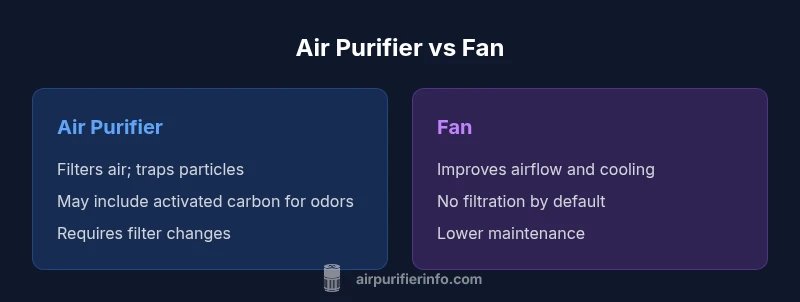
Is an air purifier the same as a fan? No. An air purifier actively cleans indoor air by pulling air through filters (often a HEPA stage) to capture dust, pollen, and pet dander, sometimes with activated carbon for odors. A fan moves air to improve comfort but does not measurably reduce particle levels. For air quality, purifier ≠ fan, though both can affect comfort.
What they do and how they differ
Air purifiers and room fans both influence indoor comfort, but they serve different core purposes. According to Air Purifier Info, an air purifier is designed to improve indoor air quality by filtering out fine particles, while a fan is primarily a device to move air for cooling and ventilation. The difference matters when you consider health goals versus comfort goals in homes with dust, allergies, pets, or cooking odors. In practice, you will notice that purifiers target particles such as dust, pollen, and dander, whereas fans affect airflow and temperature without directly reducing pollutant levels. That distinction helps homeowners decide whether their priorities include cleaner air or simply a cooler room.
How air purifiers work: filtration, CADR, and features
Air purifiers pull room air through filters to trap particles and, in many models, use activated carbon to absorb odors. Key terms to know include CADR (Clean Air Delivery Rate), which estimates how much clean air a purifier can deliver per hour for smoke, dust, and pollen. HEPA filters capture particles as small as 0.3 microns with high efficiency, while pre-filters extend the life of the main filter. Some purifiers also offer multiple speeds, timers, and quiet modes, but ozone-producing models should be avoided due to health concerns. Consider filter lifetime, replacement costs, and energy use when assessing long-term value.
How fans work: airflow, speed, and limitations
Fans operate by moving air with blades powered by a motor. The primary benefits are improved ventilation, evaporative cooling, and helping stale air circulate. Air movement can make a room feel cooler, which can indirectly influence perceived air quality, but fans do not remove most pollutants from the air. Higher fan speeds increase air turnover and noise, and in some rooms, circulating polluted air or odors without filtration can be irritating to allergy sufferers. When comfort is the sole goal, a fan is often sufficient; when air quality matters, filtration is needed.
Key metrics to compare when evaluating purifiers vs fans
To compare devices meaningfully, focus on several criteria: pollutant removal capability (CADR and filter options for purifiers), coverage area (room size), energy use (kWh or annual cost), noise levels (dB), odor removal (activated carbon vs none), maintenance (filter replacements vs cleaning), and price/value. Purifiers excel at cleaning air in bedrooms and living rooms with dust or pet dander, while fans excel at temporary cooling and air movement in warmer months. The best approach depends on your priorities and the room’s conditions.
Real-world scenarios: allergies, odors, pet dander, mold
In homes with allergies or asthma, air purifiers with HEPA filters can reduce airborne particulates that trigger symptoms, making purifiers a strong IAQ ally. For cooking odors or smoky environments, purifiers with activated carbon help absorb smells, while fans may help disperse air but won’t remove the source. Pet owners may notice cleaner air when a purifier runs continuously, while a fan alone offers little improvement in particle counts. In basements or mold-prone areas, purifiers that handle mold spores can contribute to a healthier environment, but proper moisture control remains essential.
Maintenance, costs, and lifecycle considerations
Air purifiers require ongoing filter replacements and occasional cleaning, which adds to total cost of ownership. Fans generally require less maintenance beyond cleaning blades and ensuring bearings run smoothly. Over the long term, a purifier may incur higher upfront and ongoing costs but can deliver substantial air quality benefits, especially in households with allergies, kids, or pets. When budgeting, consider not only initial purchase price but filter costs, energy consumption, and the frequency of filter changes.
Practical buying guidance: matching rooms to devices
For bedrooms and living areas with noticeable dust, pollen, or pet dander, a purifier is usually the better option for improving IAQ. In rooms where cooling or quick air movement is the priority, a fan can provide relief without requiring ongoing filter costs. Some households opt to use both: a purifier running to clean air while a fan provides cooling on hot days. The best decision depends on room size, occupant sensitivity, and whether odor control, humidity, or moisture reduction is needed.
Comparison
| Feature | Air Purifier | Fan |
|---|---|---|
| Main purpose | Filtration and air cleaning | Air circulation for comfort and cooling |
| Pollutant removal capability | High for particulates and odors (with carbon) | Low for pollutants (primarily distributes air) |
| Filtration vs airflow | Filtration-first design with filters | Airflow-first design with blades |
| Energy use | Moderate to high depending on CADR/filters | Low to moderate depending on speed; energy-efficient models exist |
| Noise | Can be quiet at low settings; higher CADR increases noise | Noise correlates with speed; typically lower baseline |
| Odor removal | Activated carbon filters help odors | Minimal odor removal; odors may be redistributed |
| Maintenance | Filter replacement and cleaning | Minimal maintenance (blade cleaning) |
| Price range | Moderate to high ($60-$500) | Low to moderate ($20-$200) |
| Best for | Air quality improvement for dust, allergies, pets | Cooling and comfort in warm rooms |
What's Good
- Clarifies the difference between air quality devices and cooling devices
- Purifiers significantly reduce particulate matter for sensitive individuals
- Fans provide immediate comfort and cooling with simple operation
- Both can be used in tandem for combined IAQ and comfort benefits
- Low barrier to entry for fans and many purifiers suited for apartments
What's Bad
- Purifiers require ongoing filter replacements and maintenance costs
- Fans do not remove pollutants and can circulate dust if used alone
- Purifiers may be noisy at higher CADR settings and require space
- Relying on a fan for IAQ without filtration may leave pollutants in the room
Air purifiers are generally the better choice for improving indoor air quality; fans excel at immediate comfort and cooling.
If air quality is your priority, choose a purifier with appropriate CADR and filters. If you mainly need cooling, a fan suffices. For balanced needs, use both strategically.
Questions & Answers
Is a purifier necessary if I already use a fan for cooling?
Not necessarily. A fan improves comfort by moving air, but it does not remove most airborne pollutants. If you have allergies or dust, a purifier offers meaningful air quality benefits.
Not always. A fan makes you cooler by moving air, but a purifier removes pollutants you breathe. If allergies are a concern, a purifier adds real air quality benefits.
Can a fan help reduce odors in a room?
Fans can disperse odors by circulating air, but they do not remove odors. Purifiers with activated carbon filters are needed to absorb smells effectively.
A fan may spread odors around, but it won't remove them. Use an odor-absorbing purifier for real reduction.
Will a purifier cool my room?
No. Purifiers do not provide meaningful cooling. They clean air while you may use a separate cooling device if needed.
Purifiers clean air, they don't cool rooms. For cooling, rely on a fan or air conditioner.
How do I size a purifier for a room?
Choose a purifier rated for your room size and look for a CADR that suits the air turnover you want. A higher ACH (air changes per hour) capacity means faster air cleaning.
Check the purifier's CADR and ensure it’s appropriate for your room size; higher air changes per hour means quicker cleaning.
How often should I replace purifier filters?
Most purifiers require filter changes every several months to a year, depending on use and air quality. A filter indicator helps; follow the manufacturer’s guidance.
Filters typically need replacement every few months to about a year, depending on use. Check the indicator and follow the instruction manual.
Are air purifiers safe for households with kids and pets?
Yes, when choosing ozone-free models and following usage guidelines. Clean air can benefit households with children and pets, though placement matters to avoid tampering.
Generally safe for families with kids and pets, just pick ozone-free models and place them where children can’t reach them.
Main Points
- Purifiers filter air; fans move air
- CADR and filter type matter for purification
- Use a purifier for IAQ, a fan for comfort
- Consider room size, noise, and ongoing costs
- In some homes, combining both devices works best