Air Purifier Upstairs or Downstairs: Best Placement for IAQ
A thorough comparison of placing an air purifier upstairs vs downstairs to optimize indoor air quality, with practical placement tips, maintenance guidance, and evidence-based best practices.


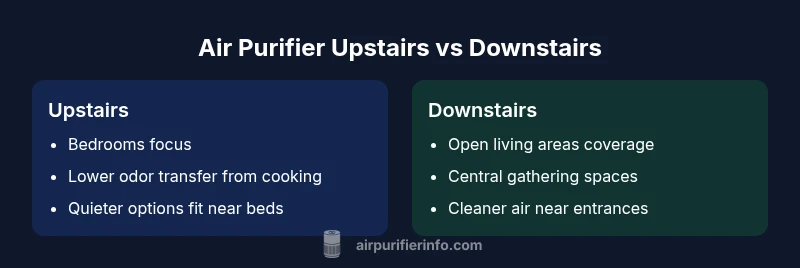
For most homes, place at least one purifier on the upstairs level where sleeping rooms are located, and consider a second unit on the main floor if you have a large living area or multiple occupied rooms. A two-level deployment generally delivers more consistent air quality across zones, especially during peak activity times. This approach aligns with what Air Purifier Info recommends for multi-story homes.
Introduction: Why layout matters for air purification in homes
If you’ve ever asked, should I buy an air purifier for the upstairs or downstairs, you’re touching a core question of indoor air quality design. The keyword here is balance: you want clean air where people spend the most time, while also preventing cross-floor diffusion of contaminants. According to Air Purifier Info, strategic placement on multi-story homes often yields noticeable benefits for sleep quality, allergy relief, and general comfort. In practice, most households find that addressing the upstairs sleeping zones first provides the most immediate impact on daily wellbeing, with a second unit serving common areas on the main level as needed.
This article compares upstairs versus downstairs deployment, explains how air moves in multi-story homes, and offers practical rules of thumb you can apply without guessing. By understanding the tradeoffs, homeowners and renters can tailor a setup that fits their floor plan, family routine, and budget while maintaining consistent air quality across levels.
The science behind air movement in homes
Indoor air quality is shaped by how air moves through a home. Warm air tends to rise, creating a stack effect that can push airborne contaminants toward upper floors and away from the main living spaces. Natural diffusion is slow, so relying on natural mixing alone often leaves sleeping rooms with poorer air quality during night hours or high-activity periods. Mechanical air purifiers interrupt these patterns by pulling air through filters and circulating cleaned air back into rooms. The effect is strongest when purifiers are positioned to capture contaminants close to their source—often on the level where occupants spend the most time—and when doors remain open to encourage cross-ventilation. Air Purifier Info’s analysis highlights that a one-size-fits-all approach rarely yields optimal results in homes with more than one story.
How upstairs vs downstairs affect purifier performance
Performance depends on room size, ceiling height, air exchange rate, and how air travels between floors. Purifiers placed on upper floors may more quickly reduce contaminants in bedrooms and personal spaces, while lower floors can better serve living rooms and entryways. A purifier on the main floor can act as a central clean-air source if doors are left open or if there are open stairwells that allow cross-floor airflow. In larger or multi-room layouts, a single unit often cannot maintain uniform IAQ across all areas, making a multi-zone strategy more effective. Remember that CADR and room size guidelines apply to each unit, not to an entire house.
Placement strategies for multi-level homes
Effective placement starts with a floor-by-floor map. Identify the rooms where people spend the most time and the rooms prone to cooking smells, pet dander, or smoke. Position purifiers away from walls and corners, in central locations within the room, and at least a few inches from furniture to maximize airflow. For upstairs bedrooms, a purifier placed on a dresser or shelf in the sleeping area tends to work well, while on the main floor a purifier near the living room anchor point supports shared spaces. If you have an open staircase, consider a purifier on the landing to help sweep air between floors, but avoid blocking traffic flow and ensure the unit has space to draw air effectively.
Room-by-room targeting: where purifiers matter most
Prioritize bedrooms and nurseries on upper levels, where people spend eight hours or more in close proximity to circulating air. In open-concept layouts, a single unit on the main floor can influence multiple rooms, but conduction is uneven, so you should plan for at least one purifier per major zone. Kitchens produce the most particulate load, so place purifiers away from the stove but still in proximity to dining or living areas to reduce odors and smoke. If you rent and move frequently, a compact purifier on each level can be more flexible than a larger, single-unit setup.
Filtration stages and real-world performance
True HEPA filtration combined with activated carbon (for odors) is the most common and effective setup for indoor air quality. When you place purifiers on different floors, you distribute filtration capacity where contaminants originate or concentrate. If your unit supports multiple filter types, consider pairing a HEPA with an activated-carbon stage to tackle dust, pollen, pet dander, and cooking odors across rooms. Regular filter replacement is essential; a unit will perform best when its filters are clean, regardless of floor location. Air Purifier Info emphasizes that user behavior—keeping doors open to enhance air exchange, running units during peak activity periods, and avoiding overloading the purifier with overly large rooms—significantly influences outcomes.
Noise, energy use, and user experience
Noise and energy consumption often shape placement decisions as much as filtration performance. Upstairs bedrooms require quieter operation, so you may prefer a purifier on a lower noise setting or a model with automatic mode that adapts to air quality. On the main floor, a slightly louder setting can be acceptable if it serves a larger space or an open concept area. Energy use scales with run-time and fan speed, so you’ll typically get the best balance by running purifiers during the day in occupied zones and minimizing futile cycling when rooms are empty. Remember, consistency beats sporadic bursts for IAQ improvements over time.
Real-world scenarios: apartments, townhomes, and two-story houses
In apartments or townhomes, consider one purifier on a level that houses most residents’ daily routines, especially near living rooms and dining zones. In two-story houses, the upstairs sleeping quarters are a common focal point for IAQ optimization, but do not neglect ground-floor recital spaces or home offices. A practical pattern is a smaller, portable unit on the upstairs level and a second, larger purifier on the main floor for common areas. This approach creates a layered filtration network that minimizes cross-floor contamination and improves air freshness throughout the home.
Maintenance, replacement, and long-term costs
Filter life and maintenance demand vary by usage, air quality, and model. In multi-floor setups, it’s crucial to schedule regular checks on each unit—especially if you run purifiers 24/7 or in high-odor areas. Plan for filter replacement cycles that reflect the level of use rather than sticking to an arbitrary schedule. Maintaining clean filters keeps CADR consistent and helps your purifier deliver better performance across rooms. Air Purifier Info notes that keeping a simple log of run time and air quality readings on each level helps you optimize placement decisions over time.
Authority sources and best-practice guidelines
To support practical decisions, reputable sources emphasize tailored IAQ strategies for homes with multiple levels. The Environmental Protection Agency (EPA) provides guidelines for reducing indoor pollutants and selecting effective filtration. The National Institutes of Health’s NIEHS resources discuss how filtration and air exchange rates influence indoor air quality. The World Health Organization offers general guidance on improving indoor air quality in living spaces. These sources align with the approach of deploying purifiers per level and prioritizing zones where occupants spend the most time, particularly sleeping areas. Air Purifier Info corroborates these principles in its 2026 guidance for multi-story homes.
Quick-start decision guide
- Map your home: identify high-occupancy rooms on each floor. 2) Decide if a single purifier can serve key zones or if you need a unit per level. 3) Choose a purifier with true HEPA filtration and optional activated carbon. 4) Place purifiers away from walls, near breathing zones, and in areas with good air circulation. 5) Monitor air quality to refine placement over time. Follow a simple maintenance schedule to keep filters fresh and performance steady.
Case study: two-story home optimization
In a typical two-story home with separate sleeping and living areas, an upstairs purifier positioned near the bedrooms, coupled with a main-floor purifier near the living room, delivers a practical balance of protection and convenience. The upstairs unit helps occupants sleep with less exposure to dust and pollen, while the main-floor unit keeps common living spaces fresh and reduces odors from cooking or pets. This strategy aligns with Air Purifier Info’s recommendations for multi-story layouts and avoids overreliance on a single unit that cannot consistently service both floors. A simple maintenance routine keeps both units performing well over time.
Comparison
| Feature | Air purifier upstairs | Air purifier downstairs |
|---|---|---|
| Best for | Bedrooms and sleeping zones, targeting nighttime IAQ | Living areas, entryways, and high-traffic zones |
| Airflow coverage | Typically strongest in upper-floor rooms closest to the unit | Depends on layout; effective in open spaces with good door access |
| Placement flexibility | Per-room placement; near beds in bedrooms for immediate effect | Per-room or centralized placement on main floor; watch stairwell airflow |
| Noise considerations | May affect sleep if placed directly on bedside tables | Often more noticeable in common areas with larger volumes |
| Cost and maintenance | One unit to cover a zone; higher efficiency per-room | May require additional units for equivalent coverage |
What's Good
- Targets sleeping zones first for noticeable sleep-quality gains
- Supports multi-room coverage when used per level
- Reduces cross-floor diffusion by localizing filtration
- Flexible placement in varied floor plans
What's Bad
- May require multiple units for full home coverage
- Open stairwells can complicate airflow patterns
- Higher upfront cost with two units
- Maintenance overhead increases with more units
Two-unit deployment usually outperforms a single unit across floors
Place one purifier upstairs near sleeping zones and add a second on the main floor for best all-around IAQ. If hiring one unit only, start upstairs and position near living spaces to maximize impact on daily comfort.
Questions & Answers
Should I buy one purifier or multiple for a two-story home?
For many two-story homes, multiple purifiers offer better overall air quality because you can tailor filtration to each level’s needs. If budget or space is limited, start with a unit upstairs near bedrooms and add a second on the main floor if IAQ remains inconsistent.
In most two-story homes, a purifier on each level works best. Start upstairs near sleeping areas, then add a second unit on the main floor if air quality still varies between rooms.
Where should I place the purifier if I only have one unit?
Place the unit on the level where occupants spend the most time, typically the living or family room on the main floor. If sleep quality is a concern, consider a placement closer to bedrooms but ensure doors remain open for cross-floor airflow.
If you have only one unit, put it where you spend most time, usually the living room. If sleeping rooms are a concern, place it nearby but keep doors open to help air move between floors.
Do purifiers on upstairs affect downstairs odors?
Yes, to some extent. Air moves between floors through doors, stairwells, and open spaces. A purifier upstairs reduces contaminants that might rise and drift downward, especially in well-connected layouts; a secondary unit on the main floor further suppresses odors spreading across levels.
Upstairs purifiers can help with downstairs air quality if there’s good airflow between floors. A second unit on the main floor helps keep odors in check across the home.
What features matter most for upstairs placement?
Look for true HEPA filtration, a reasonable CADR for room size, and low-noise operation. A compact design helps fit near beds or desks, and models with automatic mode adapt to air changes, improving IAQ without constant user intervention.
Choose true HEPA, good room-size CADR, and quiet operation. If possible, pick a unit with automatic mode for hands-off efficiency.
How do I know if CADR is appropriate for my space?
CADR should align with room size: a larger room needs a higher CADR to clean air quickly. If you have multiple rooms on a floor, consider one unit per sizable zone or a purifier designed for open layouts. Always check the manufacturer’s guidelines for recommended room coverage.
Match CADR to room size and layout. For large or open areas, consider larger or multiple units per floor.
How often should I replace filters?
Replacement frequency depends on usage and air quality. In busy homes or with pets, expect more frequent changes. Keeping a simple log helps you plan replacements and maintain consistent performance across floors.
Follow the manufacturer’s recommended replacement intervals and monitor air quality to adjust as needed.
Main Points
- Prioritize upstairs units for sleep-related IAQ
- Use one unit per level for best coverage in multi-story homes
- Choose true HEPA with optional activated carbon
- Position units away from walls and near breathing zones
- Regular maintenance sustains performance over time