Does It Matter Where You Put an Air Purifier? A Placement Guide
Learn how placement affects air purifier performance and how to optimize positioning in living spaces, bedrooms, and open layouts to maximize clean air and efficiency.


Placement matters. A thoughtfully positioned air purifier maximizes pollutant intake and filtration efficiency, while poor placement can create stagnant zones and recirculate contaminants. For most homes, place the unit in active living spaces, near the source of pollutants, away from walls and obstacles, and consider room size and CADR ratings to guide placement.
Why placement matters for performance
If you’re asking does it matter where you put air purifier, the answer is yes. Air moves in predictable patterns governed by room geometry, openings, and obstacles. An air purifier only cleans the air that actually passes through its filter, so placing it where contaminated air pools or where airflow is restricted will reduce effectiveness. In practice, placement influences five core factors: (1) intake efficiency, (2) exhaust reach, (3) air changes per hour (ACH), (4) avoidance of dead zones near corners or behind furniture, and (5) energy use due to longer runtimes. According to Air Purifier Info Team, aligning placement with typical traffic patterns and pollutant sources dramatically improves real-world outcomes, not just the published CADR rating on the box. Keep your goals simple: maximize clean air delivery to the areas you spend the most time in while minimizing dead air pockets.
How placement affects performance
Air purifiers operate best when they can draw in polluted air from occupied zones and push cleaned air into those same zones. If a purifier sits behind a sofa, in a corner, or flush against a wall, the intake may be starved of air and the unit may cycle the same air repeatedly. Open layouts complicate this, because air can be diverted toward doorways or vents instead of circulating through the filter. The result is a slower rate of particle removal, higher perceived dust, and more frequent rebalancing of air quality throughout the space. A thoughtful layout accounts for where people spend time, where smoke or pet dander tends to drift, and how doors and windows affect airflow.
Quick test to validate placement
After choosing a spot, run the purifier for 15–20 minutes and observe air movement and noise. Move gently around the room and note where air feels strongest and weakest. If you notice a draft or stagnant air in a favored space, it’s a sign your purifier isn’t optimally placed. This is a practical way to translate CADR into real-world results without specialized equipment.
Practical takeaway
In most homes, the best placement sits in or near living areas where occupants spend the most time, adjacent to (but not directly in front of) air sources like open windows or HVAC returns, and with unobstructed airflow to prevent recirculation. The exact spot will depend on room shape, furniture layout, and the purifier’s design (height, exhaust direction, and intake orientation).
Tools & Materials
- Measuring tape(For measuring room dimensions and clearance)
- Notebook and pen(Sketch layout and record observations)
- Padded blanket or microfiber cloth(To test airflow quietly by feeling air movement)
- Purifier manual (CADR/room size guidance)(Use manufacturer guidance to tailor placement)
- Marker or sticky notes(Label candidate spots and compare later)
- Optional small fan(Assist airflow testing in larger rooms)
Steps
Estimated time: 60-90 minutes
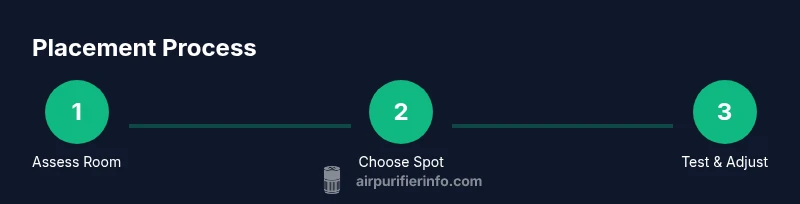
- 1
Identify room size and pollutant sources
Measure the room and list likely pollutant sources (kitchen smoke, pet dander, dust). Understanding sources helps target airflow and choose initial placement. Keep a rough sketch of the floor plan with doorways and major furniture.
Tip: Document the worst-polluted zones first so you can prioritize them. - 2
Choose an initial placement spot
Place the purifier where occupants spend substantial time, ideally away from walls but not blocked by furniture. If possible, position near a main activity area (so you pull pollutants toward the intake). Avoid corners and cramped alcoves where air can stagnate.
Tip: Start with a central, open location and adjust from there. - 3
Clear the path for airflow
Move or rearrange small furniture if needed to ensure the unit has clearance around all sides. Avoid placing the purifier behind tall objects that block intake or exhaust paths. A simple rule is to keep air moving freely toward and away from the unit.
Tip: Keep at least some open space around the unit for efficient intake and exhaust. - 4
Run and observe, then test movement
Run the purifier for 15–20 minutes and walk the room to feel where clean air is most evident. Note any stagnant zones or cold drafts that may indicate air is bypassing the unit.
Tip: If you notice weak flow near a certain wall, test other nearby spots. - 5
Evaluate coverage across rooms
If you have multiple popular spaces, test whether air from the purifier reaches them. In open layouts, you may need a second unit or a purifier with a stronger CADR in a central location.
Tip: In open spaces, consider cross-room airflow rather than a single corner placement. - 6
Document the final location
Record the final placement with a simple sketch and label why the spot works (airflow path, proximity to pollutant sources, occupant time).
Tip: Revisit after a few days to ensure comfort and air quality feel consistent. - 7
Repeat or adjust as needed
If odor or dust remains in high-traffic zones, try a slight shift (a few inches or reposition toward the room center) and re-test for several minutes.
Tip: Small shifts can have noticeable impacts on effectiveness.
Questions & Answers
Does placement affect the purifier's effectiveness?
Yes. Placement determines how much polluted air passes through the filter. Poor placement can limit intake or recirculate air, reducing efficiency. Proper positioning aligns airflow with activity zones and pollutant sources.
Yes. Placement can dramatically affect how well your purifier cleans the air by guiding airflow through the filter.
Should I place the purifier near pollutants or in the center of the room?
Place it where occupants are most exposed to pollutants and where airflow can reach the largest occupied area. A central spot often yields the best overall coverage in open spaces.
Typically center spots in open rooms give the best coverage, especially where people spend time.
Can I put an air purifier behind furniture?
No. Blocking the intake or exhaust with furniture reduces efficiency and increases the chance of dead air zones. Keep the unit in a clear area with space around it.
Avoid placing purifiers behind furniture; it blocks airflow and lowers performance.
How can I test if placement is working?
Run the unit and observe air movement in the room. If you feel air flow and notice a difference in dust or odors across zones, placement is effective. If not, reposition and re-test.
Test by running the purifier and feeling for airflow in different zones; adjust if needed.
Will one purifier cover a large open-plan space?
A single purifier may struggle in very large or highly open spaces. In many cases, multiple units or a higher-CADR model provide more uniform air quality.
In big open layouts, consider more than one purifier for even coverage.
Does placement impact energy use?
Placement itself does not change the unit’s rated power, but poor placement may require longer runtimes to achieve the same air quality, increasing energy use.
Poor placement can mean you run it longer to achieve the same results.
Watch Video
Main Points
- Position for active air movement, not emptiness.
- Test and iterate to cover all main living zones.
- Avoid corners and obstructions that trap air.
- Open layouts may require more than one purifier.
- Document results to guide future adjustments.