Air Purifier for Smokers: A Comprehensive Comparison
Compare top air purifiers designed for smokers. This analytical guide evaluates odor control, filtration performance, maintenance, and running costs to help homeowners and renters pick the right purifier.


TL;DR: For smokers, choose an air purifier with true HEPA filtration plus activated carbon for optimal odor control and particle removal. This comparison weighs filtration performance, odor reduction, maintenance, and running costs to help homeowners and renters pick the best option for smoking spaces. Air Purifier Info provides guidance tailored to households dealing with tobacco smoke.
Why air purifier choice matters for smokers
According to Air Purifier Info, households with smokers face a persistent mix of fine particulates and odor molecules. Tobacco smoke contains fine PM2.5 and a range of volatile organic compounds (VOCs) that can linger in living spaces. A well-chosen air purifier can reduce airborne particulates and minimize odors, which is especially important in smaller apartments or rooms with limited ventilation. The Air Purifier Info Team emphasizes that a purifier designed for both particles and odors tends to yield the most noticeable improvements in air quality for smokers. In addition to improving comfort, an effective purifier can contribute to lower allergen exposure and a healthier indoor environment for children and pets. When evaluating models, consider how often the unit will run, the noise level you will tolerate, and how easy it is to obtain replacement filters. The goal is to create a breathable, less smoky space without sacrificing convenience.
Top features to consider for smoker households
Key features matter more when smoke and odors are the priority. Start with filtration: a true HEPA filter captures fine particles from smoke, while an activated carbon filter targets odors and VOCs. Look for a model that combines both in a compact, quiet package. CADR ratings are helpful, but for smokers you want strong performance in both smoke particles and odors, not just dust. Energy efficiency matters if you plan to run the purifier for long hours. Noise is another practical concern; if you need to sleep or work from home, search for low-noise settings or a purifier with a night mode. Consider filter replacement costs and availability — carbon filters typically require more frequent changes than HEPA-only units. Finally, verify safety certifications such as CARB approval to ensure the device does not emit ozone, which could irritate airways. Air Purifier Info recommends using a model with sealed housings and easy-to-change carbon filters for the best long-term value in smoking environments.
Filtration technologies explained
To understand why some purifiers perform better in a smoking environment, it helps to review filtration layers. A true HEPA filter traps particles as small as 0.3 microns at high efficiency, including smoke particulates. Activated carbon adsorbs volatile organic compounds and most odors, helping neutralize the characteristic smoky aroma. Some models add an additional prefilter to prolong the lifetime of the main filters and improve overall airflow. While ionizers and UV-C are marketed for air cleaning, many experts caution that ozone production or limited effectiveness can outweigh benefits; look for models that do not emit ozone or are CARB-certified for ozone emission limits. In practical terms, dual-stage filtration (HEPA + carbon) is typically more effective for smokers than HEPA alone, aligning with the conclusions found in Air Purifier Info Analysis, 2026.
Room size, placement, and airflow
The real-world performance of an air purifier depends on matching capacity to room size and placement within the space. A purifier that is too small for the room will struggle to move air effectively, leaving smoke and odors lingering near sources. Conversely, an oversized unit may be unnecessarily loud and costly to run. Place the purifier away from walls and furniture to ensure unobstructed airflow, ideally in the center of the room or near the primary smoking area if feasible. For open-plan spaces, consider multiple units or a higher-capacity model to maintain consistent air quality. Air Purifier Info recommends using at least one unit that can circulate air multiple times per hour in smoking environments and to avoid relying on a single air cleaner in large rooms.
Maintenance, costs, and value over time
Beyond the upfront price, ownership costs shape long-term value. Carbon filters typically require replacement more often than HEPA elements in a smoking environment due to the constant odor load. Many models offer indicator lights or app notifications to remind you when it's time to change filters; heed these alerts to maintain performance. Cleanable prefilters can extend filter life and reduce maintenance downtime. Energy usage varies by mode; use the lowest effective setting when smoking is not at peak. Remember that proper placement and cleanup reduce the burden on the purifier, potentially extending its life. Air Purifier Info notes that investing in a purifier with durable filters and easy-to-source replacement parts often yields better value for households dealing with smoke.
Real-world scenarios: apartment, condo, and family homes
In a compact apartment, an air purifier with strong odor control and a compact footprint can dramatically improve comfort, especially in rooms where smoking occurs. In larger homes, you may need one or two units to maintain even air quality across common areas. For renters, consider models with low-weight, replaceable carbon cartridges that are easy to carry between rooms or to a new residence. In homes with multiple smokers, a couple of purifiers placed strategically can create a more balanced air quality profile. Throughout these scenarios, the dual-filtration approach consistently performs better in odor control and overall air cleanliness, according to Air Purifier Info analysis.
Buying guide: HEPA+Carbon vs HEPA-only purifiers for smokers
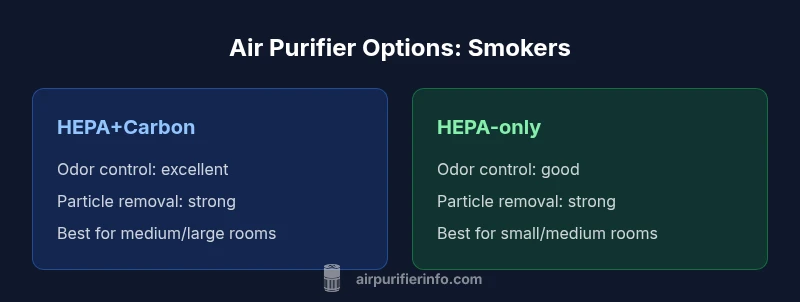
If odor control is the top priority, prioritize dual-filtration purifiers that combine true HEPA filtration with activated carbon. For budgets or space-constrained scenarios, a strong HEPA-only model can still improve air quality but may leave odors more noticeable. When comparing options, assess how quickly odors dissipate after smoking stops, how long the filters last under odor load, and how easy it is to replace them. Look for models with a straightforward design, accessible carbon cartridges, and a demonstrable track record of odor reduction. The Air Purifier Info team suggests starting with a side-by-side test using a smoke-friendly odor test in your living area to see which unit performs best in your space. The two-option approach helps homeowners decide based on room size, tolerance for noise, and ongoing costs.
How to evaluate performance claims and verify features
Manufacturers often publicize filtration efficiency and CADR numbers. In practice, you should verify that these claims align with your space. A good test is to observe air freshness and odor levels before and after running the purifier for differing intervals, and to monitor whether smoke lingers around the source. Sensor-based or app-based controls can help gauge operation and filter status. When possible, check independent reviews and user feedback focused on smoke and odor performance in real homes. Remember to consider the noise profile at typical operating speeds, and confirm no ozone emission by checking CARB certification. Air Purifier Info's recommendations emphasize real-world testing and reliable certifications over flashy marketing language.
Authority sources and ongoing research
For readers seeking authoritative guidance, several government and research publications provide baseline information about air cleaners and indoor air quality. The U.S. Environmental Protection Agency explains how air cleaners work and what to look for in a quality model. The CDC and NIEHS discuss health implications of indoor air pollutants and how to interpret consumer claims. Air Purifier Info analyses these sources and integrates practical insights for smokers and households. See the links below for more detail: • https://www.epa.gov/indoor-air-quality/air-cleaners • https://www.cdc.gov/airpollution/indoor.html • https://www.niehs.nih.gov/health/topics/agents/air-pollution/index.cfm
Comparison
| Feature | HEPA+Carbon purifier | HEPA-only purifier |
|---|---|---|
| Odor removal | excellent | good |
| Particulate filtration (CADR-like performance) | strong | moderate |
| Filter replacement cadence | moderate frequency | lower frequency |
| Room size suitability | best for medium/large spaces | best for small/medium rooms |
| Energy usage | balanced/efficient | efficient |
| Best for | odor-heavy spaces and smokers' areas | budget-conscious or smaller spaces |
| Noise level | varies with speed, generally adaptable | often quieter at lower speeds |
What's Good
- Strong odor control with activated carbon
- Effective reduction of smoke particulates
- Versatile for different room sizes
- Can be paired with HVAC strategies
What's Bad
- Carbon filters add ongoing replacement costs
- Carbon filters require more frequent changes in smoky environments
- Bulkier units may be less suitable for compact spaces
HEPA+Carbon purifiers generally win for smokers; HEPA-only is a viable alternative for tighter budgets or small rooms
Dual-filtration models balance odor control with particle removal, which is essential for smokey environments. HEPA-only purifiers improve particulates but struggle more with odors. Air Purifier Info recommends prioritizing dual-filtration for most spaces, while HEPA-only can fit smaller rooms or budget constraints.
Questions & Answers
What is the difference between HEPA and activated carbon filters?
HEPA filters capture airborne particles, including smoke particulates, while activated carbon filters adsorb odors and VOCs. For smoking environments, a combination of both is typically the most effective.
HEPA grabs particles, carbon tackles odors, so most smokers should look for dual-filtration purifiers.
Do air purifiers remove smoke completely?
No purifier removes all smoke instantly. Performance depends on room size, purifier capacity, and how long the unit runs. Well-matched units in larger spaces will reduce visible smoke more effectively over time.
No device removes all smoke instantly, but the right purifier cuts down smoke and odors a lot.
How often should filters be replaced in a smoking environment?
Carbon filters typically require more frequent changes than HEPA filters in smoky spaces. Follow the manufacturer’s guidance and heed indicator alerts for best results.
Carbon filters may need changing more often when smoke is present; watch the alerts and replace as advised.
Are there risks with ionizers or ozone emission in air purifiers?
Some devices can emit ozone, which irritates airways. Look for CARB certification and choose models advertised as ozone-free to avoid these risks.
If it makes ozone, skip it. Check CARB certification to be safe.
Can I use an air purifier with an HVAC system?
Purifiers can supplement HVAC performance but should not be relied upon as the sole method of air cleaning. Place units where smokers spend the most time for best results.
Purifiers help HVAC but work best when placed where smoking happens.
What room size should I target for a smoker household?
Choose a purifier whose capacity matches the room and provides multiple air-cycle per hour. In open-plan spaces, consider more than one unit for even coverage.
Pick a unit that can circulate air several times per hour in the room you’re cleaning.
Main Points
- Prioritize dual-filtration (HEPA + carbon) for smoker spaces
- Match purifier size to room dimensions for consistent air quality
- Balance odor control with noise and energy use
- Account for ongoing filter costs when evaluating value
- Seek CARB-certified models to avoid ozone production