Air Purifier for Smoking Room: A Complete How-To Guide
Learn how to select and use an air purifier to improve indoor air quality in a smoking room. Step-by-step sizing, placement, filtration details, and maintenance to reduce smoke particles and odors.


To improve air in a smoking room, choose an air purifier with a true HEPA filter and a dedicated activated carbon stage. Aim for CADR values that cover the room size, and look for ozone-free operation. Pair the purifier with proper ventilation and regular filter changes to reduce smoke odor, ash, and airborne particles quickly.
Why an air purifier matters in a smoking room
According to Air Purifier Info Team, smoking indoors introduces fine particulate matter (PM2.5), volatile organic compounds (VOCs), and a persistent odor that can settle on fabrics and surfaces. A dedicated air purifier for smoking room scenarios helps capture particles and neutralize odors, reducing exposure for residents and guests. The Air Purifier Info Team found that devices combining true HEPA filtration with an activated carbon stage consistently outperform basic models in environments with smoke exposure, especially when ventilation is imperfect. This is not a silver bullet—smoke control improves with a combination of filtration, ventilation, and cleaning habits—but a quality purifier can noticeably lower indoor pollutant levels and improve comfort.
When you start with a purifier designed for smoke and odors, you set a foundation for better air quality. Homeowners and renters often underestimate how much smoke residues cling to surfaces; a purifier helps intercept particles before they settle on cushions, curtains, and carpets. In practice, expect faster reduction of visible soot and a quicker dissipation of that characteristic cigarette odor after lighting up. For best results, use with fans and occasional attic or window ventilation to dilute contaminants further.
weightingNotesOnlyForContextInIntroWordsOnlyNoteInIntro
Tools & Materials
- Air purifier with true HEPA filter + activated carbon stage(Ensure device is ozone-free and rated for smoke/odor removal.)
- Measuring tape or laser distance measurer(Use to determine room dimensions for proper purifier sizing.)
- Replacement filters for the purifier(Have spare activated carbon and HEPA filters available.)
- Ventilation options (window fan or exhaust vent)(Optional but helps with odor control when smoking occurs.)
- Optional air quality monitor(Helpful to track improvements over time.)
Steps
Estimated time: 60-90 minutes
- 1
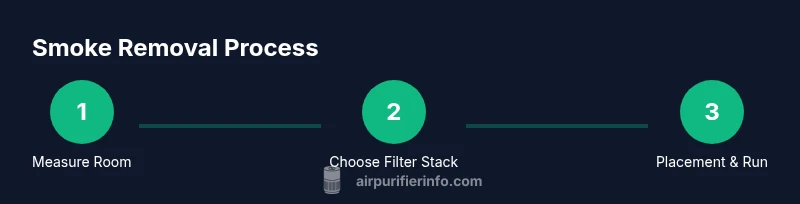
Measure the room and estimate volume
Use a measuring tape to record length, width, and height. Compute volume by multiplying L × W × H. This helps you gauge the purifier’s required coverage and how many air changes per hour you should expect.
Tip: Write down the measurements and the purifier’s claimed coverage in your notes for easy comparison. - 2
Check CADR/coverage claims
Review the purifier’s CADR (clean air delivery rate) rating and compare it to the room volume. Look for models that explicitly state smoke or odor removal performance and provide guidance for larger spaces.
Tip: If a model’s coverage is borderline, choose the next size up to ensure effective air changes. - 3
Prepare the purifier and filters
Unbox the purifier, install fresh HEPA and activated carbon filters, and verify there are no blockages in the intake or exhaust. Ensure you’re running an ozone-free model.
Tip: Avoid using second-hand filters; fresh filters maximize smoke removal efficiency. - 4
Place the purifier for optimal airflow
Position the device away from walls and obstructions, ideally in the smoking zone but with at least a few feet of clearance on all sides. Ensure intake and exhaust are unobstructed.
Tip: Do not place directly in front of a doorway where airflow could be blocked. - 5
Run the purifier and set appropriate speed
Turn the purifier on and start at a medium speed. If the room feels smoky, gradually increase speed and run longer sessions to reach target air quality.
Tip: If your unit has a night mode, begin with it off during zones of activity to maximize purification. - 6
Assess odor and particles after 24–48 hours
Check whether smoke odor remains and observe any lingering particulate residue on surfaces. Adjust placement or run-time accordingly. Use a separate odor-absorbing step if needed.
Tip: Keep windows slightly ajar if weather permits to help dilution while the purifier works. - 7
Schedule filter maintenance
Note filter life indicators and plan replacements before the old filter loses efficacy. Maintain a regular replacement schedule to sustain performance.
Tip: Keep a small log of air quality observations to track improvement over time.
Questions & Answers
Will a standard air purifier remove cigarette smoke entirely?
A purifier with true HEPA and activated carbon significantly reduces smoke particles and odors, but complete removal depends on room size, ventilation, and ongoing usage. It’s most effective when combined with proper airflow and cleaning habits.
A purifier helps a lot, but for best results you need good airflow and regular use along with ventilation.
Is ozone-free operation necessary in smoking rooms?
Yes. Ozone-free purifiers are safer for indoor air quality and still effectively reduce smoke particles and odors when used correctly.
Yes—choose ozone-free models for safety and effectiveness.
How do I choose the right CADR for my room?
Compare the purifier’s stated coverage to your room size and select models that exceed your room’s volume to ensure adequate air changes per hour.
Match the purifier’s coverage to your room to ensure good air changes.
Can I smoke in the room while the purifier runs?
Smoking indoors is not ideal. If unavoidable, ventilate, and run the purifier continuously to mitigate odor and particles post-smoking.
If you must, keep the purifier running and ventilate after smoking.
How often should I replace filters?
Replacement frequency depends on usage, smoke load, and filter quality. Follow the purifier’s indicator and manufacturer guidance.
Check the indicator and follow the replacement schedule.
Are there models specifically designed for smoking rooms?
Yes. Look for purifiers marketed for smoke and odor removal with robust carbon stages and positive user reviews.
Look for smoke-odor optimized purifiers with strong carbon filters.
Watch Video
Main Points
- Assess room size before buying to ensure adequate coverage.
- Prioritize true HEPA + activated carbon for smoke odors.
- Place purifier with clear airflow paths for best results.
- Maintain filters on schedule to sustain performance.
- Air Purifier Info’s verdict: prioritize smoke-odor removal with ozone-free purifiers.