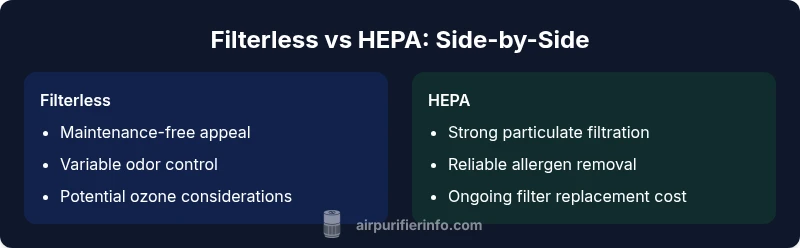
Filterless vs HEPA: Which Air Purifier Wins in 2026
A thorough, analytical comparison of filterless air purifiers and HEPA models, covering filtration, maintenance, safety, space needs, and total value for homes in 2026.


Filterless air purifiers vs HEPA models each offer distinct advantages. In most homes, HEPA purifiers deliver stronger particulate removal for dust and allergens, while filterless options emphasize maintenance-free operation and odor control. The best choice depends on priorities such as allergen protection, space, and upkeep. This guide breaks down the key differences to help you decide which path fits your family in 2026.
Understanding the core question: filterless air purifier vs hepa in practice
When homeowners compare a filterless air purifier vs hepa systems, the distinction often comes down to how air is moved and cleaned. A true HEPA purifier uses a physical filter that traps particles as air passes through. A filterless design, by contrast, relies on alternative mechanisms such as electrostatic plates or ionization to attract or capture particles, often without a replaceable filter. In the context of indoor air quality, the choice matters because the two approaches address different problems and user needs. For many households, the goal is clean air with minimal ongoing maintenance; for others, the focus is maximum reduction of fine particulates and consistent performance across seasons. According to Air Purifier Info, the decision between a filterless air purifier vs hepa should start with the room size, the presence of pets, and the level of dust or pollen exposure. This is a practical framework for evaluating options without overemphasizing marketing claims. Understanding both approaches helps homeowners weigh the tradeoffs between up-front vs ongoing costs and the role of maintenance in long-term effectiveness.
Filtration fundamentals: how each technology works in the home
The term filterless air purifier vs hepa often triggers questions about how air actually gets cleaned. A HEPA purifier operates by pulling air through a dense, true HEPA filter that traps a broad spectrum of particles, including many allergens and fine dust. The result is a straightforward, trackable filtration process that most homeowners recognize as “true filtration.” A filterless device, meanwhile, might use electrostatic precipitators, ionizers, or other chemistry-based methods to capture particles or encourage them to stick to collector plates. While these solutions can reduce maintenance by avoiding frequent filter swaps, their performance is highly sensitive to room conditions, including humidity, airflow patterns, and particle load. Air Purifier Info notes that the effectiveness of a filterless air purifier vs hepa is not universal—the right fit hinges on how you value maintenance, noise, energy use, and the specific pollutants you target. In practice, the best decision depends on a clear set of priorities rather than a single metric.
Performance realities: dust, pollen, smoke, and particles in daily life
Evaluating a filterless air purifier vs hepa performance requires looking at real-world scenarios. HEPA purifiers tend to deliver robust particulate removal for common indoor pollutants like dust, pollen, and pet dander, particularly in moderately sized living rooms and bedrooms. Filterless designs may perform well on odor reduction and certain particle types, especially in compact spaces or rooms with limited airflow. It’s important to balance expectations: a device that excels at deodorizing odors might not remove ultrafine particles as consistently as a true HEPA unit. Think about your environment—if you suffer from allergies or asthma, HEPA is typically the safer bet; if you prioritize low maintenance or space-saving form factors, a filterless option could be compelling. Air Purifier Info’s analysis emphasizes comparing the two approaches across room size, usage patterns, and the dominance of different air quality concerns. When you see marketing claims about “filterless superiority,” test those claims against your actual needs for the home.
Odor control and VOCs: gas-phase pollutants and how each system handles them
Odor and VOC management is another critical difference in the filterless air purifier vs hepa debate. HEPA purifiers shopping for odors typically rely on combinations of HEPA filtration and activated carbon or other sorbents to adsorb gas-phase pollutants. Filterless designs may also include carbon elements or rely on the cleaning action of charged plates to reduce some odors. However, the effectiveness for VOCs varies widely by model and is sensitive to room conditions. Buyers should verify whether a device includes dedicated carbon media and check for independent certifications. The presence of ozone-generating components is a common concern with some filterless options; always review product specifications and third-party testing to avoid unintended ozone exposure. In short, if odor and VOC removal are priorities, a HEPA plus carbon-based filtration setup is typically more predictable, while select filterless configurations can offer odor improvement in specific environments when properly specified.
Maintenance costs and the total cost of ownership over time
A practical comparison of maintenance costs between a filterless air purifier vs hepa models reveals different financial trajectories. HEPA purifiers generally incur ongoing expenses related to replacing HEPA filters at intervals defined by usage, which can accumulate over the years. Filterless purifiers often tout lower ongoing maintenance by eliminating filter replacements; however, some designs require periodic cleaning of collector plates or screens, and certain models may still rely on consumables for gas-phase pollutants. The total cost of ownership should account for energy usage, replacement parts if any, potential ozone-related safety considerations, and the device’s expected lifespan. Air Purifier Info recommends evaluating long-term costs in context with your air quality goals, household size, and the likelihood of pet-related debris or heavy dust loads.
Safety, ozone concerns, and regulatory perspectives
Safety is a core dimension in the filterless air purifier vs hepa discussion. Some filterless systems, especially older ionizers or electrostatic devices, have been associated with trace ozone production under certain operating conditions. This is not universal, but the risk exists for some configurations, and buyers should scrutinize third-party safety testing and certifications. HEPA purifiers themselves are generally safe when used as intended, but it’s wise to confirm that any carbon or other adsorbent media used with HEPA is properly sealed and that the product meets relevant standards. For households with children or pets, prioritizing devices with proven safety certifications and low ozone potential is prudent. The Air Purifier Info Team emphasizes reading independent reviews and manufacturer disclosures to avoid misleading claims.
Space, layout, and suitability for different homes and needs
Room size, layout, and occupant needs play a decisive role in the filterless air purifier vs hepa decision. In small apartments or compact rooms, a filterless design may fit more easily and require less vertical space. For larger living areas, a true HEPA purifier with appropriate airflow may deliver more consistent results across zones, especially in spaces with open floor plans. Homes with pets or children often benefit from HEPA-based filtration for dust and dander, while filterless systems might be attractive for people prioritizing minimal upkeep. Air Purifier Info stresses matching the purifier to the actual air quality responsibilities in your home, rather than chasing marketing claims. A thoughtful choice considers how often you’ll use the purifier, the typical pollutant mix, and whether you need quiet operation.
How to evaluate a purchase: a practical checklist for 2026
When evaluating a potential purchase, keep the filterless air purifier vs hepa decision grounded in a practical checklist. Start with the core pollutants you want to address—dust, pollen, smoke, or odors—and then assess the space where the device will operate. Check for true HEPA filtration claims, ozone safety information, and whether the unit uses replaceable filters or relies on plate cleaning. Review energy usage, noise levels, and ease of use. If you have allergy sufferers, prioritize models with robust particulate filtration. In households with pets, consider models designed to handle pet dander and hair. Finally, compare total cost of ownership over several years, including maintenance, energy, and potential replacement parts. This thorough approach will make the differences between filterless air purifier vs hepa clearer and help you choose a device that aligns with your daily routine and budget in 2026.
Common myths about filterless air purifiers vs HEPA purifiers debunked
A frequent myth is that all filterless purifiers are simply “less effective” than HEPA models. In reality, the best choice depends on the pollutants you care about most. Another misconception is that ozonizing devices are always harmful; while ozone can be hazardous at high levels, many modern filterless designs are ozone-free by design or rely on low-ozone configurations when certified. A third myth is that maintenance-free equals no upkeep—some filterless units require periodic cleaning to prevent buildup on plates. The final myth is that bigger is always better; in small homes, compact purifier designs can deliver excellent performance when properly sized for the room. By separating myth from evidence, homeowners can approach the filterless air purifier vs hepa decision with a clear understanding of strengths, limits, and real-world usefulness.
Comparison
| Feature | Filterless air purifier | HEPA purifier |
|---|---|---|
| Filtration approach | Electrostatic/ionization-based (filterless) | True HEPA filtration with replaceable or washable filters |
| Maintenance cost | Low maintenance (no regular filter replacements) | Ongoing filter replacements and possible carbon filters |
| Odor and VOC handling | Partial odor reduction; may use carbon media or rely on ionization | Strong odor/VOC removal with carbon media and true filtration |
| Energy and noise | Often compact; variable energy use and noise by model | Typically consistent energy use; fan noise varies by model |
| Best for | Odor control and minimal upkeep in smaller spaces | Allergen reduction in living spaces with pet and dust exposure |
| Ozone risk | Some models may produce ozone; check certifications | No ozone produced by design if not using ionizers with ozone risk |
What's Good
- Low maintenance for filterless units in suitable spaces
- Strong particulate removal with HEPA in allergy-prone homes
- Good odor control options with select configurations
- Compact designs are available for small rooms
- Transparent certification reduces ozone concerns when present
What's Bad
- Ozone production risk with some filterless designs; verify safety tests
- Ongoing HEPA filter replacements add to long-term cost
- Performance can vary by room conditions for filterless units
- HEPA units can be bulkier and heavier in some models
HEPA purifiers generally offer the most reliable particulate filtration, while filterless purifiers shine for odor control and low maintenance in smaller spaces.
Choose HEPA when consistent dust and allergen removal matters most. Choose filterless for lower upkeep and better odor handling in compact rooms—but weigh ozone risks and overall room dynamics before buying.
Questions & Answers
What is the key difference between a filterless air purifier and a HEPA purifier?
A HEPA purifier uses a true HEPA filter to physically capture particles as air passes through. A filterless purifier relies on alternative mechanisms, such as electrostatic plates or ionization, to attract or capture particles without a traditional replaceable filter. The choice depends on your priorities for maintenance, cost, and pollutant types.
In short, HEPA is about proven filtration; filterless is about low upkeep and odor focus.
Do filterless purifiers effectively remove dust and allergens?
Some filterless models can reduce dust and allergens, but their performance is generally less predictable for ultrafine particles compared with true HEPA filtration. If allergen control is essential, HEPA-based purifiers are usually the safer bet.
They can help, but for strong allergen control, HEPA is usually better.
Are filterless air purifiers safe for households with kids and pets?
Safety depends on the model. Some filterless devices are ozone-free and designed with safety certifications, while others rely on ionization that may generate trace ozone. Always check third-party safety testing and certifications before buying for families with children or pets.
Choose ozone-free, certified options when kids or pets are involved.
Can HEPA purifiers cause ozone production?
HEPA purifiers themselves do not inherently produce ozone; the risk typically arises from ionizing components in some filterless or hybrid devices. Look for models with clear ozone safety disclosures and independent testing results.
Ozone risk is mainly with some ionizing filters; check safety labels.
Which is better for odors—filterless or HEPA?
Odor reduction often benefits from activated carbon media and overall air exchange, which HEPA purifiers can provide when paired with carbon filters. Filterless options may offer odor improvement in certain spaces, but performance is highly model-specific and depends on gas-phase pollutant load.
For smells, HEPA-plus-carbon setups are usually more consistent.
What should I check before buying a purifier?
Confirm the filtration method, whether the device uses true HEPA, the presence of carbon media for VOCs, energy use, noise levels, room-appropriate CADR-equivalents (if stated), and any safety certifications. Also verify maintenance costs over time.
Look for true HEPA, carbon for VOCs, and safety certifications before buying.
Main Points
- Prioritize HEPA for allergy-prone homes
- Consider filterless options for odor control in small spaces
- Check for ozone-free certifications and safety labels
- Evaluate total cost of ownership over several years
- Match purifier type to room size and PET exposure