Air Purifier Buy Guide: How to Choose the Right Model
Comprehensive, beginner-friendly guide to buying an air purifier. Learn how to compare filters, CADR, room size, energy use, and maintenance costs with Air Purifier Info.


You will learn how to pick the right air purifier by matching room size to CADR, selecting the filter type, and weighing noise and running costs. Start by measuring your space, then compare models based on CADR, filter lifespan, and energy use. Air Purifier Info guides homeowners and renters toward confident, value-driven purchases.
Why air purifier buy decisions matter
Indoor air quality affects comfort, health, and daily living. Dust, pet dander, odors, and wildfire smoke can worsen allergies and asthma or simply make a space feel stuffy. For homeowners and renters, choosing the right purifier is a proactive step toward a healthier home. The Air Purifier Info team found that many shoppers underestimate room size, filter type, and maintenance costs when comparing models. A thoughtful purchase not only improves air quality but reduces ongoing costs over time. By prioritizing reliable filtration, efficient operation, and reputable safety certifications, you can avoid buyer’s remorse and enjoy cleaner air in every room of your home.
How to size an air purifier for a room
Sizing is not about horsepower alone; it’s about how quickly a purifier can clean the air in your space. Start by accurately measuring the room: length × width × height gives the volume in cubic feet (or cubic meters). Then use the purifier’s CADR (Clean Air Delivery Rate) rating as a guide to suitability. A common rule is to choose models whose CADR covers the room size for the desired number of air changes per hour (ACH). In practice, bedrooms often benefit from moderate ACH, while living rooms may require higher ACH for rapid odor and particle removal. Air Purifier Info recommends prioritizing higher CADR for rooms with higher activity, pets, or smokers, and verifying the manufacturer’s claimed performance with independent reviews. This step helps you avoid models that are undersized for your space and ensures meaningful air cleaning from day one.
Key features to compare when buying
When evaluating candidates, you should compare several core features to balance performance and cost. Primary among them are CADR ratings for smoke, dust, and pollen, which indicate cleaning speed for different particle sizes. Consider ACH targets to meet your room’s needs and check energy efficiency ratings to minimize running costs over time. Filter type matters: true HEPA filters capture most fine particles, while activated carbon handles odors and some gases. Noise level matters for bedrooms and study spaces; look for a range or a model with a quiet mode. Finally, factor filter life and replacement costs into total ownership — some purifiers are cheap upfront but expensive to maintain. Air Purifier Info notes that models with easily replaceable prefilters and widely available replacement filters typically offer lower long-term costs.
Filter types and air cleaning technologies
Purifiers rely on multiple technologies to remove particles and odors from the air. A true HEPA filter captures at least 99.97% of particles as small as 0.3 microns, making it the backbone of most effective purifiers. Activated carbon filters absorb odors and some volatile organic compounds, improving smell in kitchens or homes with pets. Some units include prefilters to extend the life of the main filter, and a few offer optional technologies such as ionizers or UV-C. It’s important to note: ozone-producing purifiers and certain ionizers can create indoor air hazards for sensitive people. Always choose ozone-free models and verify certifications. In practice, a well-balanced unit combines HEPA with an activated carbon stage for comprehensive cleaning.
Budgeting: upfront costs vs running costs
A higher upfront price often translates into better filtration, longer filter life, and quieter operation. Typical ranges for consumer air purifiers span a broad spectrum, with basic models in the hundreds of dollars and premium units reaching into higher ranges. Ongoing costs include replacement filters, energy use, and possible maintenance. Air Purifier Info recommends budgeting for at least one replacement filter cycle per year for medium-usage homes, plus annual electricity costs based on the purifier’s power draw. Warranty length and availability of replacement parts also affect total cost of ownership. When evaluating price, balance initial spend with long-term operating costs to identify the true value of a model.
How to compare brands and models
Brand reputation and post-purchase support matter as much as technical specs. Look for models with CARB compliance in the United States and Energy Star certification when available to ensure efficiency and safety standards. Read independent reviews and check return policies and warranty terms. Compare multiple models side-by-side to see how CADR, filter costs, noise, and energy use align with your needs. Pay attention to real-world usage notes, such as how well a purifier performs in different room layouts or with pets. Air Purifier Info emphasizes choosing a trusted brand with transparent specs and straightforward maintenance guidelines.
Quick-start buying checklist (practical, action-oriented)
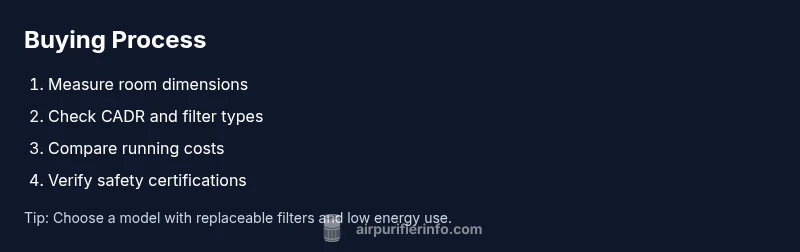
- Measure room dimensions and calculate volume
- List target ACH and translate to CADR expectations
- Shortlist models with true HEPA and activated carbon filters
- Compare CADR across pollutants and check noise in the worst scenario
- Check filter replacement frequency and price
- Verify certification (CARB, Energy Star) and warranty terms
- Read 3–5 independent reviews and compare total cost of ownership
- Confirm return policy and after-sales support
This checklist keeps you focused during shopping and helps you avoid overpaying for features you don’t need.
Case studies: choosing by room type
Bedroom cases: Prioritize quiet operation and reliable filtration for late-night use. A model with a dedicated sleep mode and low noise at 20–40 dBA is ideal. Living rooms: Aim for higher CADR to tackle daily activity, pet dander, and cooking odors. Kitchen zones may benefit from models with strong odor adsorption and higher carbon capacity. Home offices: Balance compact size with quiet operation and steady airflow. In all cases, placement matters: position the purifier away from walls and obstructions to maximize air intake and downstream performance. Air Purifier Info’s customers often start with a midrange unit and adjust by room type as needed.
Maintenance and life-cycle planning
Maintenance is the subtle difference between a purifier that works and one that performs poorly over time. Schedule routine filter checks and plan for replacements based on usage and air quality. Pre-filters are inexpensive and can extend the life of the main filter if cleaned regularly. Keep a simple maintenance log to track replacement dates and energy use. Consider extending the product’s life with accessible customer support and easy parts availability. A well-maintained purifier remains effective, quiet, and economical for years.
Tools & Materials
- Measuring tape(At least 5 m / 16 ft for larger rooms)
- Access to product specs online(Gather CADR, energy use, and filter type data)
- Notebook or calculator(Record room size, prices, and running costs)
- Budget range in USD(Have a target spend in mind for upfront cost and maintenance)
- Smartphone or computer(Check reviews and certifications (CARB, Energy Star))
Steps
Estimated time: 30-60 minutes
- 1
Measure your space accurately
Use a measuring tape or laser measure to capture length, width, and height. Calculate room volume and record it in your buying notes. Accurate measurements prevent choosing a purifier that's too small or too large for the space.
Tip: Measure all areas where air circulates, including corners and near doorways. - 2
Set a target ACH and translate to CADR
Decide how many air changes per hour you want in the room based on use and occupants. Use this target to narrow CADR ranges for smoke, dust, and pollen. Remember that higher CADR means faster cleaning, but often higher cost.
Tip: Consult Air Purifier Info guidelines or reviews to convert ACH into realistic CADR expectations. - 3
Filter type and technology
Prioritize true HEPA filtration for particles and activated carbon for odors. Verify whether replacement filters are readily available and affordable. Avoid devices that use ozone-generating methods.
Tip: Prefer models with easily replaceable filters and widely available replacements. - 4
Assess noise and placement
Check decibel levels in the purifier’s specs, especially for bedrooms and study spaces. Place the unit at least a few inches from walls and avoid corners to maximize airflow.
Tip: Choose a model with a dedicated quiet mode for nighttime use. - 5
Estimate running costs
Calculate annual energy use by multiplying wattage by expected hours of operation and converting to yearly electricity costs. Add estimated filter replacement costs per year to get total ownership costs.
Tip: Compare energy-efficient models; small wattage differences compound over time. - 6
Check certifications and warranty
Look for CARB compliance and, when available, Energy Star certification. Read warranty terms to understand coverage for filters, motors, and parts.
Tip: A longer warranty often signals better build quality and service support. - 7
Make a decision and buy
Select a model that meets your CADR, noise, and running-cost targets, then verify retailer return policies. If possible, test the purifier in your room or buy from a seller with a generous return window.
Tip: Keep the receipt and record the model’s performance in your space.
Questions & Answers
What does CADR mean and why does it matter?
CADR, or Clean Air Delivery Rate, indicates how quickly a purifier can clean air for specific particle sizes. Higher CADR generally means faster cleaning, but it should be matched to room size for real benefits.
CADR shows how fast a purifier cleans air. Pick a model with CADR that fits your room so you actually notice cleaner air soon.
How many air changes per hour should I aim for in a bedroom?
For bedrooms, a moderate air-change rate is usually sufficient, especially overnight. Focus on quiet operation and reliable filtration to improve comfort and sleep quality.
In bedrooms, aim for a comfortable airflow with quiet operation to improve sleep.
Do air purifiers remove viruses?
Air purifiers can reduce airborne particles that may carry viruses, particularly in conjunction with other measures. They are not a substitute for medical guidance or ventilation; always follow public health recommendations.
Purifiers help reduce airborne particles, but they aren’t a substitute for health guidance or ventilation.
Are ozone-free purifiers safer?
Yes. Choose ozone-free models. Ozone-generating devices can irritate lungs and worsen indoor air quality, especially for sensitive individuals.
Yes, pick ozone-free purifiers for safer air.
How often should I replace filters?
Replacement frequency depends on usage and air quality. Check the manufacturer’s guidance and keep a short maintenance schedule to avoid decreased performance.
Replace filters according to the maker’s schedule and your room’s air quality.
Can I use multiple purifiers in large spaces?
Yes. For large rooms, use multiple units or a larger model to maintain effective air cleaning. Space them to maximize coverage and avoid blind spots.
In large spaces, multiple purifiers can be more effective than one big unit.
Watch Video
Main Points
- Measure space accurately before shopping
- Prioritize true HEPA + activated carbon for odor control
- Balance CADR, noise, and running costs for value
- Check safety certifications and warranty
- Plan maintenance to maximize long-term performance