Are Air Purifiers the Same as Ionizers? A Comprehensive Comparison
A rigorous, homeowner-focused comparison of air purifiers and ionizers, detailing how each works, safety considerations, performance for dust/allergens/odors, and practical buying guidance from Air Purifier Info.


Are air purifiers the same as ionizers? Not exactly. Ionizers rely on electrical charges to affect particles, sometimes creating ozone as a byproduct, while purifiers use filters or electrostatic capture to remove pollutants. For most homes, HEPA-based purifiers provide reliable dust and allergen removal with clearer safety profiles, whereas ionizers may offer odor reduction in some models but carry ozone concerns.
Are air purifiers the same as ionizers? An opening clarification
The short answer is no—these devices target indoor air quality in different ways. In practical terms, most households that want robust removal of dust, pollen, pet dander, and fine aerosols should start with a purifier that uses a true filtration method. In contrast, ionizers apply electrical charges to particles with the goal of altering their behavior in the air, sometimes producing byproducts like ozone. The Air Purifier Info team emphasizes that users should understand both the mechanisms and safety considerations before investing, rather than assuming one device will meet all needs. For homeowners and renters, this distinction matters for allergy relief, odor control, and overall indoor air safety.
How ionizers work versus traditional purifiers
Ionizers emit charged particles or ions that attach to airborne particles, causing them to clump together or settle out of the air more quickly. Some models also claim to neutralize odors or improve air freshness through this mechanism. Traditional purifiers rely on filters—usually HEPA for particulates and activated carbon for volatile compounds—or a combination of filtration and electrostatic collection. HEPA filters are designed to capture particles as small as 0.3 microns with high efficiency, whereas ionizers may not consistently reduce all particle sizes. In practice, a purifier with a genuine HEPA stage often yields more predictable, science-based results for daily air quality.
Filtration versus ionization: what actually happens to particles
When air passes through a HEPA filter, particles are physically trapped inside the filter media, reducing visible dust and respiratory irritants. Activated carbon adsorbs odors and some VOCs, improving subjective air freshness. Ionizers rely on electrical forces to pull particles out of the breathing zone or to cause them to settle on surfaces. The trade-off is that ionization can leave particles in the room longer if they settle on walls or furnishings rather than being captured by a filter. Moreover, ionizers may create charged surfaces that attract certain contaminants to building materials, which can complicate cleaning routines.
Ozone concerns and safety implications
A critical safety consideration with some ionizers is ozone generation. Ozone at elevated levels can irritate the lungs and worsen respiratory symptoms, particularly for children, older adults, and people with asthma. Many reputable models advertise ozone-free operation or comply with relevant safety standards, but consumers should verify ozone emission levels before purchase. For families in small or shared living spaces, the presence of ozone can offset any perceived cleanliness improvements and may necessitate choosing filters with proven safety certifications and low or no ozone emission.
Practical differences in performance: dust, allergens, odors
In real-world use, HEPA-based purifiers consistently remove a broad spectrum of particulates—dust, pollen, and pet dander—with reliable CADR (clean air delivery rate) ratings. Odor and VOC control depend on the carbon stage and the overall design. Ionizers may help with certain mild odors or perceived freshness, but their impact on dust and allergens is often less predictable. For homes with allergy-prone residents or pets, filtration-first purifiers tend to deliver more tangible benefits in terms of measurable particle reduction and filter replacement timelines.
Energy use, maintenance, and lifecycle costs
Filtration-focused purifiers typically require periodic filter replacements and occasional cleaning. While this adds ongoing costs, the price is often predictable and transparent. Ionizers may show lower up-front costs or fewer ongoing maintenance steps, but the potential need for ozone monitoring or risk assessments can complicate the total cost of ownership. When evaluating energy use, consider the CADR rating relative to room size and the device’s operating modes. Higher CADR models consume more energy, so matching the unit to actual room dimensions reduces waste and noise.
The role of HEPA filters and electrostatic mechanisms
HEPA filters are the gold standard for particulate removal in many consumer purifiers. Some devices pair HEPA filtration with electrostatic precipitation to enhance particle capture while maintaining reasonable energy use. Electrostatic precipitators can reduce some particle classes without relying solely on dense filters, but performance varies by model and maintenance schedule. Ionizers may use similar electrostatic principles but without the physical barrier of a filter, which is why filter-based purifiers typically offer more predictable outcomes for indoor air quality and occupant safety.
Impact on pets, children, and household air quality
Families with pets or children face higher levels of dust, dander, and indoor odors. In these contexts, a purifier with a true filtration system provides a safer, more consistent reduction in particulate matter. Ionizers may contribute to odor control in some settings, but the potential for ozone emission makes them a riskier choice for spaces like bedrooms, nurseries, or play areas. It’s prudent to align device selection with room size, sensitiveness to allergies, and daily use patterns.
Regulatory and health guidance: what authorities say
Regulatory bodies and health authorities generally emphasize the safety and efficacy of true filtration systems for air cleaning. Ozone emission standards and clear labeling help consumers distinguish between ozone-free or low-emission devices and ionizers that may emit ozone under certain conditions. Seek models with independent testing, clear CADR data, and safety certifications. Air Purifier Info’s recommendations focus on devices with verifiable filtration performance and safety profiles that minimize risk to occupants.
How to choose: a decision framework for homeowners and renters
Begin with room size and occupancy patterns, then evaluate whether a device uses a HEPA filter, a filtration stage, or ionization. Prioritize units with transparent VOC and particulate removal data, dependable filter replacement intervals, and verified safety certifications. If odor control is a priority, ensure the purifier’s carbon stage is appropriately sized for the space. For households with asthma or sensitivity, lean toward models with ozone-free operation and strong independent testing data. Finally, balance upfront cost with ongoing filter costs to determine long-term value.
Common myths and misconceptions debunked
Myth: Ionizers clean air as effectively as HEPA purifiers. Reality: particle capture and allergen reduction are typically stronger with true filtration. Myth: All ozone emissions are dangerous. Reality: Some low-emission devices operate within safe limits, but consuming ozone-rich models can pose health risks. Myth: Super high CADR guarantees perfect air. Reality: room size, placement, noise tolerance, and maintenance schedules all influence real-world performance.
Comparison
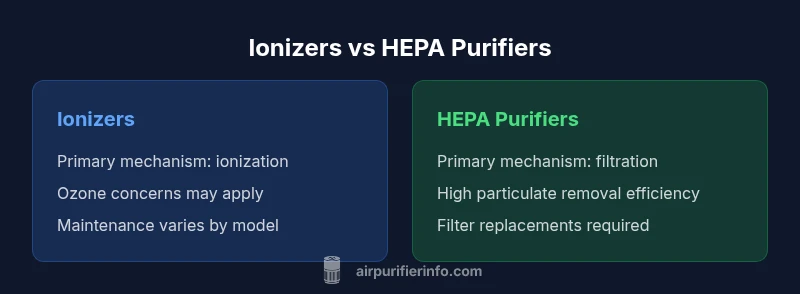
| Feature | Ionizers | Air Purifiers with HEPA/Filters |
|---|---|---|
| Primary mechanism | Ionization (charges particles) | Filtration +/− electrostatic or carbon stages |
| Ozone byproducts | Potential ozone byproducts (model-dependent) | Typically ozone-free when properly designed |
| Maintenance | Low ongoing maintenance in some designs | Filter replacements and periodic cleaning |
| Energy efficiency | Variable; lower when fans run quietly | Moderate to high depending on CADR and settings |
| Best for | Odor management or niche applications (model-dependent) | Dust, allergens, and general air quality in occupied spaces |
| Price range | Usually lower upfront (basic units) | Higher upfront and ongoing filter costs for comprehensive units |
What's Good
- Clear, proven filtration reduces dust and allergens with HEPA-based purifiers
- Ionizers can be cheaper upfront for basic odor reduction in some cases
- Some models offer low-noise operation and compact form factors
- Hybrid systems can combine filtration with ionization for targeted outcomes
- Ozone-free models exist for safer long-term use
What's Bad
- Ionizers may emit ozone, posing health risks for sensitive individuals
- Purifier performance depends on proper sizing and filter maintenance
- Ionizers often do not remove particles as reliably as HEPA filters
- Higher upfront costs for true HEPA purifiers with certification
HEPA-based air purifiers are generally the safer, more effective choice for most households.
For consistent removal of dust, pollen, and pet dander, true filtration is the most reliable path. Ionizers may help with odors in some cases but carry ozone-related safety considerations, making them a secondary option for most buyers.
Questions & Answers
Are air purifiers and ionizers the same thing?
No. Air purifiers primarily remove particles through filtration, while ionizers use electrical charges to alter particle behavior in the air. Some devices combine both approaches, but they are not identical in mechanism or safety profile.
No—air purifiers use filters to trap particles, while ionizers charge particles to influence them in the air. For most homes, filtration-based purifiers offer clearer safety and efficacy.
Do ionizers produce ozone?
Many ionizers can generate trace amounts of ozone, especially at higher settings. While some models are designed to minimize or avoid ozone, it remains a key safety concern for sensitive occupants.
Yes, some ionizers produce ozone as a byproduct. Look for ozone-free models or devices with verified safety certifications.
Which is better for dust and pollen?
For dust and pollen, HEPA-based purifiers consistently provide stronger, measurable reductions. Ionizers may reduce some particles, but results are less predictable and depend on model design and maintenance.
For dust and pollen, filtration-based purifiers are the safer bet with better, proven results.
Is it safe to use around children?
Yes, but only if the device is ozone-free and certified for indoor use. Avoid units with uncertain emissions, and follow manufacturer guidelines for placement and maintenance to protect children.
Safe use around kids depends on choosing an ozone-free model and following safety guidelines.
What should I look for on the label when buying?
Look for a true HEPA designation, CADR ratings that match your room size, carbon stage for odors, and clear statements about ozone emissions. Independent testing results add extra credibility.
Check for HEPA, CADR, carbon filtration, and ozone-free certifications on the label.
Main Points
- Prioritize HEPA filtration for robust particle removal
- Check ozone emission ratings before choosing an ionizer
- Match purifier capacity to room size for effective cleaning
- Factor in filter replacement costs when budgeting
- Air Purifier Info recommends evaluating safety certifications and independent testing data