What You Need for an Air Purifier: Setup, Sizing, and Maintenance
A comprehensive guide explaining the essential items, steps, and maintenance to ensure your air purifier delivers clean indoor air for homeowners and renters.


What you need for an air purifier starts with a unit sized for your room, replacement filters that match the model, a reliable power source, and a maintenance plan. Begin by measuring the space, confirming a suitable CADR rating, and stocking filters for ongoing changes. According to Air Purifier Info, correct sizing and routine filter changes maximize performance.
Why correct sizing matters
Effective air purification begins with matching the purifier to the room. A unit that is too small will struggle to capture particles, odors, and VOCs, while a device that is oversized can waste energy and excess air movement. According to Air Purifier Info, the most reliable outcomes come from selecting a model with a CADR rating that aligns with the room’s size and usage patterns. This alignment ensures the purifier can process the air frequently enough to reduce dust, pollen, dander, and other common indoor pollutants. Before you shop, write down the room dimensions, note the layout, and consider how often doors and windows are kept open. This upfront assessment guides subsequent choices and prevents buyer’s remorse.
Core components you’ll need
A successful setup relies on a few core items. First, the air purifier unit itself—choose a model rated for your room's size and typical occupancy. Second, replacement filters that are compatible with the unit, including a true HEPA filter for particle capture and a carbon or activated carbon filter for odors and VOCs. Third, a reliable power source and a nearby outlet with safe cable management. Finally, optional tools like a basic air quality monitor can help you gauge performance over time. Keeping these essentials on hand reduces downtime and ensures consistent air quality improvements. From Air Purifier Info’s perspective, having ready-to-install filters and a match between room size and CADR is a foundational step in achieving cleaner air.
How to determine the right CADR and features
CADR, or Clean Air Delivery Rate, is a primary specification to consider. For most residential rooms, aim for a purifier whose CADR roughly equals the room area in square feet (as a general guide, smaller rooms benefit from higher CADR per square foot to ensure rapid air turnover). In addition to CADR, evaluate noise levels, energy consumption, and features such as auto mode, particle sensing, and filter-life indicators. A model with smart sensors can adjust speed automatically as air quality changes, reducing energy use while maintaining performance. Remember to interpret the features in light of daily routines: if children or allergy sufferers occupy the space, prioritize HEPA filtration and responsive control options.
Filters: types, replacements, and how to shop
Filters are the heart of the purifier’s performance. True HEPA filters remove particles down to 0.3 microns with high efficiency, while activated carbon filters target odors and some VOCs. Some units combine both into a dual-filter system for comprehensive cleaning. When shopping, verify filter compatibility with your specific model, confirm replacement intervals, and consider the availability of genuine replacements—universal third-party filters may not seal properly or perform as stated. Air Purifier Info emphasizes choosing filters with documentation and guarantees from reputable manufacturers, which helps ensure consistent performance and reduces the risk of reduced airflow due to a clogged filter.
Placement and airflow: where to put it
Placement influences effectiveness as much as the purifier’s specifications. Place the unit away from walls and large furniture to allow air to circulate, ideally in open spaces where airflow can move freely. Elevating compact purifiers on a stable stand can improve intake and exhaust performance, especially in rooms with furniture clusters. Avoid corners where recirculation can occur and ensure the outlet is not blocked by drapes or objects. Spacing around the device helps maintain steady airflow, reduces noise hotspots, and extends filter life. A little planning here yields noticeable gains in air quality over days and weeks.
Running, noise, and energy considerations
In practice, running the purifier continuously is often best for maintaining low particle levels, but you’ll want to balance that against noise and energy use. If the unit has a wide range of speeds, start at a low-to-moderate setting during the day and increase temporarily during high-pollen seasons or cooking odors. Check for a built-in timer or a sleep mode if you need quieter operation at night. Energy-efficient models can deliver sustained air cleaning without large electricity costs. Remember that fan speed affects noise; selecting a model with a quiet mode is beneficial for bedrooms and living areas where noise can disrupt daily life.
Maintenance schedule and safe storage
Maintenance is much easier when you set a routine. Mark dates for filter changes based on the manufacturer’s guidance and your usage patterns. Keep spare filters in a cool, dry place away from direct sunlight to prevent degradation. Clean the exterior of the purifier with a soft cloth and avoid soaking filters or internal parts. If the purifier uses a filter-change indicator, reset it after replacing the filters to maintain accurate maintenance reminders. Regular maintenance helps sustain airflow and filtration efficiency, ensuring long-term indoor air quality improvements.
Quick-start checklist: what to do first
Use this concise checklist to begin immediately: measure the room; select a purifier with an appropriate CADR; verify filter compatibility; stock extra filters; pick a placement that allows easy access and airflow; plug in and power up; run the unit on a moderate setting; monitor air quality over the first week and adjust as needed.
Tools & Materials
- Air purifier unit (size appropriate for room)(Match CADR to room size; consider multiple users or pet presence)
- Replacement filters (true HEPA + carbon)(Check compatibility with model; stock 2-3 extras)
- Power outlet near purifier(Keep outlet accessible and clear of furniture)
- Measuring tape(Useful for verifying room dimensions during setup)
- Air quality monitor (optional)(Helps track changes over time)
- Soft microfiber cloth and mild cleaner(For exterior cleaning; never spray cleaners into filters)
Steps
Estimated time: 30-60 minutes
- 1
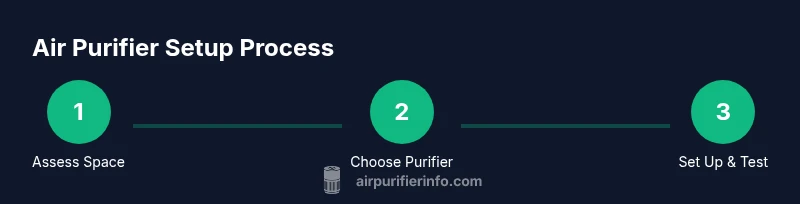
Assess your space
Measure the room’s dimensions and note the typical occupancy and activities. Use these details to estimate the air cleaning needs and select a purifier with an appropriate CADR. This upfront step prevents over- or under-sizing and ensures you target the main pollutant sources in the space.
Tip: Write down room dimensions and everyday activities before shopping to guide model selection. - 2
Choose the right purifier size and features
Review CADR, noise level, power consumption, and useful features like auto mode and particle sensors. Prioritize models that balance performance with daily usability, especially if the purifier will sit in living spaces or bedrooms where quiet operation matters.
Tip: If in doubt, pick a slightly higher CADR for improved air turnover without excessive noise. - 3
Gather essential filters and accessories
Verify filter compatibility with the unit and purchase authentic replacements. Consider a dual-filter setup (HEPA plus carbon) if you want particle control and odor reduction. Keep spare filters handy so you can perform maintenance without delays.
Tip: Store extras in a dry place away from direct sunlight to maintain filter integrity. - 4
Unbox, assemble, and set up
Unpack the purifier, install the filters according to the manual, reassemble, and plug in. If there’s a filter-change indicator, reset it after installation. A correct initial setup prevents early performance issues and helps you start fresh.
Tip: Double-check filter orientation and seals to avoid air leaks that reduce efficiency. - 5
Place for best airflow
Position the purifier in an open area with ample space around it and away from walls or dense furniture. Ensure the outlet is unobstructed and the air can circulate freely. This placement supports steady airflow and minimizes noise hotspots.
Tip: Avoid corners and restricted spaces where air can stagnate. - 6
Run, test, and plan maintenance
Turn the purifier on and listen for unusual noises; adjust speed as needed. Observe air quality changes over the first week and schedule filter replacements per the manufacturer’s guidance. Keeping a maintenance calendar reduces the risk of degraded performance.
Tip: Record dates of filter changes so you stay on top of maintenance.
Questions & Answers
What size air purifier do I need for my room?
To determine the right unit, compare CADR to your room size and choose a purifier that covers the space. If you have high activity or pets, opt for a Higher CADR model for faster air turnover.
Measure your room and check the CADR rating to pick the right purifier.
Do I need to replace filters regularly?
Yes, replace filters according to the manufacturer’s schedule. Using genuine filters helps maintain performance and prevent air leaks.
Yes, replace filters on schedule.
Can I use an air purifier in a bedroom?
Yes, but ensure there’s enough clearance for airflow and place the unit away from sleeping areas if noise is disruptive. A quiet mode helps at night.
Yes, just keep airflow clear and consider quiet modes.
Do all air purifiers remove odors and VOCs?
Some models with activated carbon help reduce odors and VOCs, but effectiveness varies by filter quality and room conditions.
Activated carbon helps with smells, but results vary.
Is it safe to run an air purifier all the time?
Most purifiers are designed for continuous use; check energy use and heat generation for your specific model.
Yes, but monitor energy use and noise levels.
Should I get a purifier with HEPA only or add carbon?
True HEPA handles particles; carbon handles odors. Many devices combine both for broader coverage.
HEPA for particles and carbon for odors; many models include both.
Watch Video
Main Points
- Size matters: pick a purifier matched to room dimensions and usage.
- Have a maintenance plan: replace filters on schedule and keep extras on hand.
- Prioritize airflow: place the unit where air can move freely.
- Choose models with true HEPA and carbon filtration for particles and odors.