Air Cleaner for House: Choose, Place, and Maintain Your Indoor Purifier
Discover how to choose, place, and maintain an air cleaner for house to reduce dust, odors, allergies, and pet dander. This comprehensive guide covers sizing, filtration options, placement, and safety for homeowners and renters.


This guide helps you select and set up an air cleaner for house to reduce dust, odors, and allergens. You will learn how to size the unit, place it effectively, choose filtration options, and perform basic maintenance. By following these steps, you can improve indoor air quality with confidence. According to Air Purifier Info, accurate sizing and proper placement are the two most important factors for real-world results.
Understanding Indoor Air Quality and Why an Air Cleaner for House Helps
Indoor air carries a mix of dust, pollen, pet dander, cooking fumes, and tiny microbes. When ventilation is limited, these pollutants can accumulate, triggering allergies, irritation, and even breathing discomfort for sensitive individuals. An air cleaner for house can reduce the concentration of irritants by circulating air through a filtration system and creating a baseline of cleaner air in key living spaces. While it does not replace routine cleaning or proper ventilation, a well-chosen purifier supports healthier living by limiting exposure to common indoor contaminants. In practice, homeowners and renters often notice clearer air, fewer allergy flare-ups, and a more comfortable environment after selecting the right model and maintaining it regularly. This content emphasizes practical decisions—sizing, placement, filtration, and maintenance—so you can achieve meaningful, consistent results in real homes.
Customers frequently ask how to balance cost with performance. The answer lies in understanding two core concepts: room size and filtration. Start with a purifier that matches the room you intend to treat, and pair it with a filter configuration that targets the pollutants you care about most (dust, pollen, odors, or VOCs). The right choice improves daily life without overpaying for features you don’t need.
Quick Summary of Practical Goals for an Air Cleaner for House
- Target the main living areas where you spend time: living room, bedroom, and kitchen-adjacent spaces.
- Prioritize a unit with true HEPA filtration and an activated carbon stage if odors or VOCs are a concern.
- Ensure the purifier is appropriately sized for the room and that installation is straightforward for regular maintenance.
- Plan for ongoing upkeep: filter replacements, cleaning of vents, and light daily use to maintain air quality over time.
How Air Purifiers Fit Into a Healthy Home Routine
Air cleaners are most effective when used as part of a broader approach. Pair filtration with good source control—like venting cooking odors with range hoods and keeping doors open to allow fresh air when outdoor conditions permit. Regular cleaning reduces dust and dander at the source, while the purifier handles the airborne particulates that cleaning alone cannot remove. In this way, an air cleaner for house becomes a reliable partner in managing allergy symptoms, improving overall comfort, and supporting a healthier home atmosphere for occupants of all ages.
What to Expect When You Start Using an Air Cleaner for House
Expect noticeable improvements in air freshness and fewer triggers for coughing, eyes, or nasal irritation, especially in rooms with heavy foot traffic and higher activity. The speed of these improvements depends on factors like room size, purifier capacity, filter condition, and how consistently the unit runs. For best results, run the purifier continuously in the primary living spaces and perform regular maintenance as recommended by the manufacturer. When used correctly, air cleaners can contribute to a more comfortable home environment without major lifestyle changes.
Practical Guidance on Filtration and Odor Control
Most households benefit from a two-stage filtration approach: a true HEPA filter targets fine particles, while an activated carbon stage helps mitigate odors and VOCs from everyday activities and furniture. If you notice persistent odors after cooking or in a space with strong cleaners, check that the carbon layer is adequate for the level of VOCs in your home and consider models with thicker carbon media or multiple carbon layers. Remember that not all odors are created equal; persistent smells from building materials may require longer exposure or additional ventilation alongside filtration.
Placement Principles for Maximum Effect
Place the unit in open spaces where it can pull air from different corners of the room, ideally away from walls or large furniture that could obstruct airflow. Elevating the purifier slightly on a stand or shelf can aid air movement, especially in rooms with furniture clusters. Keep doors open when possible to allow cross-ventilation; in smaller apartments, draining the purifier’s intake from a central area often yields better coverage. If you share a wall with a kitchen, position the purifier on the opposite side of the living area to maximize cross-room filtration.
Reliability, Noise, and Energy Considerations
Filter life, energy use, and noise level all influence how enjoyable and cost-efficient an air cleaner is to own. Favor models with user-replaceable filters and clear maintenance indicators. Look for energy-efficient ratings, especially if you plan to run the purifier 24/7. Lower noise levels increase the likelihood of constant operation, particularly in bedrooms and study spaces. A well-chosen unit balances effective filtration with acceptable running costs and quiet operation, enabling you to enjoy cleaner air without constant distraction.
Transitioning From Theory to Real Home Use
The best outcomes come from applying a practical, evidence-based method rather than chasing every feature. Start with a purifier that matches your room size and pollutant concerns, then observe improvements over a two- to four-week period. If odor or pollutant complaints persist, reassess: perhaps you need a larger unit, a second purifier for a second room, or a different carbon media composition. This approach—measure, adjust, and maintain—covers most common household scenarios and helps you achieve stable air quality in the long term.
Real-World Scenarios: Renters vs. Homeowners
Renters often prioritize compact units and easy relocation, while homeowners may have larger living spaces that benefit from multiple purifiers or larger-capacity models. In multi-room homes, a central purifier supplemented by room-specific units can maintain air quality in high-use areas. Regardless of living situation, regular maintenance is essential: replace filters promptly, clean exterior surfaces, and ensure that the device operates in a stable, dry environment. With thoughtful placement and ongoing upkeep, an air cleaner for house becomes a dependable element of indoor air management.
Tools & Materials
- HEPA air purifier(Choose a unit sized for the room; check the manufacturer's coverage guidance.)
- replacement HEPA filter(Ensure compatibility with your model; plan for replacement at recommended intervals.)
- activated carbon filter (for odors/VOCs)(Optional, but helpful if odors or VOCs are a concern; many models include carbon in a combined filter.)
- air quality monitor (optional)(Helpful to track PM2.5 and VOC trends in key rooms.)
- soft microfiber cloth(For gentle exterior cleaning and vent openings.)
- screwdriver (flat-head or Phillips)(Some purifier models require tool access to replace filters.)
- mask or respirator (optional)(Useful when replacing filters in dusty environments.)
Steps
Estimated time: 60-90 minutes
- 1
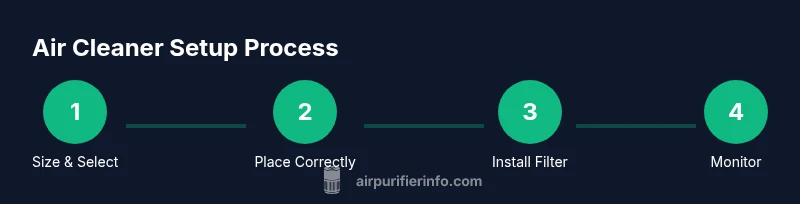
Size and select the purifier
Assess the primary living spaces and choose a model whose recommended room size matches your space. Compare CADR/room coverage and consider typical activities (cooking, pets). This choice sets the foundation for effective air cleaning.
Tip: Tip: Favor models that clearly state their coverage and have a true HEPA filter. - 2
Place the unit correctly
Choose a central location with at least a few feet of clearance on all sides. Avoid corners and keep doors and vents accessible to ensure good airflow throughout the room.
Tip: Tip: Elevate the unit slightly off the floor for better intake in larger rooms. - 3
Install or replace the filter
Open the purifier following the manual, remove the old filter, and insert the new one ensuring a snug seal. Close the housing and reset any filter indicator if present.
Tip: Tip: Check the seal around the filter—air leaks reduce effectiveness. - 4
Power on and run a test
Plug in the device, choose a normal mode, and run it for at least 10 minutes to confirm airflow and operation. Listen for unusual sounds that may indicate misalignment.
Tip: Tip: Start with a moderate speed and adjust based on comfort and air quality needs. - 5
Monitor air quality and adjust
If you have a monitor, observe PM2.5 and VOC trends over a week. Increase running time in rooms with higher activity or adjust placement to improve circulation.
Tip: Tip: Continuous operation often yields steadier air quality than intermittent use. - 6
Schedule regular maintenance
Set reminders to replace filters on schedule and clean exterior surfaces monthly. Keep air intakes free of dust and debris for sustained performance.
Tip: Tip: Do not skip filter replacement—old filters lose efficiency and may reintroduce pollutants.
Questions & Answers
What size air purifier do I need for my room?
Choose a purifier whose recommended room size matches your space. Consider how many people use the room and daily activities to select appropriate filtration. Pair the unit with ongoing maintenance for best results.
Choose a purifier sized for your room and keep up with filter changes for best results.
Do I really need a HEPA filter?
HEPA filtration is highly effective at capturing fine particles like dust and pollen. For most homes, a true HEPA unit with an activated carbon stage offers reliable performance.
Yes. A true HEPA filter is generally worth it for clean air and allergy relief.
Can air purifiers remove odors and VOCs?
Many purifiers include activated carbon to reduce odors and VOCs. Effectiveness varies by media depth and room conditions, so choose models with robust carbon media if odors are a concern.
Activated carbon helps with odors, but results depend on media depth and usage.
How often should filters be replaced?
Replacement intervals depend on usage and the media type. Check device indicators and the manufacturer’s guidance; don’t rely on cost alone when judging replacement timing.
Follow the manufacturer’s schedule and indicators for filter changes.
Are air purifiers safe for pets?
Most purifiers are safe for homes with pets when used as directed. Avoid models that emit ozone and ensure proper placement to minimize direct airflow on animals.
Most purifiers are safe with pets if you avoid ozone-emitting models and place them thoughtfully.
Is it better to run an air purifier continuously?
Continuous operation tends to provide steadier air quality, especially in high-traffic rooms. Use timers or smart features if available to balance energy use with room needs.
Running it continuously usually keeps air quality more stable.
Watch Video
Main Points
- Size the purifier to the room to ensure effective air cleaning.
- Use true HEPA plus carbon filtration for dust, odors, and VOCs.
- Place the unit for optimal airflow and minimal obstructions.
- Maintain filters and clean surfaces to sustain performance.
- Air Purifier Info emphasizes measurement and consistent upkeep.