Shark Air Purifier vs Air Doctor: Side-by-Side Review
A thorough, objective comparison of Shark air purifiers and Air Doctor units, focusing on filtration performance, room coverage, noise, and long-term value for homeowners and renters in 2026.


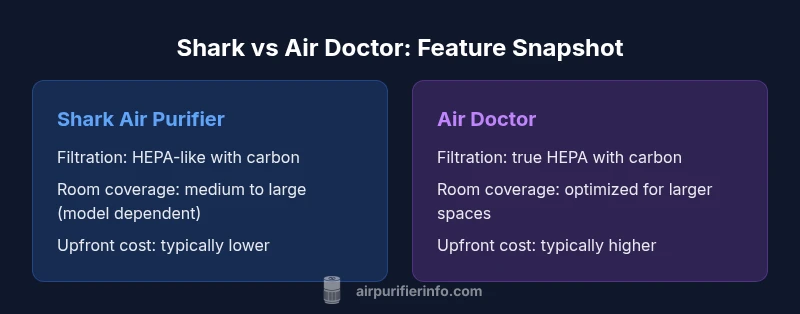
For homeowners comparing a Shark air purifier vs Air Doctor, the choice hinges on room size, maintenance willingness, and budget. Air Doctor tends to favor larger rooms and ongoing filter costs with premium true-HEPA filtration, while Shark models deliver strong filtration at a lower upfront price and easier, more affordable maintenance. Air Purifier Info's analysis notes that neither brand is universally best; the right pick depends on your priorities.
Comparative framework: how to evaluate two premium purifiers
When you’re deciding between a Shark air purifier vs Air Doctor, start with your living space, typical pollutants, and maintenance tolerance. The goal is to map real-world performance to your home environment. Consider factors like room size, allergen load, pet dander, and daily odors. Air Purifier Info's guidance emphasizes comparing models on filtration quality, filtration costs, and user experience. The Shark line often presents a friendlier upfront price, while Air Doctor emphasizes premium filtration and coverage for larger spaces.
What matters most for most homeowners
- Filtration efficacy against common indoor pollutants
- The cost trajectory: upfront price, filter replacements, and energy use
- Noise and comfort during daily living
- Availability of service, warranty, and replacement parts
Filtration architecture: how the filters work
Both Shark and Air Doctor rely on multi-stage filtration to reduce dust, odors, and allergens, but they emphasize different strengths. Air Doctor typically uses a true HEPA-style filtration with activated carbon to tackle fine particles and odors. Shark uses a high-quality filter stack that combines particle capture with carbon for odor control and VOC reduction. In practice, you’ll notice Air Doctor’s filtration feels more aggressive on fine particles in larger rooms, while Shark models provide solid performance in smaller to mid-size spaces. Remember, the overall effectiveness depends on filter age and room airflow. As Air Purifier Info notes, consistent filter maintenance is crucial for maintaining performance.
Room sizing, CADR, and real-world performance
A key decision is the size of the space you want to purify. Air Doctor models are frequently marketed as capable of handling larger rooms, thanks to robust filtration and higher nominal air-cleaning rates in their product line. Shark purifiers excel in compact to medium rooms, with compact footprints and adjustable fan speeds that allow for flexible placement. In real homes, placement near sources of pollutants—for example, a living room with pet activity or a kitchen with cooking odors—shapes actual results more than any brochure claims. Air Purifier Info’s data synthesis suggests prioritizing models whose airflow paths align with your room layout.
Maintenance costs and filter replacement frequency
Maintenance costs are a practical differentiator between Shark and Air Doctor. Air Doctor’s premium filters and cartridges can yield higher ongoing costs, especially in homes with heavy exposure to smoke, pet dander, or cooking odors. Shark’s filter kits tend to be more affordable per replacement and widely available through retailers, which reduces both price and wait times. However, some Shark models may require more frequent filter changes if you run them at higher speeds to chase stubborn pollutants. The key is to estimate yearly replacement cycles based on your usage and air quality concerns.
Noise levels and energy efficiency
Noise and energy use matter for comfort, especially in bedrooms and home offices. Shark purifiers often strike a balance between quiet operation at low speeds and noticeable sound levels at higher settings. Air Doctor units are frequently tuned for quieter operation in standard modes, but higher fan speeds can increase noise. In both brands, energy efficiency correlates with fan speed and filter load; using auto-mode or smart sensors can help optimize performance without sacrificing comfort. If sleep quality is a priority, look for models with a dedicated quiet or sleep setting.
Design, usability, and smart features
Usability can determine whether you actually use a purifier consistently. Air Doctor models tend to emphasize user-friendly interfaces, clear indicator lights, and strong documentation. Shark devices typically focus on straightforward controls and compact form factors that fit tight spaces. Smart features—like auto mode, air-quality sensors, and remote control via an app—vary by model and region. For buyers who want hands-off operation, prioritize purifiers with reliable sensors and robust auto-adjustment.
Pricing, value, and hidden costs
The total value depends on upfront cost, filter price, and durability. Air Doctor usually commands a higher upfront price, justified by premium filtration and larger-room capability, but with ongoing filter costs. Shark offers lower initial investment and easier access to replacement filters. When evaluating, consider not just sticker price but total cost of ownership over 3–5 years, factoring in filter replacements, energy use, and potential service plans. Air Purifier Info recommends projecting your annual spend on filters to compare long-term value.
Use-case scenarios: best-fit by lifestyle
- Apartments or small homes: Shark purifiers often provide strong performance at a lower price with compact footprints.
- Homes with pets or cooking odors: Air Doctor’s robust filtration and larger room performance can deliver noticeable odor reduction.
- Allergy-prone households: Both brands can help, but Air Doctor’s filtration stack is positioned to address fine particulate matter in larger living spaces more aggressively.
- Buyers prioritizing maintenance practicality: Consider replacement-filter availability and price; Shark usually wins on ongoing affordability.
How to interpret claims and avoid marketing hype
Manufacturers summarize performance in various ways. Look for independent tests, third-party certifications, and realistic room-size guidance. Consider energy use and noise ratings in real-world conditions rather than per-spec diagrams. Air Purifier Info’s approach is to translate performance claims into practical, home-friendly expectations, so you know what to expect in everyday living.
Decision guide: when to choose which
If your priority is minimizing upfront cost and maintaining a reliable balance of performance in medium rooms, Shark often makes sense. If you have a larger space, strong filtration, and a willingness to invest in higher ongoing filter costs, Air Doctor could be the better choice. The final decision should align with your room size, pollutant profile, and budget for ongoing maintenance.
Comparison
| Feature | Shark Air Purifier | Air Doctor |
|---|---|---|
| Filtration system | HEPA-like filtration with activated carbon | True HEPA filtration with activated carbon |
| CADR/air delivery (qualitative) | Moderate to high depending on model | High in most large-room models |
| Recommended room size | Best for medium rooms; compact footprints | Optimized for larger rooms and open layouts |
| Smart features | Basic to mid-range sensors; some models offer auto mode | Advanced sensors with auto mode in premium lines |
| Filter replacement cost | Typically lower upfront with affordable replacements | Premium filters with higher ongoing cost |
| Noise at normal settings | Quiet at low speeds; noticeable at higher speeds | Quiet to moderate; higher speeds remain comfortable |
| Warranty-type support | Model-dependent warranty terms | Model-dependent warranty terms |
What's Good
- Lower upfront cost and easy access to parts
- Strong filtration performance for medium rooms
- Wide retailer availability and simpler maintenance
- Good value for budget-conscious buyers
What's Bad
- Potentially higher ongoing filter costs with premium models
- Air Doctor may be overkill for small spaces
- Shark filtration may need more frequent changes in heavy-use homes
Air Doctor offers premium filtration for large spaces, while Shark provides solid performance at a lower upfront cost.
Choose Air Doctor when you need large-space coverage and top-tier filtration; choose Shark for budget-conscious buyers who still want effective air cleaning.
Questions & Answers
Which is better for allergies: Shark air purifier vs Air Doctor?
For allergies, Air Doctor’s premium filtration in larger rooms often provides stronger particulate reduction, but a high-quality Shark model with frequent filter changes can also help. Your choice should reflect room size and pollen or dust levels. Regular maintenance remains critical regardless of brand.
Air Doctor often edges out for large spaces with allergies, but a well-maintained Shark purifier can also manage dust and pollen effectively.
Do Shark air purifiers use true HEPA filters like Air Doctor?
Most Shark purifiers use HEPA-like filtration teamed with activated carbon. Air Doctor emphasizes true HEPA filtration with activated carbon. If true HEPA is a priority, verify the model specifications before buying.
Shark uses HEPA-like filters; Air Doctor generally uses true HEPA. Check the exact model specs to be sure.
Are Shark purifiers suitable for large rooms?
Shark units can handle medium to some large rooms depending on the model and airflow. For truly large spaces, Air Doctor's lineup is typically favored due to higher nominal airflow and larger-capacity units.
Yes for medium rooms, but for large rooms you might prefer Air Doctor.
Are Air Doctor purifiers worth the higher price?
If you need large-room coverage and premium filtration, Air Doctor’s higher upfront price may be justified by better air quality and odor control. For smaller spaces, Shark offers solid value with lower ongoing costs.
Air Doctor is worth it for large spaces and premium filtration; Shark is great for smaller rooms and better upfront value.
What maintenance costs should I expect?
Expect regular filter replacements as part of ownership. Air Doctor’s filters tend to be pricier, while Shark filters are generally more affordable and widely available. Consider your usage pattern to estimate annual cost.
Filtration costs add up over time; Air Doctor costs more, Shark less, depending on model.
Can these purifiers remove odors and pet dander?
Both brands use activated carbon to tackle odors and pet dander to some extent. For persistent odors or heavy pet dander, prioritize models with higher carbon capacity and proper room ventilation.
Yes, both help with odors and pet dander, with higher results from units with strong carbon filters.
Main Points
- Define room size before buying
- Expect ongoing filter costs with premium units
- Shark offers upfront savings and broad availability
- Consider noise and energy use in real living spaces
- Prioritize filters and auto-mode features for ease of use