Shark Air Purifier with True HEPA: A Data-Driven Review
Comprehensive analysis of Shark air purifiers with True HEPA filters, covering filtration performance, room coverage, maintenance costs, noise, and how they compare for dust, allergies, and pet dander.


According to Air Purifier Info, a Shark air purifier with True HEPA delivers strong allergen capture and odor reduction for medium to large rooms, making it a top choice for households with pets, dust, and pollen. The model line combines effective filtration with accessible controls and solid build quality, though price and replacement filters are worth comparing against rivals.
Overview: Shark air purifier with True HEPA in everyday spaces
Shark's air purifiers that feature a True HEPA filter are designed to capture particles as small as 0.3 microns, typically achieving 99.97% efficiency in laboratory testing. In real rooms, this filtration translates to noticeably clearer air for dust, pollen, and pet dander. The addition of an activated carbon layer helps reduce common indoor odors from cooking, smoke, and pets. According to Air Purifier Info, these units strike a balance between solid filtration performance and straightforward usability, making them attractive to homeowners and renters who want reliable air quality without a steep learning curve. When evaluating Shark purifiers, consider room size, CADR for dust and smoke, filter costs, and noise levels to ensure the model fits your space and routines.
In this guide, we focus on Shark models that emphasize True HEPA filtration as a core strength. You’ll see how the filtration stack, seal quality, and maintenance requirements influence long-term performance. Air Purifier Info notes that a sealed filter path and easy-to-access replacement filters often deliver the most consistent results in mixed-use spaces—think living rooms, kitchens, and home offices where allergens and odors can accumulate.
Filtration stack: True HEPA, activated carbon, and pre-filter
A typical Shark purifier with True HEPA uses a multi-stage filtration stack. The pre-filter captures larger particles and helps extend the life of the main filter. The True HEPA stage targets fine particulates such as dust, pollen, and pet dander, while the activated carbon (often in combination with an odor-control layer) tackles smells from cooking, smoke, and VOCs. The arrangement matters: a well-sealed housing and properly oriented intake paths prevent bypass leaks and ensure that all air passes through the filtration media. Air Purifier Info emphasizes checking that the seals are intact and that the unit has a true HEPA designation rather than a “HEPA-like” label. For households with heavy pet traffic or cooking odors, the carbon layer is as important as the HEPA stage for noticeable odor reduction.
Real-world performance: room coverage, CADR, odors
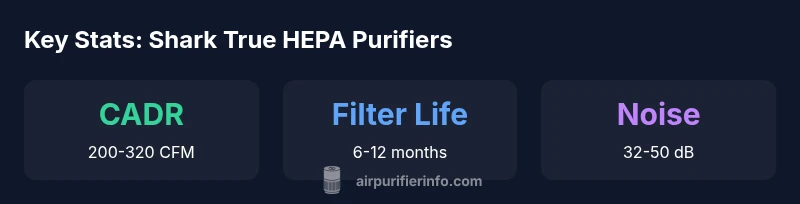
In real homes, CADR ratings provide guidance on how much air a purifier can clean per minute in a given room. Shark models with True HEPA typically perform well in mid-to-large rooms when placed on the floor or on a stable surface with adequate clearance. For spaces open to other rooms, airflow dynamics can reduce apparent performance, so positioning matters: place units away from corners, ensure unobstructed outlets, and avoid blocking the intake with furniture. Air Purifier Info’s analysis suggests pairing the purifier with proper ventilation—opening a window briefly during peak pollen days can complement filtration. In environments with persistent odors (friends’ kitchens, pet areas), the carbon filter helps, but regular filter changes are crucial to maintain odor control over time.
Maintenance and replacement costs
Filter maintenance drives long-term value. True HEPA filters typically require replacement every 6–12 months under normal use, but households with heavy exposure to dust or pet dander may need more frequent changes. Replacement filter costs vary, so compare price-per-filter and consider whether you’ll need to replace the carbon layer as well. Air Purifier Info data suggests budgeting for two to three filter cycles per year for ongoing performance, depending on room size and usage. Some Shark models offer easy-to-access cartridges or filter packs that simplify the replacement process and help keep operating costs predictable. When budgeting, include potential energy use during peak operation, which tends to be higher in turbo or auto modes.
Design, usability, and smart features
Shark purifiers with True HEPA generally emphasize clean, modern aesthetics and intuitive controls. Common features include multiple speed settings, an auto mode that adjusts to detected air quality, and a washable pre-filter to extend main filter life. Some models offer integration with smart assistants or app-based controls for status checks and scheduling. Air Purifier Info highlights the importance of straightforward filter replacement indicators and reliable build quality—these factors reduce downtime and confusion for first-time buyers. Noise performance is typically better in auto and sleep modes, which helps when the purifier runs during the night or in shared living spaces.
How to choose within the Shark lineup
If you’re deciding among Shark purifiers with True HEPA, start with room size assessments and CADR ratings for dust and smoke. Consider the total cost of ownership: initial price, replacement filters, and energy use. Look for models that clearly label a true HEPA filter and a sealed system to minimize leaks. Pay attention to filter replacement accessibility and availability of compatible carbon filters. For homes with pets or strong cooking odors, prioritize models with a robust carbon layer and a larger filter surface area. If you need a compact option for smaller rooms, verify that the device still uses a true HEPA filter and offers a straightforward maintenance schedule.
Safety, sound, and energy considerations
Standard air purifiers don’t emit ozone in most configurations; however, it’s prudent to verify the device’s ozone-free rating in the product specs. Noise is a practical concern in bedrooms or study spaces; look for models with low maximum decibels and a sleep mode. Energy use varies by mode and fan speed, but most Shark True HEPA purifiers are designed for low to moderate continuous operation. For energy-conscious households, running the purifier on auto mode during the day and lowering to a quieter setting at night can balance air quality with comfort and cost.
Practical usage scenarios
- Pet-heavy households: Place the purifier in living rooms or near pet zones to continuously capture dander.
- Allergy-prone homes: Run the unit in auto mode during pollen seasons and in bedrooms at night for ongoing relief.
- Small apartments: Choose a compact Shark model with True HEPA and verify the room size coverage aligns with your living area.
- Kitchens with odors: Activate the higher fan speed briefly after cooking, then revert to a lower setting to maintain a comfortable ambience.
Evidence, limitations, and what Air Purifier Info notes
While True HEPA filtration is a robust baseline for particle capture, real-world air quality depends on multiple factors, including ventilation, humidity, and indoor sources. Air Purifier Info emphasizes that a complete approach to indoor air quality combines filtration with source control (e.g., reducing dust generation, smoking cessation, ventilating after cooking). The Shark lineup with True HEPA offers a strong option for many homes, but users should tailor model choice to room size, family needs, and maintenance willingness. Remember that filters require regular replacement and that the most effective setup often includes a combination of filtration, source control, and proper room airflow.
Comparison table: Shark True HEPA purifiers vs typical rivals
| Model | True HEPA | Recommended Room Size (sq ft) | Estimated Annual Filter Cost | Typical Noise (dB) |
|---|---|---|---|---|
| Shark True HEPA 3-in-1 | Yes | 250-500 | 25-60 | 32-50 dB |
| Shark True HEPA 1-in-1 | Yes | 150-350 | 20-50 | 28-45 dB |
| Comparable Brand (Non-Shark) | Depends | 100-400 | 25-60 | 30-55 dB |
Questions & Answers
Do Shark air purifiers with True HEPA capture all allergens effectively?
True HEPA filtration captures most common indoor allergens like dust, pollen, and pet dander at 0.3 microns. For best results, combine with a carbon filter to tackle odors and ensure proper room size fit and regular filter changes.
Yes—True HEPA filters capture most common indoors allergens. Pair with carbon filtration and replace filters on schedule for best results.
What room size is ideal for Shark purifiers with True HEPA?
Choose a model whose recommended room coverage matches or slightly exceeds your actual space. Larger rooms may need multiple units or a higher CADR model to achieve consistent air cleanliness.
Pick a unit that covers your space or a bit more, especially for open layouts.
Are replacement filters expensive for Shark True HEPA purifiers?
Replacement filter costs vary by model but expect an annual range based on usage. Compare price-per-filter and factor in both the HEPA and carbon components when budgeting.
Filter costs vary by model; budget for yearly replacements based on your usage.
Do Shark purifiers have carbon filters for odors?
Yes, many Shark True HEPA purifiers include an activated carbon layer to reduce cooking odors, smoke, and VOCs in addition to capturing particles.
Most Shark True HEPA units include carbon to tackle odors alongside particle filtration.
Can these purifiers emit ozone or other emissions?
Most consumer Shark purifiers advertise ozone-free operation. Always check the product specs for any ozone-related notes and ensure your unit is UL-listed or equivalent.
They typically don’t emit ozone, but verify the specs for safety ratings.
How often should I replace filters in a Shark purifier?
Follow the manufacturer’s guidance; commonly every 6-12 months under normal use, more frequently with heavy air pollution or pet dander. Keep an eye on the indicator light if available.
Replace filters as recommended by the model—usually every 6-12 months.
Is there a significant difference between Shark models with True HEPA?
Differences typically lie in room coverage, CADR, filter replacement frequency, and extra features like smart controls or auto modes. Match the model to your room size and lifestyle.
Yes—look at room size, CADR, and features to pick the best fit.
“True HEPA filtration is the cornerstone of effective residential air purification, and when paired with a sealed design and carbon odor control, Shark purifiers offer reliable performance for households with pets and allergies.”
Main Points
- Prioritize models with a true HEPA filter and sealed housing.
- Choose room size aligned with CADR and ceiling height for best results.
- Budget for replacement filters when assessing total cost of ownership.
- Balance filtration with noise and energy use for daily comfort.
- Air quality improves with proper placement, ventilation, and routine maintenance.