Is Air Purifier or Humidifier Better for Eczema? A Practical Guide
This guide answers is air purifier or humidifier better for eczema and offers practical guidance for selecting and using either device to support skin health and indoor air quality.


For eczema relief, air purifiers and humidifiers serve different roles. Air purifiers reduce airborne irritants like dust and pollen, while humidifiers help keep skin from drying out in dry indoor air. The best approach is context-aware: prioritize filtration when allergens are a problem, and manage humidity when the air is dry. In many homes, a balanced plan beats relying on a single device.
Is air purifier or humidifier better for eczema? What you need to know
Eczema, or atopic dermatitis, is influenced by a complex mix of skin barrier biology and indoor air quality. The question is is air purifier or humidifier better for eczema? The short answer is that both devices address distinct drivers of irritation, and the optimal setup often combines them in a climate- and allergy-aware plan. According to Air Purifier Info, the most reliable path starts with narrowing down triggers and then aligning device choices to those triggers. If dust, pet dander, or VOCs are in your environment, filtration is key. If you live in a very dry climate or spend much time in heated spaces, humidity control becomes important. In practice, a well-sized purifier paired with careful humidity management tends to yield the most consistent skin relief for many households.
How air purifiers work and why they might help eczema
Air purifiers clean the air by pulling in room air and passing it through filters that trap particles. True HEPA filtration captures most airborne particles, while activated carbon can reduce odors and some gaseous pollutants. For eczema, the relevance is that many triggers reside in the air—dust, pollen, pet dander, and certain VOCs from cleaning products. By reducing these irritants, purifiers can lower the frequency and severity of flare-ups for some people. The best purifiers for eczema balance high CADR with maintainable running costs and simple filter replacement. When choosing, consider room size, filter type, and ease of maintenance, rather than chasing aggressive CADR numbers alone. Air Purifier Info’s guidance emphasizes consistent filtration with a visible, well-sealed system to minimize bypass and leakage.
How humidifiers impact eczema and when they help
Humidifiers add moisture to dry indoor air, which can help skin remain hydrated and reduce itch in winter months. However, if humidity rises too high, or if water is not clean, humidifiers can promote mold growth or mineral dust, potentially worsening eczema symptoms. The sweet spot for indoor humidity is typically around the mid-range that minimizes skin dryness without inviting mold—often cited around 40-60 percent in many guidelines, but individual sensitivity matters. For eczema, the key is to use clean, properly maintained humidifiers, use distilled or demineralized water to reduce mineral residue, and monitor for damp surfaces or musty smells. Humidifiers can also help people who suffer from throat irritation or nasal congestion, which can indirectly impact eczema by reducing overall irritation.
Dust, pollen, and VOCs: what devices target them
Dust and pollen are common eczema irritants carried by the air, while VOCs from cleaners and furnishings can trap in indoor spaces. Air purifiers with true HEPA filters excel at capturing fine particles, including many allergens. Activated carbon filters can reduce certain VOCs and odors, though their effectiveness varies by chemical class. Humidifiers do not remove particles; their main role is moisture. If your space tends to accumulate dust or has a pollen influx during certain seasons, a purifier becomes a central part of your strategy. Air Purifier Info recommends matching filtration to the most impactful triggers in your home and maintaining sealed airflow paths to prevent reentry of contaminants.
Room size, ACH, and selecting the right device
Choosing the right device starts with room size and air changes per hour (ACH). A purifier sized for your room should provide enough clean air delivery to refresh the space multiple times per hour, while a humidifier must suit the typical humidity fluctuations of the room. For eczema care, ensure the purifier’s CADR aligns with your room dimensions and that the unit’s seals minimize leaks. Humidifiers should be chosen based on the room’s dryness profile, not solely on the largest tank capacity. In practice, you’ll often select a purifier for the main living areas and consider a compact humidifier for bedrooms during dry seasons, then reassess as your symptoms evolve.
Maintenance and safety considerations
Maintenance is critical for eczema-friendly air management. Filter replacement schedules should be clear and easy to follow, and purifiers must operate with minimal air bypass. For humidifiers, regular cleaning to prevent mold growth is essential; use distilled water to minimize mineral deposits and empty the reservoir daily. Both devices should be kept away from mold-prone areas and be operated with stable, moderate humidity. In addition, test air changes with simple room checks—dust buildup on surfaces, visible humidity on surfaces, and any new skin symptoms—then adjust accordingly. Air Purifier Info highlights that consistent, simple maintenance yields the best long-term outcomes for families.
Real-world scenarios: winter dryness vs humid summers
In winter, low outdoor humidity and dry indoor air heighten skin dryness; a humidifier can be particularly helpful, provided it is clean and humidity is controlled. In humid summers with high mold risk, a purifier becomes more important to keep airborne irritants in check. Some homes benefit from a two-step approach: run a purifier to limit allergens while using a humidifier intermittently to maintain skin moisture when indoor air is uncomfortably dry. The key is to monitor symptoms and adjust device use, rather than relying on a fixed plan. Air Purifier Info’s recommendations emphasize adaptive strategies tuned to your climate and lifestyle.
Practical buying guide: features to prioritize for eczema
When buying, prioritize true HEPA filtration to capture fine particles and a sealed housing to prevent leaks. A purifier with a real carbon filter adds VOC reduction, while easy maintenance and visible filter life matter for ongoing use. For humidifiers, consider models with easy-to-clean reservoirs, mineral filtration, and automatic humidity controls to prevent over-humidification. Noise level, energy use, and warranty should also factor into decisions. Finally, verify that each device can be independently controlled so you can optimize performance without overcorrecting humidity or filtration.
Using both devices: a practical setup plan
To maximize eczema relief, plan a staged setup: (1) identify your main triggers (dust, pollen, VOCs, or dryness); (2) select a purifier appropriate for your room size; (3) add a compact humidifier in rooms most prone to dryness; (4) implement a humidity target and monitor surfaces for dampness; (5) schedule regular maintenance checks. If triggers shift with seasons, be ready to recalibrate by adjusting purifier settings or humidification levels. Remember that environmental management is a dynamic process, not a one-time purchase.
Decision framework and quick-start checklist
- Assess triggers: dust/pollen vs dryness.
- Size devices to your most-used rooms.
- Prioritize true HEPA plus carbon filtration for purifiers.
- Use distilled water for humidifiers and keep humidity around 40-60%.
- Maintain regular cleaning and filter replacement schedules.
- Monitor skin symptoms and adjust usage accordingly.
- Consider a combined approach if both triggers and dryness are present.
Comparison
| Feature | Air purifier | Humidifier |
|---|---|---|
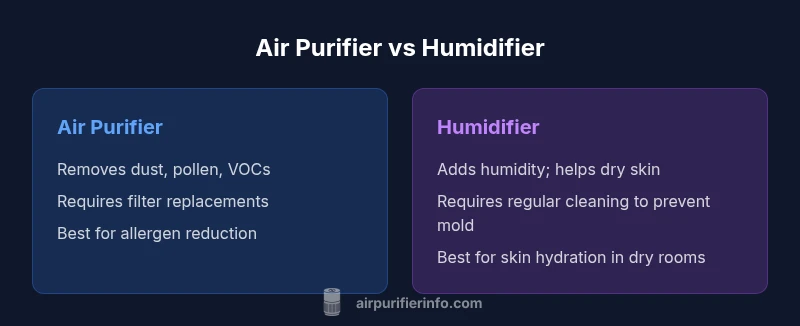
| Primary function | Remove airborne irritants and allergens | Add moisture to dry air |
| Impact on eczema symptoms | Can reduce trigger particles and flare frequency | May improve skin hydration but does not remove airborne irritants |
| Maintenance required | Filter replacements; occasional cleaning | Regular reservoir cleaning; mineral buildup management |
| Best for | Allergen reduction in living spaces | Skin hydration in dry climates (seasonal) |
| Energy usage | Moderate; depends on model | Low to moderate; depends on water use |
What's Good
- Reduces exposure to dust, pollen, and VOCs
- Helpful for households with multiple triggers
- Filters can be upgraded or maintained over time
- Humidification can relieve skin dryness in dry climates
What's Bad
- Not a cure for eczema; must be used as part of a broader skincare plan
- Maintenance costs can add up (filters, water, energy)
- Humidifiers carry mold and mineral risk if not cleaned properly
- Effectiveness depends on correct sizing and placement
Air purifiers are generally a steadier ally for eczema triggers; humidifiers help skin hydration when humidity is controlled
Opt for a purifier to reliably cut airborne irritants. Use a humidifier selectively to address skin dryness, with strict humidity and maintenance controls. A combined, climate-aware setup often yields the best eczema relief.
Questions & Answers
Can an air purifier improve eczema symptoms?
Yes, for many people, reducing airborne irritants can lessen flare triggers. It’s not a cure, but it often lowers the burden of allergens in the home.
Yes—air purifiers can help by removing airborne irritants that commonly trigger eczema flare-ups.
Can using a humidifier worsen eczema?
If humidity becomes too high or if the water isn’t clean, humidifiers can promote mold growth or mineral deposits that irritate the skin. Use distilled water and monitor humidity.
Humidifiers can help if used carefully, but poor maintenance can worsen eczema symptoms.
What features matter most for eczema in an air purifier?
Look for true HEPA filtration, good sealing, and a carbon filter for VOCs. Easy filter access and appropriate room sizing are also important for consistent results.
Focus on true HEPA, sealed housing, and easy maintenance.
Is it safe to run both devices at the same time?
It can be safe and beneficial if humidity is kept in check. Monitor humidity levels and ensure the purifier doesn’t create new moisture sources.
Yes, you can run both, but watch humidity and cleanliness closely.
How do I decide between buying a purifier or a humidifier?
If airborne triggers dominate, start with a purifier. If dryness is the primary issue, a humidifier makes sense. Many homes benefit from a combined plan, tailored to seasonal needs.
Start with the issue that bothers you most, then adjust as symptoms evolve.
Main Points
- Prioritize true HEPA filtration for allergen reduction
- Match device size to the room for effective air changes
- Monitor humidity to avoid mold and over-wetting surfaces
- Use distilled water and regular cleaning for humidifiers
- Consider a combined approach in dry climates or high allergen seasons