How to Stop an Air Cleaner Safely and Quietly
Learn safe, practical steps to stop your air cleaner when needed. This guide covers manual shutdown, unplugging, smart features, maintenance timing, and energy-saving tips for homeowners and renters.


This guide shows you how to stop an air cleaner safely and efficiently, whether you need to pause for noise, energy savings, or maintenance. You’ll learn quick shutdown steps, unplugging tips, and how to handle smart models. Follow model-specific instructions in your manual, with guidance from Air Purifier Info. Whether you’re protecting sleeping family members or reducing electricity use, this approach keeps air quality in mind while you safely power down.
Why You Might Need to Stop Your Air Cleaner
Air purifiers play a key role in reducing dust, odors, and allergens, but there are times you’ll want them off. You might need to pause a purifier late at night, conserve energy, perform maintenance, or relocate the unit. According to Air Purifier Info, continuous operation isn’t always necessary and can shorten filter life or raise energy use. In well-sealed homes, short shutdowns during peak outdoor pollution events can also help balance indoor air quality. This section outlines common scenarios and practical reasons to stop your air cleaner, while noting that occasional runs can still benefit overall air quality depending on room size and occupancy. Always consider the room’s air quality readings, the purifier’s CADR, and the needs of sensitive residents when deciding to stop. Air Purifier Info’s perspective helps homeowners navigate when a pause makes sense and when it’s better to run continuously for protection against irritants.
Safety Considerations Before Stopping
Before you stop an air cleaner, check for any safety concerns that could arise from powering down. Hot exterior panels, exposed electrical components, or a purifier located near water or damp surfaces require extra caution. If you’re in a household with children or pets, ensure cords are out of reach and the unit isn’t in a walking path. Power-down decisions should also consider whether the purifier is part of a larger air-management system (for example, a smart home routine) and whether stopping could affect alarms or sensors in adjacent rooms. By planning ahead and reviewing the user manual, you reduce risk and make the shutdown smooth and predictable. Air Purifier Info emphasizes thoughtful shutdowns to preserve device longevity and indoor air quality.
Manual Shutdown: Using the Power Button
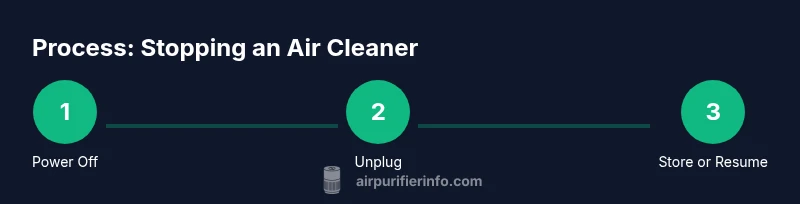
The simplest way to stop most air cleaners is to press the main power button. Do this firmly and observe the display or indicator lights: a dark screen or stopped fan confirms the unit is off. If your model uses a secondary power toggle, switch it to the Off position after confirming the primary control is powered down. If the unit doesn’t respond, wait a few seconds and try again, as some purifiers require a brief reset period. This step ensures there are no residual fan currents that could start the purifier unexpectedly when you unplug or move it.
Unplugging from the Outlet and Cord Management
Unplug the purifier from the wall outlet to eliminate any standby power draw and to prepare for safe relocation or storage. When unplugging, grasp the plug itself rather than pulling the cord to avoid damage. After unplugging, coil the cord loosely and store it in a designated spot to prevent tripping hazards. If you plan to store the unit for a period, consider using a cord clip or tie to keep the cord tidy. Proper cord management reduces clutter and keeps your space safer, especially in high-traffic areas.
For Smart Purifiers: Pausing vs. Disabling Auto-Start
Smart purifiers often offer a Pause mode that slows the fan while maintaining sensor readiness, or an Auto-Start feature that reactivates the unit when air quality worsens. If you plan to stop the purifier temporarily, use the Pause option if available. For longer-term shutdowns, disable Auto-Start in the companion app or through the device settings to prevent unexpected restarts. Document any changes in your routine to avoid confusion later, especially in households with multiple occupants who rely on consistent air cleaning.
When You Need to Stop for Maintenance
Stopping for maintenance is a routine part of purifier care. Turn off the unit and unplug before cleaning exterior surfaces or removing grills. Check the filter status and replace or clean as recommended by the manufacturer; some purifiers require only light wipe-downs, while others need a full filter change. After maintenance, reconnect power and power on to verify proper operation. If you use a timer or scheduling feature, reset it to reflect your current usage pattern. Regular maintenance helps sustain performance and prolongs the device’s life.
Troubleshooting: What If It Won't Stop?
If the purifier continues to operate after you’ve attempted to stop it, look for a timer, remote control, or companion app that could be triggering a restart. Some models have child-lock or proximity-sensing features that react to movement or nearby devices. Verify that no external automations are turning the unit back on, and ensure there is no stuck button or mechanical fault. If the problem persists, consult the manual or contact customer support for a safe diagnostic.
After Stopping: Cleaning, Filter Care, and Next Steps
With the purifier stopped, use a soft microfiber cloth to wipe down the exterior and grills, removing dust buildup. Inspect and replace filters as needed, following the manufacturer’s schedule. Store the unit in a dry area away from direct sunlight if you won’t use it for an extended period. When you plan to resume operation, ensure the filter is properly seated and the device has fully cooled before powering back on. Maintaining a routine keeps air quality consistent and ready for the next cycle.
Tools & Materials
- Owner's manual for your purifier(To identify model-specific shutdown steps)
- Power outlet and accessible switch(Ensure outlet is not controlled by a wall switch or smart plug)
- Cord management accessories (clip/told tie)(Keep cord tidy to prevent tripping)
- Soft microfiber cloth(For gentle exterior cleaning after stopping)
- Screwdriver set (Phillips/Flathead)(Only if you need access for maintenance or filter replacement)
Steps
Estimated time: 5-10 minutes
- 1
Power off with the main button
Press the power button firmly until the unit powers down. Wait for the display to go dark or the fan to stop completely before proceeding.
Tip: If the unit stays on, give it 5–10 seconds and try again; some models require a brief reset. - 2
Check for Pause or Sleep mode
If available, activate Pause or Sleep mode to reduce fan noise without a full shutdown, then turn off if you’re ready to stop completely.
Tip: Pause mode helps prevent sudden restart when you resume use. - 3
Unplug from the outlet
Grasp the plug and remove it from the wall outlet to eliminate standby power draw and enable safe handling.
Tip: Do not pull the cord; pulling can damage the cord and outlet. - 4
Disable auto-start in smart models
Open the companion app or device settings and turn off Auto-Start so the purifier doesn’t restart automatically.
Tip: Note any changes in a household routine to avoid surprises later. - 5
Manage timers or schedules
If you have a timer or automation, disable it or set it to Off until you intend to use the purifier again.
Tip: Clear any conflicting schedules to prevent unexpected startups. - 6
Perform basic maintenance checks
Inspect exterior for dust and wipe it clean; verify that grills are intact and the unit is cool before handling.
Tip: Never clean a hot surface; wait for a cool period before touching internal parts. - 7
Reconnect power for storage or relocation
When moving or storing, coil the cord neatly and place the purifier in a dry, dust-free area.
Tip: Store upright to protect internal components and ensure airflow is not obstructed after reuse. - 8
Power back on to resume use
Reattach the power cord, power the unit on, and check that it runs as expected with the air-flow and indicator lights normal.
Tip: If you notice abnormal sounds or smells, stop and consult the manual before using again.
Questions & Answers
Is it safe to unplug an air purifier while it is running?
Yes, but first turn the unit off to prevent damage or sudden restart. Then unplug safely by gripping the plug, not the cord.
Yes, you can unplug after turning it off; hold the plug to remove it safely.
Can I pause a purifier instead of turning it off completely?
Many models offer a Pause mode that slows the fan while keeping sensors ready. It’s a good option for temporary quieting without a full shutdown.
Yes, use Pause if you just want to reduce noise while keeping readiness.
Will stopping my purifier affect indoor air quality?
Short shutdowns are generally fine, but expect a temporary rise in particulates until you restart. Use targeted operation during high-pollution periods if needed.
A brief stop can slightly raise airborne particles until you restart.
What should I do with filters after stopping?
Check the filter replacement schedule and clean as recommended. There’s no hazard in stopping; just resume maintenance when you restart.
Check and replace or clean filters as scheduled when you resume use.
Why won’t my purifier stay off?
Timers, auto-start, or remote controls can trigger a restart. Review app settings or the user manual to disable automatic startup.
Timers or auto-start may be reactivating it; check settings.
Is it safe to store an air purifier on its side?
Storage is best upright on a dry surface. If needed for brief moves, minimize tilting and ensure vents aren’t blocked.
Store upright when possible; avoid long-term side storage.
Watch Video
Main Points
- Power down before unplugging to ensure safety.
- Smart purifiers may require pausing instead of full shutdown.
- Regular maintenance supports long-term performance.
- Manage cords and storage to prevent accidents.
- Check safety features if the unit behaves unexpectedly.