How to know if an air purifier is good: a buyer's guide
Learn how to evaluate air purifiers using CADR, filtration, noise, energy use, and independent testing. A practical, buyer-focused guide for homeowners and renters seeking real indoor air quality improvements.


To know if an air purifier is good, start with room size and CADR alignment: the purifier should move enough air for your space. Check filter type (HEPA or equivalent) and replacement availability. Compare energy use and noise levels, then read independent tests or real-world reviews to verify performance.
Why Knowing a Good Air Purifier Matters
For homeowners and renters, choosing a good air purifier is a step toward healthier indoor air. When you know what to look for, you avoid costly mistakes and you get cleaner air faster. According to Air Purifier Info, understanding real-world performance matters more than glossy specs. The Air Purifier Info team notes that a well-matched purifier reduces dust, odors, and allergens more reliably than a model chosen by price alone. In this section, we lay the groundwork for understanding what makes a purifier genuinely effective, not just popular.
Defining a 'Good' Air Purifier
What counts as "good" varies by space and needs. For one person, a quiet purifier with sturdier filters in a small bedroom may be perfect; for a family in a busy living area, a larger unit with stronger filtration and smarter sensors could be better. A good purifier reliably reduces contaminants, but it should also be affordable to operate over time. Your goal is balance: strong cleaning power without excessive noise or cost. The Air Purifier Info team emphasizes that no single spec guarantees quality—contrast CADR, filter efficiency, and user experience, then weigh trade-offs.
Core Metrics to Check
Key metrics help you gauge performance without bias. CADR (Clean Air Delivery Rate) and room size compatibility tell you how fast a purifier cleans that particular space. Filtration matters: a true HEPA filter (H13/H14) captures most fine particles, while an activated carbon stage helps odors and some VOCs. Look at energy use and noise at typical settings; higher power often means more noise and higher running costs. Filter replacement frequency and cost are also part of the total ownership picture. Air Purifier Info analysis shows that performance scales with real-world use, not just lab numbers.
How to Test a Purifier at Home
Testing at home gives practical insight. Start by placing the purifier in the intended room and noting the main dust sources. Run the unit on a normal setting and observe air freshness over several hours. Use a portable air quality monitor or rely on the purifier's indicators to gauge changes in PM2.5 and other particles. If you notice significant odor removal and consistent air quality improvement, you likely have a good fit. Document results to compare models later.
Interpreting Specifications vs Real World
Manufacturers present impressive specs, but real-world conditions vary. A high CADR on paper may translate to only modest improvements in a crowded room if the purifier is frequently blocked by furniture or placed near walls. Conversely, a compact unit with smart sensors can outperform a larger model in busy spaces if it adjusts appropriately. The lesson is to test in your own space, read independent testing when available, and watch for marketing puffery. Air Purifier Info's research suggests relying on real-world tests over marketing claims.
How to Compare Models Without Bias
Create a side-by-side checklist across models you’re considering. For each model, confirm room-size compatibility, filter type, filtration stages, noise levels, and energy use. Note replacement filter prices and availability, warranty terms, and service support. Use independent reviews and third-party tests as tiebreakers rather than marketing claims. A structured comparison helps homeowners and renters make confident choices.
Maintenance, Costs, and Longevity
Total cost of ownership matters. Some purifiers have cheap upfront prices but expensive filters or frequent replacements. Check how often filters need replacement, the price per filter, and whether pre-filters are washable. Also consider energy use at typical speeds; a purifier with efficient electronics can save money over years. Keep an eye on indicator lights for maintenance and factor in warranty coverage.
Making a Final Choice
With your criteria defined, you can assemble a short list of two or three models. Prioritize real-world performance, trusted filter technology, and predictable running costs. Ask for test results or independent reviews for the shortlisted models, and consider a trial period if available. The Air Purifier Info team recommends anchoring your decision to objective measurements and practical usage in your home, not glossy marketing claims.
Tools & Materials
- Air quality monitor or purifier with built-in sensors(Use PM2.5, VOC, and particle counters if available)
- Measuring tape or room size calculator(Accurately determine square footage and ceiling height)
- Checklist sheet or note-taking app(Record specs, tests, and impressions for each model)
- Access to model manuals or spec sheets(Confirm filtration stages, filter cost, and warranty)
Steps
Estimated time: 30-45 minutes
- 1
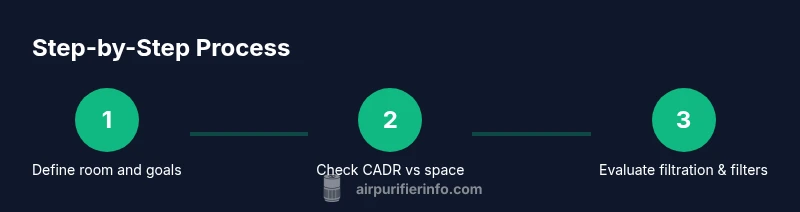
Define room size and air-cleaning goals
Measure the room and determine how quickly you want the air to feel cleaner. Set a practical target for air changes per hour (ACH) based on the room’s use and occupant sensitivity. This baseline guides every model you consider.
Tip: Document room dimensions and expected ACH in your checklist. - 2
Check CADR compatibility with your space
Compare CADR ranges to your room size. A larger CADR typically cleans faster, but only if the unit can be operated comfortably in that space. Avoid models whose CADR is far outside your target range.
Tip: Use a simple formula: desired CADR should roughly equal room square footage times a factor tied to ACH goals. - 3
Verify filtration stages and filter type
Ensure the purifier uses a true HEPA filter (H13/H14) or equivalent and includes carbon for odors or VOCs if that matters to you. Check replacement filter availability and costs.
Tip: Prefer models with washable pre-filters to extend overall life. - 4
Assess noise and energy use
Consider noise at typical operating speeds and the energy impact of running at those speeds. Higher power settings can be loud and costlier over time, so balance performance with comfort.
Tip: Look for a low-dB mode suitable for bedrooms or study spaces. - 5
Look for independent tests and certifications
Search for third-party tests or certifications beyond marketing claims. Independent tests give a truer sense of performance in realistic conditions.
Tip: Note the test conditions to compare apples-to-apples with your space. - 6
Estimate ongoing costs
Factor in filter replacement frequency and price, plus annual electricity usage. A model with affordable filters and efficient operation wins long-term.
Tip: Create a 1-3 year cost estimate per model for a fair comparison. - 7
Compare features that matter to you
Assess smart features (auto mode, sensors, remote control), warranty, and service availability. Prioritize features that affect real-world usefulness in your home.
Tip: Skip gimmicks; prefer features that support consistent performance. - 8
Test in your space and decide
If possible, trial two or three top models in your home. Compare air quality readings, odor changes, and daily usability over 1-2 weeks.
Tip: Keep a short trial log to justify your final choice.
Questions & Answers
What is CADR and why does it matter?
CADR (Clean Air Delivery Rate) indicates how quickly a purifier cleans a room. A higher CADR generally means faster reduction of particles, but you must pair it with room size and noise tolerance to ensure practical performance.
CADR tells you how fast the purifier cleans air. Higher numbers are better, but only if the unit fits your room and runs quietly enough for daily use.
Should I always choose a purifier labeled HEPA?
Yes for most users. A true HEPA filter captures a high percentage of fine particles. Verify it is truly certified and that replacement filters are available and affordable.
Yes. Look for true HEPA filtration and confirm replacement parts are easy to obtain.
How long do filters last and how much do replacements cost?
Filter life varies by usage and environment. Check the manufacturer’s recommended replacement interval and price per filter to estimate ongoing costs.
Most filters need replacement every several months to a year depending on use. Check costs and plan accordingly.
Are energy-efficient purifiers better for long-term use?
Energy efficiency reduces running costs over time. Compare models with clear energy data and prefer those with lower watts at standard settings.
Yes, energy-efficient models save money over time and reduce operating costs.
Can air purifiers remove odors and gases effectively?
Purifiers with activated carbon or other adsorbent media help with odors and some VOCs, but effectiveness varies by model and room conditions.
Odors can be reduced with carbon filters, but results depend on the source and room layout.
Are compact purifiers suitable for large rooms?
Compact units can work in large rooms if they have adequate CADR and regular operation, but you may need a higher-capacity model for consistent performance.
Small purifiers can do the job only if they have enough power for the space; otherwise, bigger is better.
Watch Video
Main Points
- Match CADR to room size for effective cleaning.
- Prioritize true HEPA filtration and accessible filter replacement.
- Balance noise, energy use, and running costs.
- Rely on independent testing, not marketing claims.
- Plan for maintenance costs in total ownership.