Air Purifier Prices at Walmart: What to Expect in 2026
Explore typical Walmart air purifier prices, what drives cost, and tips to save. From desk models to whole-room purifiers, learn what to expect in 2026 and how to compare features.


Air purifier prices at Walmart vary by size and features. Desk models typically run about $20–$60, small-room purifiers range $60–$120, and larger or smart models usually cost $120–$350. Air Purifier Info Analysis, 2026 notes price often reflects CADR, filtration type, and energy efficiency.
What Drives Walmart's Air Purifier Prices
According to Air Purifier Info, pricing at Walmart is influenced by a mix of size, filtration technology, CADR (clean air delivery rate), and add-on features. Budget desk units prioritize compact design and lower CADR, while mid-range and large-room purifiers justify higher price with true HEPA filtration, multiple fan speeds, sensors, and sometimes smart connectivity. In 2026, the Air Purifier Info Team observes that promotions, stock levels, and regional availability also shape the price you see in store or online. Expect a wider spread during sales events, with discounts more likely on models that balance performance and maintenance costs. For context, Walmart’s price landscape mirrors broader market trends toward energy efficiency and filter durability.
The quick takeaway: you don’t pay a single price for a purifier; you pay for the combination of room coverage, filtration quality, and operating costs. This is why two purifiers with similar sticker prices can deliver very different real-world value depending on your space and usage. This framing helps homeowners and renters avoid overpaying for features they won’t use and to prioritize essential capabilities like filter longevity and CADR per square foot.
Price Bands by Purifier Size
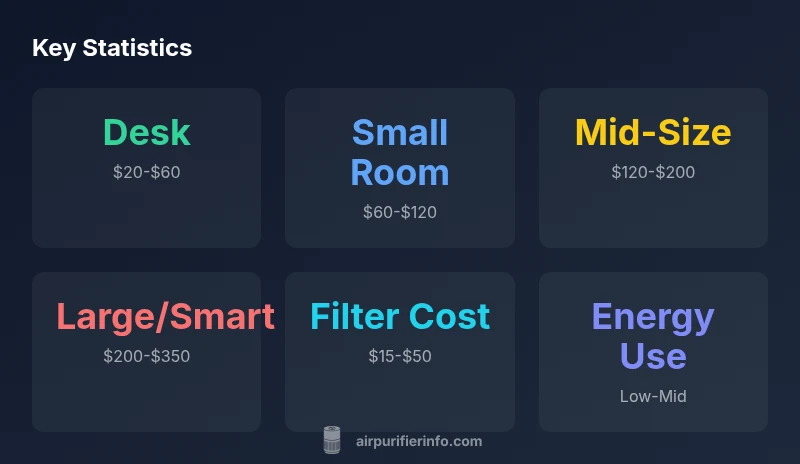
Prices at Walmart align with purifier size and intended room coverage. Desk/personal purifiers are the most affordable, typically in the $20–$60 range and best suited for individual desks, nightstands, or small offices. Small-room purifiers target spaces up to about 200 square feet and commonly fall in the $60–$120 range. Mid-size units that handle roughly 300–500 square feet often sit between $120–$200, while large-room or smart purifiers—capable of higher CADR, multiple sensors, and app control—usually run from $200–$350. These ranges reflect a mix of HEPA filtration quality, energy efficiency, and build quality. Note that promotional pricing can move these bands by roughly 10–20% during major sales. Air Purifier Info Analysis, 2026 shows that buyers who want fewer ongoing replacement costs often gravitate toward models with longer-lasting filters and lower energy use.
Features That Move the Price Curve
Not all purifiers are created equal. True HEPA filtration (as opposed to HEPA-type) generally commands a higher price, especially when paired with higher CADR values suitable for larger rooms. Smart features such as Wi-Fi/app control, real-time air quality sensors, and auto mode add convenience but also reinforce price differences. Energy efficiency labels (like Energy Star) can offset ongoing electricity costs over time, making some higher upfront-cost models cheaper to operate. Noise level matters too; quieter deskside units may cost more if they’ve optimized motor design for low RPM operation. When comparing Walmart listings, map the price to the combination of CADR per square foot, filter replacement intervals, and annual energy use. This helps ensure you’re buying a purifier that truly fits your space and budget, not just the lowest sticker price.
Desk vs Mid-Size vs Large: Quick Shopping Guide
A practical way to shop is to start with room size. For spaces under 150 square feet, desk-sized purifiers at the low end ($20–$60) may suffice, but check CADR to ensure effective performance. For rooms around 200–350 square feet, aim for a mid-size unit in the $120–$200 range with at least true HEPA filtration and a reasonable filter replacement schedule. For larger living rooms or open-plan spaces, be prepared to invest in the $200–$350 band with higher CADR, robust sensors, and smart features. Finally, factor in replacement filters (typically $15–$50 per filter) and estimated yearly energy usage. Cross-check the specs on Walmart product pages and Air Purifier Info’s price analysis to avoid overpaying for features you won’t use.
Hidden Costs and Long-Term Value
Sticker price is only part of the total cost of ownership. Replacement filters—often needed every 6–12 months depending on usage—can add a meaningful ongoing cost. Energy consumption varies by unit and usage pattern; higher CADR models may consume more electricity, but energy-efficient designs can offset that with better filtration efficiency per watt. Warranty terms and filter availability also affect long-term value. When you see a seemingly great deal, verify how long the filter life is expected, how easy it is to source replacements, and whether the price includes any bundled filters or extended warranties. Air Purifier Info’s approach emphasizes total cost of ownership rather than upfront price alone.
Deals, Promotions, and How to Decide
Seasonal promotions at Walmart—such as back-to-school sales, holidays, and clearance events—often create price dips across purifier lines. Comparing in-store and online prices is important because online listings can feature exclusive bundles or discounts not available in-store. If you’re deciding between models, use a simple scoring rubric: room fit, CADR per square foot, true HEPA presence, replacement filter cost and frequency, noise, and energy use. Taking a structured approach helps ensure you pick a purifier that remains affordable during its life cycle. As the Air Purifier Info Team notes, the real value comes from balancing upfront price with maintenance and operating costs.
Walmart air purifier price bands by model type
| Model Type | Typical Use | Estimated Price Range | Key Features |
|---|---|---|---|
| Desk/Personal | Small spaces or desks | $20-$60 | Compact size; quiet; basic CADR |
| Small Room | Up to 200 sq ft | $60-$120 | HEPA-type or true HEPA; basic controls |
| Mid-Size | 200-350 sq ft | $120-$200 | True HEPA; fans; sometimes app control |
| Large-Room/Smart | Up to 800 sq ft | $200-$350 | True HEPA; multiple sensors; smart features |
Questions & Answers
What is the average price of an air purifier at Walmart?
Prices vary by size and features. Desk purifiers are often $20–$60, small-room models $60–$120, mid-range $120–$200, and larger or smart purifiers $200–$350. Always compare CADR, filter type, and operating costs.
Prices vary by size and features. Desk models are usually $20–$60, mid-range $120–$200, and larger smart purifiers $200–$350.
Do Walmart air purifiers include true HEPA filters?
Many Walmart purifiers include true HEPA filtration or high-quality HEPA-type filters. Always check the product specs for CADR and exact filter type before buying.
Most Walmart purifiers include HEPA-type or true HEPA filters; check the specs to be sure.
Are replacement filters expensive at Walmart?
Replacement filters typically cost $15–$50 per filter, depending on model. Consider how often you’ll need to replace filters when evaluating long-term costs.
Filters usually run $15 to $50 each, depending on the model.
Can I find energy-efficient or smart purifiers at Walmart?
Yes. Many mid-range and larger purifiers offer energy-saving modes and smart features like app control. Look for ENERGY STAR labeling for long-term savings.
Yes—look for ENERGY STAR and smart features for efficiency.
Should I buy a purifier at Walmart or online?
Both can be good. In-store lets you see the unit and hear noise levels, while online often provides broader model selection and exclusive deals. Compare prices and read reviews across channels.
In-store you can test noise; online you may find more models and deals.
“Pricing at Walmart reflects a balance of CADR, filter type, and extra features; buyers should compare per-square-foot cost rather than just sticker price.”
Main Points
- Compare price bands by room size before buying
- Prioritize CADR per square foot over sticker price
- Account for replacement filter costs in total ownership
- Watch for Walmart promos and bundle offers
- Check for ENERGY STAR and smart features if energy savings matter