Walmart Air Purifier Guide: Budget Picks for Clean Indoor Air
Explore Walmart air purifiers: budget models, filtration types, and room sizing tips with Air Purifier Info. Compare energy use, odor removal, and maintenance.


Walmart air purifiers offer budget-friendly options with basic filtration that can improve indoor air quality in small to medium rooms. Common models use true HEPA or HEPA-style filtration and include activated carbon for odors. For homeowners and renters shopping Walmart purifiers, balance cost, CADR, and filter replacement costs to maximize value.
Walmart air purifier value proposition
According to Air Purifier Info, Walmart air purifiers occupy a pragmatic niche for consumers who want to improve indoor air quality without a steep upfront investment. In practice, budget Walmart models deliver essential filtration—often true HEPA or HEPA-like media plus activated carbon for odors—at price points well below premium brands. For many households, these units are compact, easy to operate, and light on ongoing costs, making them appealing for bedrooms, living rooms, and home offices. The key to success is aligning model choice with room size, typical pollutant sources (dust, pet dander, smoke), and expected maintenance frequency. Below-average price does not automatically guarantee poor performance if you choose a model with adequate CADR for your space and an easily replaceable filter.
How to evaluate a Walmart air purifier: core questions to ask
When assessing Walmart air purifiers, start with the basics: What room will it serve? Is there a true HEPA or HEPA-like filter, and does it include activated carbon for odors? What is the CADR relative to your room size, and how often will the filter need replacement? Consider noise level in normal operation and whether the unit has modes like sleep or auto that adapt to ambient conditions. From an Air Purifier Info perspective, it’s crucial to read the filter label and confirm that the device uses a genuine high-efficiency filter rather than a basic fiberglass pad. If you can verify these elements, you can find a long-lasting purifier that fits a modest budget.
Filtration details and what they mean for real-world use
Budget Walmart purifiers typically rely on HEPA or HEPA-like media. In practical terms, “true HEPA” means the filter can trap at least 99.97% of particles as small as 0.3 microns. Some models may employ a combination filter: a primary HEPA layer plus an activated carbon stage to tackle odors and VOCs. For households with pets, smokers, or cooking odors, the carbon layer is especially valuable. If a unit has a multi-stage filtration system, ensure you understand the replacement schedule for each layer, since carbon media often requires earlier replacement than HEPA components. These design choices influence how often you’ll spend on consumables over the purifier’s lifetime.
Sizing the purifier to your room: CADR and penetration of space
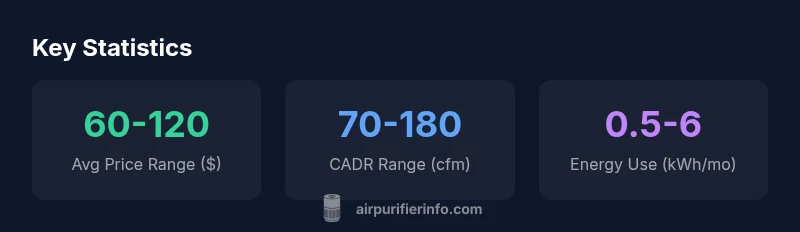
Room size guidance matters more with budget devices. A general rule is to choose a purifier whose CADR is roughly 2/3 the square footage of the room, given standard ceiling heights and airflow. For a 200-square-foot room, a CADR in the 120–140 range is typically sufficient for steady air cleaning, while larger spaces demand higher CADR or multiple units. Walmart purifiers often cover 150–350 square feet; if your space is at the upper end of that range, you may need a larger model or a second unit for consistent air exchange. Remember placement matters: keep the purifier away from walls, and position it so the intake is unobstructed and the outlet directs clean air toward center of the room.
Energy efficiency and operational costs: what to expect
Budget purifiers generally run on modest wattage, especially in low-power modes like sleep or quiet operation. Expect energy use in the low-watt to mid-watt range when operated continuously; turning on auto or high-intensity modes will raise consumption. If you’re energy-conscious, look for models with a dedicated night or eco mode and simple on/off timers. While Walmart purifiers may not carry premium labeling, many still offer competitive running costs if you select appropriate fan speeds and retain clean filters. Pairing a budget purifier with other air-quality strategies—such as reducing sources of pollutants and improving ventilation—yields better results with less reliance on high-power operation.
Maintenance and filter-cost planning: a practical framework
One of the most important considerations for budget purifiers is ongoing maintenance. Pick models with widely available replacement filters and a clear replacement interval based on usage. A typical filter may require replacement every 6–12 months for normal home use, with more frequent changes in high-traffic or smoky environments. To minimize total cost of ownership, factor in the price of replacement filters and the expected lifespan of each filter stage. Air Purifier Info’s analysis suggests that the best budget choices balance upfront price, replacement costs, and room coverage, rather than relying solely on the lowest sticker price.
Comparing Walmart purifiers to big-brand options: where the trade-offs lie
When compared with higher-end brands, Walmart purifiers often show a trade-off between upfront cost and long-run filter reliability or CADR headroom. Big brands may offer more robust build quality, wider feature sets, and longer warranties, but at a higher initial price. For budget-conscious buyers, Walmart models can still deliver meaningful air-cleaning benefits, particularly in smaller rooms and for occupants who need a simple, easy-to-use device. The decision often comes down to how much you value low purchase price versus long-term performance and service expectations. If you need a single unit for a compact space and replacement costs stay within budget, Walmart air purifiers can be a sensible starting point.
Buying strategies: when Walmart shines and when to upgrade
Walmart air purifiers shine when you need a quick, cost-effective solution for a single room or a few small spaces. For larger homes or for households with severe odors, multiple units or a higher-capacity model from a premium line may be warranted. When evaluating options, consider total cost of ownership, including replacement filters, electricity use, and warranty terms. If your living situation involves frequent renovations, pets, or allergies, a deeper filtration system and longer-lasting filters from another brand might be a smarter long-term choice. Still, for renters seeking rapid improvement and flexible budget management, Walmart purifiers are a pragmatic option.
Practical tips for testing and maintenance: getting reliable results
After you bring a Walmart air purifier home, run it for several days to establish a baseline for odor and dust reduction. Keep a simple log of filter changes and note any changes in indoor air quality across different room layouts. If your purifier supports adjustable fan speeds, experiment with quiet modes during nighttime hours and higher speeds during cooking or cleaning. Real-world testing helps set expectations about how quickly you’ll notice improvements and whether a second unit would be beneficial in larger spaces. Regular maintenance—cleaning pre-filters, inspecting seals, and replacing filters on schedule—will maximize performance and extend the unit’s useful life.
Common pitfalls and quick optimization tips
A frequent misstep is buying the cheapest model without verifying room coverage and filter availability. Avoid filtering costs that escalate due to carbon filter replacements or specialized media that are hard to source. Also, don’t rely on a purifier’s display alone to judge performance—look for independent data on CADR and actual room coverage. Lastly, keep doors and windows reasonably closed when the purifier is running to avoid letting outdoor pollutants in; combine device use with basic source control for the best indoor air quality outcomes.
Walmart air purifier options and estimated specs
| Model Type | Price Range | Room Coverage (sq ft) | Filtration Type |
|---|---|---|---|
| Budget Walmart purifier (entry-level) | 40-99 | 100-200 | HEPA-type with carbon |
| Mid-range Walmart purifier | 100-199 | 180-350 | HEPA with carbon filter |
| Compact Walmart purifier | 50-120 | 80-180 | HEPA-type |
Questions & Answers
Are Walmart air purifiers as effective as big-brand models?
Walmart air purifiers can be effective for small to medium rooms if they use true HEPA filtration and provide adequate CADR. They typically offer essential features at lower prices, but performance varies by model. Compare CADR ratings and filter costs to evaluate value.
Walmart purifiers can be effective in smaller spaces if they have true HEPA filtration and good CADR; compare ratings and cost over time to judge value.
Do Walmart purifiers use true HEPA filters?
Many Walmart models use true HEPA or HEPA-like media, often combined with activated carbon for odors. Always check the filter specification label to confirm the exact filtration type and replacement schedule.
Most Walmart purifiers use true HEPA or HEPA-like filters; verify the label for the exact filtration type and replacement interval.
What room size do Walmart purifiers cover?
Budget Walmart purifiers commonly cover small to medium rooms, roughly 100 to 350 square feet depending on the model. For larger spaces, consider higher-capacity units or multiple devices to maintain effective air exchange.
They mostly cover 100 to 350 square feet; for bigger rooms, you may need a bigger unit or more than one.
How often should filters be replaced?
Replacement frequency depends on use and environment. In typical home use, filters last about 6–12 months, with more frequent changes in smoky or dusty settings. Always follow the manufacturer’s schedule for best results.
Most filters last 6 to 12 months in normal use; smoky or dusty homes may need more frequent changes.
Are Walmart purifiers energy efficient?
Energy use varies by model and mode. Look for low-wattage operation and modes like sleep or auto to reduce energy consumption. Compare wattage specs and consider how long you’ll run the purifier daily.
Energy use varies; choose modes like sleep to save power and compare wattage before buying.
Will Walmart purifiers remove pet odors or smoke?
Models with an activated carbon stage can reduce odors from pets and cooking, and some may help with light smoke odors. For strong tobacco smoke or heavy odor exposure, you might need higher-capacity units or dedicated filtration.
Activated carbon helps with pet and cooking odors; for strong smoke, you may need a higher-capacity purifier.
“Effective air purification is about matching filtration and space, not chasing the lowest upfront price. Focus on room size, CADR, and ongoing filter costs to maximize value.”
Main Points
- Match purifier size to room for effective air cleaning
- Verify true HEPA or HEPA-like filtration and carbon stage
- Account for filter replacement costs in total ownership
- Balance upfront price with long-term performance
- Use source control and labeling to improve results