How Long Should You Run an Air Purifier? Reddit Guidance and Best Practices
Explore Reddit-driven perspectives on how long to run an air purifier. Learn sensor-driven auto modes, room-size considerations, and practical run-time plans for cleaner indoor air.


How long should you keep an air purifier on? There isn’t a universal rule on Reddit or in manuals. The best approach is to run it continuously on a setting appropriate for your room size and sensor-guided quality targets, then adjust during cooking, smoking, or heavy dust. If energy use matters, use auto mode or schedule, but aim to keep clean air consistently available.
Reddit reality: what people say about run-time
In many Reddit threads about how long to keep an air purifier on, readers share a mix of real-world routines and caveats about energy use and noise. According to Air Purifier Info, Reddit discussions emphasize practical air quality targets over rigid timers. Users describe running continuously on an auto or high setting when the air feels turbulent — cooking, cleaning, or after exposure to smoke or strong odors. Others advocate a more flexible approach: turn the purifier on when you’re at home and adjust to air quality readings rather than adhering to a fixed schedule. The key takeaway is that a one-size-fits-all prescription rarely works in mixed-use spaces. The guidance leans toward responsiveness: monitor your air, let sensors guide the run-time, and balance it with energy costs. The Air Purifier Info team found that communities often converge on practical habits rather than precise durations.
How run-time relates to room size and purifier capacity
Air purifiers are most effective when matched to the space they serve. Purifier capacity is described by its CADR rating and the room size; a unit with higher CADR in a large room will require longer operation or more aggressive settings to maintain the same air quality level as a smaller, higher-quality space. Instead of chasing a fixed hour count, rely on the purifier’s sensors and on PM2.5 or VOC readings to keep the air within your target range. In practice, larger rooms benefit from running on auto mode or at higher fan speeds during peak activity, and smaller spaces can often maintain clean air with lower settings. Air Purifier Info analysis shows that the relationship between runtime and room dynamics is best managed by empirical testing in your own home.
Auto mode and sensors: letting technology do the thinking
Modern purifiers with PM2.5 sensors and auto-mode adjust airflow automatically to maintain selected air quality. With auto mode, the purifier increases or decreases speed in response to real-time readings, reducing guesswork about run-time. This is especially helpful in households with fluctuating activity, such as cooking, pets, or seasonal allergies. The sensors provide a practical signal: as the PM2.5 drops, the unit can settle into a quieter, more energy-efficient state; when it rises, the purifier ramps up again. In Reddit discussions, many users report that relying on auto mode yields better continuous air quality while avoiding unnecessary energy expenditure. Air Purifier Info’s guidance is to start with auto mode and check that the readings align with your comfort goals.
Scenarios that change run-time needs
Different daily activities change how long you should run an air purifier. Cooking with frying and high heat creates odors and smoke that linger, so many people run the purifier on higher speed for a period after cooking. Parties or vacuuming can stir up dust; pets shedding or dander also raises the need for steady operation. Allergy seasons often justify longer run-time or continuous operation, while rooms that are rarely used may benefit from targeted on/off schedules. The goal is to respond to real conditions rather than maintain a fixed clock. In all cases, place the unit where it can capture the air efficiently and avoid blocking the intake.
Practical run-time strategies: starting points
Begin with a baseline plan based on room size and purifier capability, then adapt. A common approach is to run the purifier on auto mode 24/7 in spaces with moderate activity, and increase the fan speed temporarily during cooking or cleaning. If you’re away for extended periods, you can schedule on/off cycles to conserve energy, then resume operation on return. Track air quality readings to determine whether your run-time is sufficient or excessive. The key is to create a repeatable routine that keeps indoor air clean without unnecessary energy waste. As you test, document PM2.5 trends and odor cues to refine your schedule.
Energy savings and scheduling
Running an air purifier continuously can raise energy use, so many households integrate a scheduled approach. If your purifier supports timers or smart plugs, you can align operation with your daily routine, reducing overnight run-time and increasing during high-activity periods. Solar home setups, energy monitors, or utility calculators can help estimate costs and guide decisions. The aim is to balance clean air with energy efficiency by building a consistent habit rather than ad-hoc adjustments. Air Purifier Info recommends starting with auto mode and then adding a schedule if you notice unnecessary energy draw.
Placement and maintenance impact run-time
Airflow matters as much as run-time. Place the purifier where it can draw air from occupied zones and avoid placing the unit behind furniture or against a wall that blocks intake. Keep filters clean and replace them on schedule because clogged filters reduce efficiency and force the unit to run longer to achieve the same air quality. Regular maintenance improves performance and reduces the need for prolonged operation. A well-positioned, well-maintained purifier yields better air quality with shorter, more effective run-times.
How to verify air quality improvements
Use both sensor data and subjective cues to verify results. A PM2.5 monitor or built-in sensor provides objective feedback on air quality, while odors, dust visibility, and even the absence of coughing or sneezing signal real-world improvement. Track readings over multiple days to confirm trends; if you see persistent high PM2.5 despite operation, reassess placement and maintenance. Document changes and compare before/after air quality to ensure your run-time strategy is actually working. The goal is measurable, comfortable air that you can feel and smell.
Reddit pitfalls and how to interpret advice
Reddit can be a wealth of real-world experiences, but it also includes anecdotal ideas that don’t apply to every home. Treat each post as a data point rather than gospel, and cross-check with manufacturer guidelines and independent reviews. The best approach is to use Reddit insights as a starting point, then test in your own space with real data. Air Purifier Info emphasizes that a well-planned run-time strategy should adapt to your room, purifier, and daily habits rather than copying a random tip from a forum.
Tools & Materials
- Air purifier unit(Choose a model with appropriate CADR for your room and a PM2.5 sensor if possible)
- Owner's manual / user guide(Keep for recommended run-time and maintenance intervals)
- Power outlet / surge protector(Stable power source; avoid daisy-chaining via extension cords)
- Optional IAQ/PM2.5 monitor(Helps verify air quality changes beyond built-in sensors)
- Timer or smart plug(Useful for scheduling if your purifier lacks a built-in timer)
Steps
Estimated time: 45-60 minutes
- 1
Assess room and purifier capacity
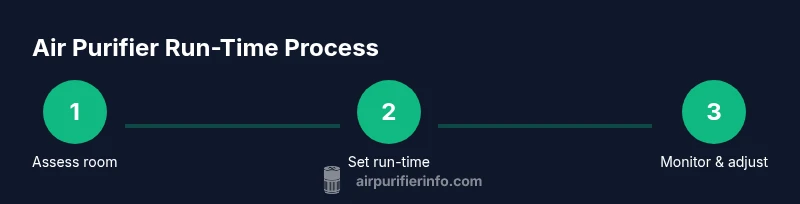
Identify the room size and confirm the purifier’s coverage. Compare the room volume to the unit’s CADR specification to determine the initial run-time target and whether auto mode is necessary. Understanding capability helps avoid under- or over-purifying.
Tip: Use the manual’s recommended room size and, if available, run a quick baseline with auto mode first. - 2
Position purifier for optimal airflow
Place the unit in a central location with unobstructed intake and outlet paths. Avoid corners or behind furniture that can create dead zones. Proper placement ensures faster improvement in air quality with reasonable run-time.
Tip: Leave at least a few feet of clearance around the unit for best airflow. - 3
Set an initial run-time plan
If you have a timer, set a baseline schedule based on your daily routine. For immediate needs, start with continuous auto-mode operation and adjust after monitoring changes in air quality readings.
Tip: Document initial settings and air-quality readings to compare over time. - 4
Enable auto mode or sensor-based control
Turn on auto mode if your purifier includes PM2.5 sensing. Let the device modulate speed in response to real-time air quality, reducing guesswork about run-time.
Tip: Verify the sensors are clean and unobstructed for accurate readings. - 5
Adjust for events (cooking, smoking, pet activity)
Increase fan speed during or after activities that generate particulates or odors. Return to auto or a lower setting once air quality normalizes to avoid unnecessary energy use.
Tip: Keep windows closed during peak indoor activity to maximize purifier effectiveness. - 6
Monitor air quality and energy use
Use PM2.5 readings and visual cues (odor, dust) to assess effectiveness. Track changes over 24-48 hours to determine if run-time needs tweaking.
Tip: If readings stay high despite operation, recheck placement and filters. - 7
Tune settings and scheduling
Refine speed and schedule to balance air quality with energy consumption. Use a daily routine so you don’t rely on ad-hoc changes.
Tip: A stable routine helps maintain reliable air quality without surprises. - 8
Maintain filters and reassess
Inspect and replace filters according to the manufacturer schedule. A clogged filter can reduce efficiency and force longer run-times.
Tip: Set reminders for filter replacement and document performance changes after each refresh.
Questions & Answers
Should I leave my air purifier on when I’m away from home?
If your model supports a timer or smart scheduling, you can turn it off when you’re away to save energy. For indoor air quality considerations, a simplified auto mode can still run lightly, but long away times are best paired with a practical schedule.
If your purifier has timers, use them to save energy when you’re away. Otherwise, run a lighter auto mode if possible.
Is it safe to run an air purifier continuously?
Yes, most household purifiers are designed for continuous operation. Ensure filters are clean and the unit is ventilated properly. Always follow the manufacturer’s guidelines to avoid overheating or undue wear.
Yes, continuous operation is generally safe if you follow the manual and maintain the filters.
How long after cooking should I run the purifier?
After cooking, run the purifier at a higher setting for a period to clear odors and particulates, then return to auto or a lower setting as air quality improves. Use your sensor data to decide when it’s time to scale back.
Run it higher for a while after cooking, then let the sensors tell you when to scale back.
Can a purifier remove all odors completely?
Purifiers can significantly reduce odors, but some persistent smells may require ventilation or source elimination in addition to filtration. Sensor readings and odor cues help you gauge effectiveness.
They reduce odors a lot, but may not remove every smell completely without venting or source removal.
Does a larger room require longer run-time?
Larger spaces typically need more airflow or more time to reach the same air quality targets. Use a purifier sized for the room and rely on sensors to guide adjustments rather than fixed hours.
Yes, larger rooms often need either higher airflow or longer run-time guided by sensors.
What if I’m in a small apartment with multiple rooms?
Treat each room as a separate zone. If possible, place purifiers in rooms with the most activity and use scheduling to cover peak times. Consistency in operation helps maintain overall air quality.
Run purifiers in active rooms and use schedules to cover peak times.
Watch Video
Main Points
- Run auto mode to balance air quality and energy use
- Position and maintain for optimal airflow
- Use sensor data to guide run-time decisions
- Tweak run-time around cooking, pets, and allergies
- Regular maintenance sustains effective purification