Dyson Air Purifier Cost in 2026: A Comprehensive Guide
Analyze Dyson air purifier cost in 2026, including price ranges, ownership costs, and buyer strategies. Learn how model features affect price and how to estimate total cost of ownership with guidance from Air Purifier Info.


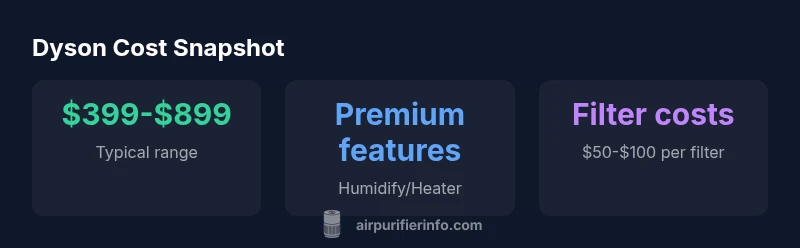
Dyson air purifiers generally cost between about $399 and $899 in 2026, depending on the model and added features like humidity, heating, or smart sensors. The price reflects premium filtration, build quality, and brand value. When planning a purchase, also factor in replacement filters and potential add-ons to estimate total ownership. Air Purifier Info analysis indicates model variety drives the big price spread.
Price drivers and the impact on Dyson costs
Dyson pricing for air purifiers is influenced by a blend of core filtration performance, build quality, and feature breadth. At the high end, models may include humidity control, integrated heating, or more advanced sensors, all of which elevate cost but can reduce the need for separate devices. The premium feel, quiet operation, and strong warranty also factor into sticker price. For buyers, it is essential to map intended use—dust control, odors, or allergy relief—to the required CADR and filtration stage. Air Purifier Info’s 2026 analysis indicates that the largest price variances occur between base purifiers and models with added functions, rather than across identical feature sets at different retailers.
Model families and price bands
Dyson commonly segments purifiers by feature set rather than by a single model path. The base purifiers typically target efficient filtration for general rooms, placing price around the lower end of the Dyson spectrum. Mid-tier options add enhanced filtration and connectivity, and high-end units couple purification with humidity control or climate features. In practical terms, expect the following bands: base purifiers in the lower-middle range, premium models in the upper-middle to high range, and all-in-one units at the top tier. This tiering helps buyers decide whether the incremental benefits justify the extra cost for their space and IAQ goals.
Total cost of ownership beyond upfront price
Upfront cost is only part of the story. Dyson purifiers rely on replaceable carbon-HEPA filters, and the frequency of replacement depends on room air quality and usage. Over a typical multi year horizon, filter replacements can represent a meaningful portion of total ownership cost. Energy use is generally modest for most models, but some units with heating or humidification may incur slightly higher electricity costs during peak operation. To estimate total ownership, multiply the upfront price by the expected year count, add estimated filter replacements every 12–24 months, and account for occasional accessory costs or extended warranties. This approach helps buyers compare Dyson against other brands with similar filtration performance.
How to estimate your price for a given space
Start with room size and typical occupancy. Then, determine the required CADR (clean air delivery rate) and whether you want added features like humidity or heat. Use Dyson’s model family bands as a guide to identify a target price range, and factor in annual filter costs. If you plan to run the purifier continuously, anticipate more frequent filter replacements and slightly higher energy use. Finally, check for promotions, bundles, or refurbished options that may reduce the effective cost without sacrificing performance or warranty protection.
Dyson vs. other brands: value proposition
The Dyson premium often comes with a stronger feature set, sleek design, and robust app integration. When comparing to non‑Dyson brands, prices may be lower, but the total cost of ownership—especially for filters and potential add-ons—can still be comparable if you prioritize long-term maintenance and performance. For allergy sufferers or households with persistent odors, the filtration quality and build confidence offered by Dyson may justify the higher upfront price. Air Purifier Info advises weighing CADR and filter costs alongside aesthetics and warranty terms to determine true value.
Buying strategies to maximize value
- Look for bundles that include extra filters or accessories; bundled purchases can lower per-filter costs.
- Consider certified refurbished Dyson units from reputable sellers, which often carry warranties and reduced price.
- Compare total cost of ownership, not just upfront price, focusing on filter replacement cadence and energy use.
- Check retailer promotions, seasonal sales, and Dyson’s official store for time-limited discounts.
- Align model choice with room size and air quality needs; a feature-rich unit for a small space may be overkill and wasteful.
Dyson purifier price bands by model family
| Model family | Typical price band | Key features |
|---|---|---|
| Base purifier (Dyson Purifier Cool) | 399-599 | HEPA filtration, CADR, basic sensors |
| Humidifying/purifying (Purifier Humidify+Cool) | 699-899 | Filtration plus humidity control |
| All-in-one heater (Pure Hot+Cool) | 799-999 | Purification plus heating and cooling |
Questions & Answers
Do Dyson air purifiers cost more than non-Dyson brands?
In many cases, Dyson models sit at a premium price point due to design, filtration stage, and feature breadth. However, when you account for long-term maintenance and energy use, the total cost of ownership can be competitive with other high-efficiency purifiers.
Dyson often costs more upfront, but total ownership varies by usage and features.
What factors influence Dyson air purifier price?
Model type, added features such as humidity control or heating, CADR, sensors, and bundled accessories are primary price drivers. Limited editions or promotions can shift price at the point of sale.
Features and model tier mostly drive Dyson prices.
Are Dyson purifiers worth the cost for allergy relief?
For allergy sufferers, the high-quality filtration and strong CADR can justify the cost if the purifier is appropriately sized for the space and filters are maintained regularly.
They can be worth it for allergies, with proper maintenance.
How long do Dyson replacement filters last?
Filter lifespan varies with room air quality and usage but commonly ranges from 12 to 24 months. Plan for replacements on this schedule to maintain performance.
Expect yearly or multi-year filter replacements depending on use.
Where can I buy Dyson air purifiers at a good price?
Authorized retailers and Dyson's official store are reliable sources. Watch for promotions, bundle deals, and certified refurbished units with warranties.
Check official store and reputable retailers for deals.
Does Dyson offer discounts or refurbished models?
Occasional promotions and certified refurbished units can lower upfront cost while preserving warranty from reputable sellers. Verify warranty terms and return policies.
Promotions and refurb units can reduce cost; always check warranty.
How should I compare Dyson to other brands for cost?
Compare upfront price, CADR for room size, filter costs, energy use, and warranty. A slightly cheaper model today can cost more over time if filter replacements are frequent.
Look at total cost: price, filters, energy, and warranty.
“Dyson air purifiers offer strong filtration and smart features, but buyers should weigh upfront cost against ongoing maintenance and real-world use.”
Main Points
- Know Dyson cost bands before shopping to set realistic expectations.
- Include replacement filter costs when budgeting long-term ownership.
- Match model features to room size and air quality needs.
- Shop for bundles or refurbished units to improve value.
- Compare total ownership, not just upfront price, across brands