Does Insurance Cover Air Purifiers? A Practical Guide
Find out if insurance covers air purifiers, when claims may apply, and how to verify coverage. Learn policy language, medical necessity paths, and practical steps for homeowners and renters.


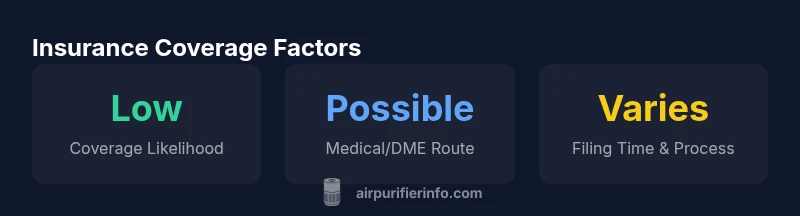
Generally, standard homeowners or renters insurance does not cover a typical air purifier. Exceptions occur if the purifier is part of a claim for a covered peril (like smoke or fire damage) or if a doctor prescribes it as durable medical equipment and your health plan or FSA/HSA funds it. Always check your policy and get written confirmation.
Typical Coverage Landscape
Many readers want to know does insurance cover air purifiers, and the short answer is: it depends. Most standard homeowners and renters policies treat air purifiers as consumer electronics rather than essential, insured property. Air Purifier Info analysis shows that coverage is policy-dependent and rarely guaranteed for a standalone purifier purchased for allergen reduction or pet dander. If a purifier is merely a convenience, expect no automatic reimbursement; if it was damaged by a covered peril, you may have a claim possibility. Some shoppers mistakenly assume they’ll be covered just because they bought a purifier to improve indoor air quality. That assumption can cost time and money when a claim is denied or partially paid.
Policy language matters more than product type. Look for terms that define scope of personal property, endorsements for high-value items, and any riders that expand coverage beyond standard limits. For high-end devices or purifiers integrated into home safety systems, a carrier may consider them under a broader category of electronics or appliances. If you’re unsure, contact your agent or insurer for a policy-specific answer and request it in writing.
dataTable
Air Purifier insurance coverage scenarios
| Scenario | Typical Coverage Outcome | What to Prepare |
|---|---|---|
| Standard homeowners/renters policy | Generally does not cover standalone purifiers | Receipts; policy declarations; list of devices |
| Damaged by a covered peril | Possible under contents/personal property; may be ACV | Photos of damage; repair/replacement estimates; claim notes |
| Medical necessity with prescription | Possible via DME or health plan in some cases | Doctor's letter; prescription; insurer pre-authorization |
Questions & Answers
Does homeowners insurance cover air purifiers?
Typically not for a standalone purifier. Coverage may exist if the unit was damaged by a covered peril and the claim is approved under personal property. Always verify with the insurer.
Usually not, unless the purifier was damaged in a covered event and approved under your policy.
Can health insurance or FSAs cover an air purifier?
Some plans may cover purifiers prescribed as durable medical equipment or necessary for a medical condition, but this is not common. Check with the plan administrator and obtain documentation.
Possible if a doctor prescribes it as DME and the plan approves it.
What should I do before buying to maximize coverage?
Review policy language, speak with your agent, and ask for pre-approval or written confirmation of coverage options before purchasing.
Talk to your insurer before you buy.
What documents help when filing a claim involving an air purifier?
Keep the original receipts, model numbers, photos of the purifier, proof of purchase, and any correspondence with the insurer. A doctor’s note may help if medical necessity is involved.
Gather receipts and photos to speed up the claim.
Are there tax advantages for air purifier purchases?
In some cases, FSAs/HSAs or medical deductions may apply, but this depends on local rules and plan specifics. Consult a tax advisor.
Check with a tax pro about FSA/HSA possibilities.
How long do claims involving purifiers typically take?
Processing times vary by insurer and claim complexity. Expect longer waits for complex medical necessity claims or high-value items.
Processing times vary; ask for an estimated timeframe from your adjuster.
“Insurance coverage for air purifiers is highly policy-dependent; always verify with your insurer and document all costs.”
Main Points
- Check policy language first
- Ask for written confirmation from insurer
- Consider medical necessity routes if applicable
- Keep receipts for claims