Do You Need an Air Purifier If You Have HVAC? A Thorough Comparison
Explore whether HVAC filtration alone suffices or if a room air purifier adds value. This data-driven comparison weighs central filtration versus standalone purifiers, sizing, costs, and maintenance for better indoor air quality.


Do you need an air purifier if you have HVAC? Short answer: an HVAC system with a high-MERV filter helps, but standalone purifiers often deliver more targeted cleaning for occupied rooms. For many homes, using both in tandem—HVAC filtration plus room purifiers—yields the best overall air quality. Consider room size, pollutant types (dust, pet dander, smoke), and budget; a purifier can fill gaps left by central filtration, especially in zones with limited air mixing or during peak allergy seasons.
Do You Need an Air Purifier If You Have HVAC? An Analytical Look
The central question for many homeowners is whether an air purifier is truly necessary when their home already relies on an HVAC system. According to Air Purifier Info, the short answer is nuanced: central filtration via the HVAC can address the bulk of airborne particles, but a dedicated room purifier often adds value in zones with limited air exchange or during peak allergy seasons. By understanding how HVAC filtration interacts with standalone purifiers, you can craft a layered approach that improves indoor air quality without overspending. The goal is to reduce exposure to common indoor pollutants—dust, pollen, pet dander, and odors—while keeping energy use and maintenance manageable.
How HVAC Filtration Works and Why It Matters
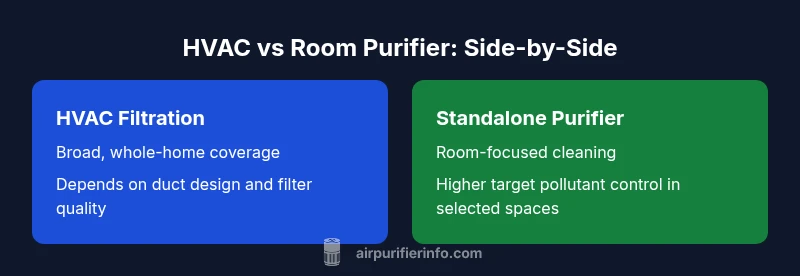
HVAC filtration relies on installed filter media inside the furnace or air handler to trap a broad range of particles as air circulates. A higher-efficiency filter can capture smaller particles, reducing indoor concentrations of dust and allergens. The rate at which air is cleaned depends on the system design, filter quality, and how often the fan runs. In many homes, this central filtration is the backbone of indoor air quality, especially when the ductwork is well-sealed and the filtration schedule is consistent. However, central filtration has limits: rooms far from the air handler, poor air mixing, or occupied spaces with rapid pollutant generation can experience gaps. In these cases, a room purifier offers targeted cleaning where people spend the most time.
How Standalone Purifiers Complement Central Filtration
Standalone air purifiers operate independently of the HVAC cycle. They often feature a higher CADR (clean air delivery rate) relative to room size and can be positioned where air exchange is strongest or weakest. Purifiers excel at targeting specific pollutants—pet dander in bedrooms, cooking odors in living areas, or wildfire smoke near a home office. They also provide flexibility: you can add purifiers in rooms that see high traffic or where family members react to irritants. The key is matching purifier capacity to room size and pairing purifiers with central filtration to create a multi-zone air-cleaning strategy. Air Purifier Info emphasizes choosing units that suit actual room dimensions and pollution profiles rather than relying on a single, one-size-fits-all device.
When Central Filtration Alone Might Be Sufficient
In well-designed homes with high-quality HVAC filtration (for example, a filter rated for higher efficiency and regular replacement), the central system can significantly reduce general pollutants across large living areas. In these cases, the purifier’s role might be minimized to specific rooms or times when targeted improvement is desired—such as during allergy seasons or after cooking or smoking. The most practical approach is to assess air quality trends by room and look for indicators like lingering odors, visible dust, or persistent sneezing symptoms when indoors. A balanced plan prioritizes central filtration as the backbone while reserving purifiers for zones with the greatest need, a stance supported by contemporary IAQ guidance.
When to Add a Room Purifier: Key Triggers
- Persistent allergen symptoms in a bedroom that is distant from the HVAC return.
- Rooms with frequent cooking, strong odors, or smoke.
- Pets that shed heavily in living spaces.
- People with asthma or chemical sensitivities who notice improvements with targeted cleaning.
- Situations where the HVAC runs continuously, but outdoor air quality fluctuates and infiltrates the home. In these scenarios, a purifier acts as a focused barrier to reduce exposure where it matters most. Air Purifier Info recommends evaluating how pollutants enter each room and selecting purifiers that address those specific challenges.
Sizing, Selection, and Practical Guidelines
When integrating HVAC filtration with room purifiers, start with sizing principles rather than guesses. For central filtration, ensure the filter is rated well for the expected pollutant load and that replacement intervals align with manufacturer guidelines. For purifiers, match the unit to room size and target pollutants: larger rooms demand higher CADR, while rooms with strong odors may benefit from purifiers with odor control capabilities. Look for models labeled ozone-free and with verified filtration efficiency. If you share a home with children, elderly residents, or pets, consider placing purifiers in bedrooms and common living areas where people spend the most time. The goal is to achieve a layered defense that reduces exposure while remaining mindful of energy use and noise levels.
Maintenance, Costs, and Energy Considerations
Maintenance is a critical factor in any IAQ upgrade. HVAC filters require periodic replacement, while room purifiers need routine cartridge or HEPA-filter changes. Budget for both upfront costs and ongoing maintenance. Energy use matters: running multiple devices can raise electricity bills, so consider energy-efficient models and operational schedules (e.g., lower speeds overnight). Noise can affect comfort, especially in bedrooms and home offices; opt for devices with quiet operation modes. A thoughtful plan balances cleaning effectiveness with tenant comfort and long-term costs, ensuring the solution remains sustainable over time.
Myths, Pitfalls, and Safety Considerations
A common misconception is that any purifier will solve all indoor air problems. In reality, the most effective IAQ strategies combine central filtration with targeted room purifiers. Be wary of ozone-emitting devices or purifiers marketed as “ionic” without third-party verification. Look for devices with credible test reports and independent certifications. Air Purifier Info highlights the importance of choosing ozone-free products and verifying CADR values in real-room conditions. Proper placement, maintenance, and a realistic expected outcome should guide your decisions rather than marketing claims.
Comparison
| Feature | HVAC with high-MERV filter | Standalone room air purifier |
|---|---|---|
| Pollutants targeted | Broad central filtration (dust, pollen, larger particles) | Room-specific pollutants (dust, smoke, odors, pet dander) |
| Air changes per hour potential | Depends on system sizing and duct design | Independent units can be placed to optimize room ACH |
| Room coverage | Whole-home coverage via ducts | Single rooms or zones |
| Noise | Low to moderate (system-dependent) | Can be quiet or audible depending on speed |
| Upfront cost | Low to high (depends on filter quality) | Moderate for a purifier unit |
| Maintenance cost | Filter replacements required for HVAC | Filter replacements for purifier units |
| Energy use | Integrated with home energy use | Additional energy for purifier units |
| Best for | General indoor air quality and multi-room needs | Targeted purification in high-use rooms or zones |
What's Good
- Improved overall air quality when used together
- Fills gaps in rooms with poor air mixing
- Supports allergy management with targeted purification
- Offers room-level control and flexibility
- Can be cost-effective by optimizing existing HVAC filtration
What's Bad
- Higher upfront and ongoing costs
- Maintenance adds to scheduling (filters, energy)
- Potential for redundancy if central filtration is already strong
- Noise and space considerations for multiple devices
Adopt a combined approach for most homes.
A layered strategy, using a well-maintained HVAC filter plus room purifiers in problem zones, provides broad coverage and targeted cleaning. This balances performance with cost, energy use, and maintenance responsibilities, delivering tangible air quality benefits.
Questions & Answers
Do purifiers create ozone or other safety concerns?
Most modern purifiers are designed to be ozone-free. If a unit includes ionization or ozone-emitting modes, disable those features and verify with third-party testing. Prioritize certified models and follow manufacturer maintenance guidelines to ensure safe operation.
Most purifiers don't produce ozone. Avoid models that advertise ionization unless independently certified for safety.
Can I use a purifier with an existing HVAC system?
Yes. A purifier can complement HVAC by targeting zones with poor air exchange. Ensure the purifier's CADR aligns with room size and avoid overloading the system with incompatible devices. Coordinate maintenance schedules to keep both systems operating well.
Yes—use room purifiers to fill gaps in specific rooms while your HVAC handles general cleaning.
What should I look for when sizing a purifier for a room?
Choose a unit with a CADR appropriate for the room size, and verify it can address your priority pollutants (dust, pollen, odors, smoke). Check noise levels, energy efficiency, and filters replacement intervals to ensure sustainable operation.
Pick a purifier sized for the room and pollutant type, with good CADR and quiet operation.
How often should HVAC filters and purifiers be replaced?
Follow the manufacturers’ guidelines; generally, HVAC filters are changed seasonally or as indicated by performance, while purifiers require filter replacements on a set schedule based on usage and environmental conditions.
Change filters as recommended by the maker; don’t let dirty filters linger.
Are room purifiers energy-efficient?
Many purifiers are energy-conscious, especially models with efficient motors and auto modes. Consider units with Energy Star ratings and use scheduling to minimize running time in unoccupied rooms.
Yes, pick efficient models and use schedules to save energy.
Is a purifier necessary in a well-ventilated home?
Even in well-ventilated homes, purifiers can help reduce indoor pollutants generated inside the home (cooking, pets, activities). They provide an added layer of filtration where central ventilation may not reach perfectly.
Even if your home is well-ventilated, purifiers can help clean up indoor pollutants.
Main Points
- Assess room-by-room needs before buying purifiers
- Prioritize upgrading HVAC filters where possible
- Pair central filtration with purifiers in high-use zones
- Manage noise, energy, and maintenance expectations
- Budget for ongoing filter replacements and energy use