Do You Need an Air Purifier If You Have Central Air? A Homeowner's Guide
Explore whether you should add an air purifier when you already have central air, how purifiers complement HVAC filtration, and practical tips for selecting the right model for dust, odors, allergies, and pet dander in a typical home.


Do you need an air purifier if you have central air? Not always, because most central HVAC systems filter air as it circulates. A purifier can help when dust levels are high, odors linger, or allergy symptoms persist in rooms with poor airflow. Portable purifiers offer targeted help, while whole-home options depend on your system and duct design.
Do You Really Need an Air Purifier With Central Air?
If your home already has central air, you might assume you’re fully covered for indoor air quality. The reality is nuanced. Central HVAC filtration typically handles particle removal as air moves through ducts, but filter efficiency and duct design vary widely. According to Air Purifier Info, many homes still experience dust buildup, lingering odors, and seasonal pollen incursions in rooms that don’t mix air efficiently. A purifier can fill gaps by targeting problem areas and improving overall airflow, especially in rooms that see heavy use or poor circulation.
How Central Air and Portable Purifiers Complement Each Other
Central air systems filter air across the entire home, but portable purifiers provide localized, high-efficiency filtration where occupants spend the most time. When positioned in bedrooms or living rooms, portable purifiers can reduce dust, pet dander, and odors more quickly than relying on central filtration alone. This combination often yields faster air quality improvements without modifying your HVAC. Air Purifier Info notes that pairing approaches can deliver noticeable benefits for sensitive individuals while keeping utility costs reasonable.
The Types of Air Purifiers to Consider
Air purifiers come in several core families. HEPA purifiers trap 99.97% of tiny particles but vary in room capability. Activated carbon purifiers excel at odors and chemical pollutants. Some units offer UV-C sterilization or ionization, but ozone-generating models should be avoided for home use. When you have central air, you may prioritize compact, high-CADR portable units for bedrooms and living areas, complemented by a carbon filter for odors. Always choose ozone-free options to protect indoor air quality.
How to Size an Air Purifier for Your Space
Size matters: pick a purifier whose Clean Air Delivery Rate (CADR) matches the room size. A purifier that is too small won’t improve air quickly, while an oversized unit can be unnecessary and noisy. For rooms up to 150 square feet, a CADR of 120–180 is typical; larger spaces require proportionally higher CADR. If you’re unsure, start with one unit in the most-used room and monitor perceived air quality. CADR figures aren’t the only guide—consider room layout and airflow.
Placement and Flow: Where to Put a Purifier for Best Results
Placement affects effectiveness. Position purifiers away from walls, in the center of the room, or near sources of pollutants (pets, kitchens, smoking areas). Elevate units about 3–5 feet off the floor for better circulation in spaces with vaulted ceilings or multi-level layouts. Avoid placing purifiers behind furniture or in corner alcoves where air recirculates slowly. Consistent placement helps maintain steady air quality throughout the day.
Maintenance Tips to Keep Purifiers Effective
Regular maintenance preserves performance. Check and replace filters on schedule; HEPA and carbon filters typically require 6–12 months depending on use and air quality. Keep the exterior clean and free of dust buildup, which can impede intake. If you’re using multiple devices, stagger replacement timelines to maintain consistent filtration across the home. Air Purifier Info emphasizes following manufacturer guidance for filter life and safe operation.
When Central Air Might Be Sufficient on Its Own
In smaller homes with efficient ducts and high-quality HVAC filters (e.g., MERV 13+), central filtration may meet your needs for basic particle removal. For households without persistent odors or allergies, upgrading to a top-tier central filter or running the system more often during peak pollen seasons can provide most of the benefit. However, for occupants with asthma or severe allergies, supplementary portable purifiers may still offer meaningful relief.
Costs, Savings, and Return on Investment
Purifiers come in a wide price range, with ongoing filter replacement costs to factor in. A compact unit might cost less upfront, while a high-efficiency purifier or several units add to the initial investment. Consider the cost per cubic foot of air cleaned, scheduled maintenance, and energy use when evaluating value. In many homes, targeted purifiers deliver noticeable air quality gains without the expense of major HVAC upgrades.
Real-World Scenarios: Dust, Odors, Pet Dander, and Allergies
If you notice dusty surfaces, allergic symptoms, or pet odors lingering after cooking or in the bedroom, a purifier can help. In homes with frequent cooking odors, fans or range hoods limit odor dispersion, but a purifier with a carbon filter can further reduce residual smells. Pets introduce dander and hair that circulate; HEPA filtration significantly lowers ambient particle counts when placed where occupants spend time. Each scenario benefits from a tailored approach—location, purifier type, and maintenance cadence all matter.
Step-by-Step Approach to Decide and Implement
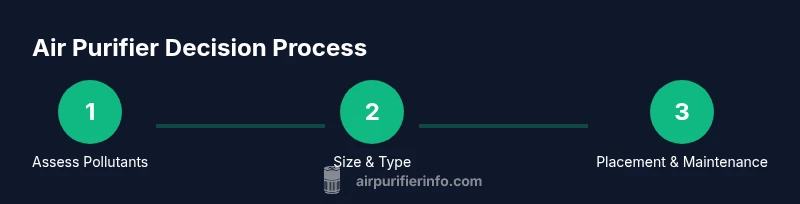
This section translates theory into action. Start by evaluating your worst-affected rooms, then choose purifier types based on dominant pollutants (particulates vs. odors). Size the devices to the room, plan placement for optimal airflow, and set a maintenance calendar. Finally, reassess after a few weeks to determine if additional purifiers or changes in central filtration are warranted.
Tools & Materials
- Air purifier (portable)(Choose a model with the appropriate CADR for your room size)
- Replacement filters (HEPA and activated carbon)(Have spare filters on hand for maintenance)
- Measuring tape(Measure room dimensions to estimate air volume)
- Room size calculator or CADR guideline sheet(Helpful for sizing, not mandatory)
- Owner’s manual / product specs(Check for filter life and ozone-free operation)
- Notebook or app for maintenance logs(Track filter changes and performance)
Steps
Estimated time: 30-60 minutes initial setup; ongoing maintenance varies by filter life (3-12 months)
- 1
Assess problem areas and goals
Identify rooms with the most dust, odors, or allergy symptoms. Note how often you use each space and whether central filtration seems insufficient. This step sets the scope for sizing and placement.
Tip: Write down specific pollutants (dust, pet dander, cooking odors) to guide filter choice. - 2
Choose purifier type and size
Select a purifier with a CADR suitable for the room. If odors are primary, pair HEPA with carbon. Ensure the unit is ozone-free and certified for safe household use.
Tip: For bedrooms, aim for a CADR close to the room’s floor area to balance speed and noise. - 3
Plan placement
Position purifiers to maximize air exchange in the busiest zones. Avoid corners and place away from walls to prevent recirculation. In multi-room homes, prioritize spaces with limited airflow.
Tip: Elevate units if ceilings are high or airflow pathways are obstructed. - 4
Check compatibility with central HVAC
Review whether your central system’s filter (MERV rating) is compatible with added purifier activity. Some purifiers can operate independently without altering the HVAC fan speed.
Tip: Do not rely on purifiers to replace central filtration; treat them as supplements. - 5
Install and run
Unbox and assemble the purifier. Install fresh filters and run on a comfortable noise setting initially. Observe air quality changes over several days.
Tip: Use a portable air quality monitor if possible to quantify improvements. - 6
Monitor and replace filters
Track usage and replace filters according to manufacturer guidelines. Vacuum or wipe external surfaces to prevent dust buildup that can clog intake.
Tip: Set reminders in a calendar app to avoid missed maintenance. - 7
Reassess needs
After 2–4 weeks, evaluate whether the purifier choice meets your goals. If allergy symptoms persist, consider a second unit or a central filtration upgrade.
Tip: Seasonal changes (pollen, cooking seasons) may require adjustments. - 8
Long-term maintenance plan
Create a schedule for filter changes and cleaner operations. Keep spare filters handy and track energy use for budgeting.
Tip: Use only manufacturer-approved filters to protect performance and warranty.
Questions & Answers
Do central air systems already filter dust?
Central systems typically use a fixed-filter setup that captures a portion of particulates. Upgrading the central filter (higher MERV rating) can improve performance, but it may not catch all odors or fine particles. A purifier can address remaining pollutants in specific rooms.
Central systems filter some dust, but upgrading filters or adding purifiers can target remaining pollutants in key rooms.
Are air purifiers safe to use with central HVAC?
Yes, portable purifiers are generally safe and effective when ozone-free. Do not rely on purifiers to replace central filtration; use them to augment air quality where needed.
Yes, they’re safe when ozone-free and used to supplement central filtration, not replace it.
How do I choose the right purifier for my space?
Match the purifier’s CADR to room size, prioritize HEPA filtration for particles, and carbon for odors. Check for ozone-free operation and lower noise levels for bedrooms or study areas.
Pick a purifier with the right CADR for the room, HEPA for particles, carbon for odors, and no ozone.
Will an air purifier reduce odors and pet dander?
Yes, HEPA filters reduce pet dander, while activated carbon helps with odors. For strong odors, consider an unit with both filtration types.
Purifiers with HEPA plus carbon filters can cut odors and dander effectively.
How often will I need to replace filters?
Filter life depends on usage and indoor air quality but typically ranges from 6 to 12 months for HEPA and carbon filters. Higher pollution areas may require more frequent changes.
Most filters last 6 to 12 months, more often in busy homes.
Can purifiers help with allergies in a central-air home?
Purifiers can reduce airborne allergens when used in conjunction with a high-quality central filter. Target individual rooms where symptoms are worst for the best effect.
They help, especially in rooms where allergies are strongest.
Watch Video
Main Points
- Assess where purifiers will make the biggest impact.
- Size and placement determine effectiveness more than price alone.
- Purifiers are supplements, not replacements for good central filtration.
- Choose ozone-free, appropriately powered units for safety.
- Create a maintenance schedule to sustain air quality gains.