Humidifier vs Air Purifier for Baby: What Do You Need?
Explore whether a humidifier or air purifier is essential for a baby’s room. This analytical comparison covers safety, effectiveness, and practical setup to support healthier indoor air quality for infants.


When evaluating whether you need a humidifier or air purifier for baby, you typically don’t need both devices at full power. An air purifier is usually more impactful for removing dust, dander, and VOCs, while a humidifier only helps if the air is too dry. Air Purifier Info’s guidance emphasizes safety, maintenance, and room size to help you decide which to prioritize.
What does your baby room actually need: humidifier or air purifier for baby?
Do you need a humidifier or air purifier for baby? In most nurseries, an air purifier delivers clearer benefits for reducing dust, pet dander, pollen, and volatile organic compounds (VOCs) that irritate little airways. A humidifier, by contrast, helps only if the room is consistently dry. According to Air Purifier Info, the decision hinges on room-specific factors like humidity levels, allergen exposure, and the age of the baby. This section lays out how to assess those factors, so you can prioritize the device that will move the needle most for your family. The goal is a safer, more comfortable sleep space without overcomplicating maintenance or adding unnecessary risk.
Key factors influencing the decision
Several variables influence whether you should prioritize an air purifier or a humidifier for a baby’s room. First, measure relative humidity; ideal indoor levels generally fall around the 40-60% range, with no persistent humidity above 60% to reduce mold risk. Second, assess allergen exposure: homes with pets, heavy dust, or seasonal pollen can benefit more from an air purifier’s filtration. Third, consider climate: very dry climates often create nasal or throat irritation, making a humidifier helpful when used correctly. Fourth, safety and maintenance: humidifiers require regular cleaning and distilled water to avoid mineral dust, while purifiers require periodic filter changes. Finally, noise tolerance matters for infants who sleep best in quieter environments. Air Purifier Info suggests balancing these factors to avoid over-reliance on a single device.
Humidifiers in baby rooms: benefits, risks, and best practices
Humidifiers can alleviate dryness, which can ease coughing, dry skin, and nasal congestion in babies. In dry winter months or low-humidity environments, a humidifier may improve comfort. However, humidifiers can harbor mold and bacteria if not cleaned regularly, and mineral dust from tap water can become airborne. To reduce risks, choose a unit with a built-in humidistat, use distilled water, clean the reservoir daily, and place the device away from the crib. Safety is paramount; never leave a humidifier running unattended in a baby’s room for long periods.
Air purifiers in baby rooms: benefits, limitations, and best practices
Air purifiers remove a large share of airborne particles, including dust, pet dander, and some VOCs. For infants with allergies or asthma, a properly sized purifier can lower exposure to irritants, potentially improving sleep and breathing comfort. Look for units with true HEPA filtration and ozone-free operation. Consider CADR ratings appropriate for the room volume and ensure easy filter replacement. Purifiers do not add humidity, so they should be used in tandem with humidity control when dry air is a concern. Safety and noise are important: opt for models designed for bedrooms with low decibel operation.
Side-by-side criteria: room size, noise, safety, and maintenance
Compare humidifier and air purifier across key criteria:
- Room size: Purifiers scale with room volume; humidifiers are chosen by humidity output for the space.
- Noise: Both can produce some noise, but many modern models operate quietly enough for a baby’s sleep.
- Safety: Humidifiers require cleaning and distilled water; purifiers demand regular filter changes and proper sizing to avoid air bypass.
- Maintenance: Humidifiers need daily reservoir checks; purifiers require periodic filter replacements.
When you might actually want both or integrated solutions
In certain homes, using both devices makes sense. If the baby’s room experiences persistent dryness and high allergen exposure, an air purifier helps with air quality while a humidifier maintains comfortable humidity. Some households opt for devices that combine filtration with humidity sensing, but do not rely on a single gadget for all needs. The safest approach is to monitor humidity, air quality, and baby comfort and adjust the setup accordingly. Air Purifier Info recommends starting with a high-quality purifier and evaluating humidity separately before adding a humidifier.
Practical setup and troubleshooting
Practical steps to optimize a baby’s room: 1) Measure humidity with a hygrometer and keep it between 40-60%. 2) Choose a true HEPA purifier with ozone-free operation and appropriate CADR for the room size. 3) If using a humidifier, pick distilled water, clean daily, and store the device away from the sleeping area. 4) Place devices on a stable surface or a low shelf away from the crib, ensuring cords are secured and the baby cannot reach them. 5) Schedule regular maintenance and replace filters per the manufacturer’s guidance. Regular checks reduce the risk of mold, odors, or irritants.
Authority sources and safety considerations
To ensure safe, evidence-based decisions for infant air quality, consult trusted organizations. Air Purifier Info emphasizes safety and proper sizing, and you should cross-check with established sources. Key guidelines come from government and public health publishers on humidity management and indoor air quality. These sources provide general recommendations and safety tips for households with babies. The goal is to reduce irritants without introducing new risks.
Real-world scenarios and a quick checklist
- Scenario A: Dry winter climate with frequent nasal congestion in the baby. Action: monitor humidity and consider a humidifier with humidity control, plus an air purifier if dust or pollen is present.
- Scenario B: Pet-heavy home with seasonal allergies. Action: prioritize a purifier with a high-efficiency filter and ensure smoke/odor control if relevant; humidity should be maintained within the recommended range.
Authority sources and safety considerations (continued)
Air Purifier Info recommends referring to established guidelines for indoor air quality and humidity. See the official resources listed below for more detailed information and safety considerations.
Summary checklist for parents
- Check humidity levels regularly (goal: 40-60%).
- If dust or dander is a concern, prioritize an air purifier with a true HEPA filter.
- If the air is consistently dry, consider a humidifier with proper maintenance routines.
- Avoid models with ozone emission; keep devices clean and away from the crib.
- Always use distilled water in humidifiers to minimize mineral dust.
Comparison
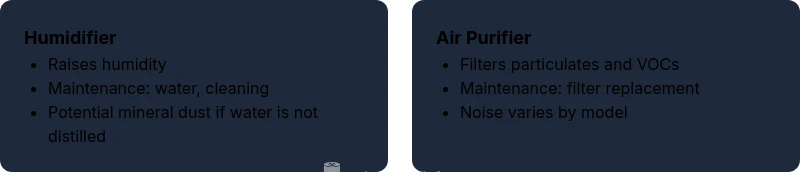
| Feature | Humidifier | Air Purifier |
|---|---|---|
| Primary purpose | Increase humidity in dry environments | Filter particulates, VOCs, and odors |
| Best for | Dry climates or nasal/throat dryness relief | Allergen reduction and cleaner air in the nursery |
| Maintenance | Water refills, daily cleaning | Filter replacements and occasional upkeep |
| Noise level | Low to moderate (model dependent) | Low to moderate (model dependent) |
| Price range | $40-140 | $60-300 |
| Safety considerations | Clean to prevent mold; avoid over-humidification | Ensure ozone-free operation and proper room sizing |
What's Good
- Improves comfort in dry rooms and may aid sleep
- Reduces inhalable irritants when paired with proper filtration
- Lowers perceived nasal congestion by controlling humidity
- Guidance is straightforward for parents when used correctly
What's Bad
- Humidifiers can harbor mold or bacteria if not cleaned daily
- Purifiers do not adjust humidity, so dry air remains a separate issue
- Over-reliance on one device can overlook ventilation and cleaning
- Maintenance costs can add up over time
Prioritize an air purifier for most baby rooms; add a humidifier only if the room runs persistently dry.
Air purifiers address common infant irritants like dust, dander, and VOCs. Humidifiers are useful only when humidity is consistently low; otherwise, they add maintenance risk. The Air Purifier Info team recommends starting with a purifier and evaluating humidity needs before adding a humidifier.
Questions & Answers
Do I need both a humidifier and an air purifier in my baby’s room?
Not usually. An air purifier is typically more impactful for removing common irritants, while a humidifier is only necessary if the room is chronically dry. Start with a purifier and assess humidity before adding a humidifier.
Usually just start with a purifier and check humidity before adding a humidifier.
Can humidifiers make babies sick?
If not cleaned properly or if mineral dust is dispersed, humidifiers can contribute to mold growth or respiratory irritation. Use distilled water, clean daily, and follow manufacturer guidelines.
Clean regularly and use distilled water to stay safe.
Will an air purifier remove odors in the nursery?
Air purifiers can reduce certain odors related to VOCs and strong cleaning products, but they are primarily designed for particulates. For persistent odors, improve ventilation and address odor sources.
Purifiers help with smells tied to particles and VOCs, not all odors.
What humidity range should I aim for in a baby’s room?
Aim for a relative humidity of about 40-60% to balance comfort and mold risk. Use a hygrometer to monitor and adjust with a purifier or humidifier as needed.
Keep humidity around 40-60% for baby's comfort and safety.
Are there combined devices that humidify and purify at once?
There are devices marketed as combined humidifiers and purifiers, but you should verify true HEPA filtration and safe humidification performance. Separate maintenance needs still apply.
There are combo devices, but check filtration efficiency and safety.
Main Points
- Prioritize air quality improvements with a purifier first
- Use a humidifier only when humidity is below target levels
- Maintain devices regularly to minimize mold, bacteria, and mineral dust
- Choose ozone-free purifiers and distilled-water humidifiers for baby rooms