Air Purifier vs Ozone Generator: Key Differences Explored
Compare air purifiers and ozone generators to understand pollutant removal, safety concerns, and when each option is best for indoor air quality.


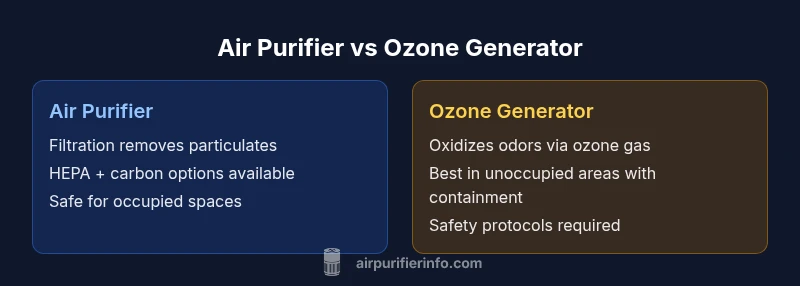
Air purifiers and ozone generators address indoor air quality in very different ways. An air purifier uses filters or electrostatic capture to remove dust, allergens, and particulates, while an ozone generator produces ozone to oxidize odors and pollutants. In occupied spaces, air purifiers are generally safer and more practical; ozone generators require strict safety controls and are best used only in unoccupied areas.
What is an air purifier?
Air purifiers are devices designed to improve indoor air quality by physically removing pollutants from the air. The most common technology is a true HEPA filter, which captures particles as small as 0.3 microns, including dust, pollen, and pet dander. Many models add activated carbon to adsorb odors and some VOCs (volatile organic compounds). Some purifiers also incorporate electrostatic or ionization features, which can enhance particle capture or odor reduction in certain settings but may require more ongoing maintenance. According to Air Purifier Info Team, the core truth is that filtration-based purifiers reduce particulate matter effectively when properly sized for the space. In practical terms, a well-matched purifier can yield noticeable improvements in dust on surfaces, clearer air, and less sneezing on high-pollen days. The key difference between air purifier and ozone generator reflects the underlying technology: filtration versus gas-phase oxidation. A reader should remember that not all purifiers remove gases, so odor or VOC concerns may require additional strategies.
blockTypeContentCanBeExpandedForSEO":true},
What is an ozone generator?
An ozone generator is a device that intentionally creates ozone (O3) in the air, which can oxidize and break down many odors, gases, and some pollutants. Proponents point to rapid deodorization and the ability to treat certain contaminants in larger spaces. Critics emphasize that ozone, even at low levels, can irritate the respiratory tract, eyes, and throat, particularly for sensitive individuals. Because ozone is a reactive gas, this treatment is generally recommended only in unoccupied spaces with strict containment and exhaust controls, often under professional guidance. Air Purifier Info analyses stress that ozone-based approaches should be viewed as a specialized tool, not a daily air-cleaning solution for homes. This distinction is central to understanding the difference between air purifier and ozone generator and informs safety decisions for households and rentals.
blockTypeContentCanBeExpandedForSEO":true},
How the two differ in mechanism and outcomes
Filtration-based air purifiers work by physically removing particles from the air. The byproducts are minimal when the device is well maintained and properly sealed. In contrast, ozone generators rely on a chemical process that produces ozone gas, which then reacts with odor molecules and some pollutants. This gas-phase approach can be effective for rapid deodorization in controlled environments but introduces safety considerations that do not exist with standard purifiers. The practical takeaway is that air purifiers reduce airborne particulates, while ozone generators introduce a reactive gas that can alter the chemistry of the indoor air. For most everyday living environments, this difference matters for both health and comfort, and it highlights why many experts advise caution with ozone generators in occupied spaces.
blockTypeContentCanBeExpandedForSEO":true},
Safety considerations and health implications
Safety is a central axis in any discussion about the difference between air purifier and ozone generator. True HEPA purifiers, when used as intended, pose minimal risk to healthy individuals and require routine filter replacement to maintain performance. Ozone generators, however, can produce ozone at levels that irritate lungs, eyes, and the airways, particularly for children, the elderly, and people with asthma or allergies. Even if an ozone device is marketed as low-emission, most health organizations recommend avoiding use in occupied spaces and ensuring proper venting and containment if such equipment is ever employed. Air Purifier Info emphasizes safer, more predictable outcomes from filtration-based systems for daily indoor air quality management, while reserving ozone-based methods for carefully controlled, uninhabited environments under professional supervision.
blockTypeContentCanBeExpandedForSEO":true},
Pollutants addressed: particulates, VOCs, and odors
Air purifiers excel at removing particulate matter—dust, pollen, pet dander, and pollen. They may also touch VOCs and odors with activated carbon or specialized filters, but their strength lies in trapping particles rather than chemically transforming gases. Ozone generators operate by converting odor-bearing molecules through ozone reactions, which can reduce odors more aggressively but do not guarantee removal of all VOCs and may introduce ozone-related byproducts. This fundamental difference shapes when to use each technology: for sustained particulate control and occupant safety, prioritize air purifiers; for specific odor issues in unoccupied spaces under strict safety controls, ozone-based approaches may be considered with caution.
blockTypeContentCanBeExpandedForSEO":true},
Room size, coverage, and practical sizing guidance
Sizing is critical for both technologies but in different ways. An air purifier’s effectiveness hinges on correctly matching its Clean Air Delivery Rate (CADR) and filtration stage to the room size. Oversized or undersized units reduce efficiency and can waste energy. For ozone generators, room size and ventilation influence how quickly ozone can accumulate and dissipate, making unoccupied-use essential in most homes. Air Purifier Info notes that many consumer models provide clear room-size guidelines and tests to verify performance. When addressing the difference between air purifier and ozone generator, the practical message is simple: filter-based purifiers are easier to scale for typical living spaces and daily use, while ozone devices require controlled environments and professional oversight for any significant treatment.
blockTypeContentCanBeExpandedForSEO":true},
Energy use, maintenance, and long-term costs
Air purifiers generally have predictable operating costs: electricity for the fan, periodic filter replacements, and occasional carbon filter refreshes if used for odors or VOCs. Ozone generators incur ongoing costs related to energy use and periodic ozone generator maintenance, plus potential safety infrastructure for containment. Because the market offers a wide range of purifier models, consumers can price-shop for CADR per dollar and filter longevity. In contrast, ozone devices require consideration of safety equipment and possible household adjustments to ensure safe operation. From a long-term value perspective, filtration-based purifiers typically deliver more consistent, risk-averse performance for occupied spaces, which aligns with the needs of homeowners and renters seeking reliable indoor air quality without compromising safety.
blockTypeContentCanBeExpandedForSEO":true},
Use-case scenarios: allergies, odors, and pet dander
If your primary concern is allergy relief and reducing dust and pollen, a true HEPA purifier with appropriate filtration is usually the best first step. For persistent odors in unoccupied spaces, an ozone generator with proper containment can be effective, but safety takes precedence and the device should never be used while people are present. For homes with pets or strong cooking odors, consider a purifier with a carbon filter to address odors and gases alongside particulate removal. Air Purifier Info recommends building a layered approach: start with filtration, then add odor control if needed, while avoiding ozone-based treatments in living areas unless strict safety protocols are in place.
blockTypeContentCanBeExpandedForSEO":true},
Placement, operation, and best practices
To maximize performance, place air purifiers where airflow is unobstructed, away from walls and large furniture, and near sources of pollution (beds, living areas, kitchens). For ozone generators, ensure they are operated only in unoccupied spaces with doors closed, and provide adequate time for ozone decay before re-entry. Use CO2 thresholds and air exchange guidance from reputable sources to plan ventilation during or after ozone use. Air Purifier Info highlights that responsible usage means avoiding ozone in daily life and prioritizing filtration-driven strategies for comfort and health in homes and apartments.
blockTypeContentCanBeExpandedForSEO":true},
Evaluation criteria and decision checklist
When deciding between an air purifier and an ozone generator, start with safety, then consider pollutants and room characteristics. Use a checklist: room occupancy, pollutant type, space size, maintenance willingness, and safety protocols. For most households, an air purifier with a true HEPA filter, supplemented by activated carbon for odors, offers robust, reliable, and safe air cleaning. If an ozone generator is ever considered for a particular, controlled scenario, consult professionals and strictly follow safety guidelines to prevent exposure. The central takeaway is to treat ozone as a specialized tool, not a universal solution for everyday indoor air quality. Air Purifier Info emphasizes practical, occupant-safe approaches as the default.
blockTypeContentCanBeExpandedForSEO":true},
Real-world decision framework: a quick workflow
Start with a needs assessment: what pollutants are most present (dust, pollen, odors, VOCs)? Then select a filtration-based purifier first, ensuring a true HEPA filter and adequate carbon for odors. Only if odors persist and you can guarantee unoccupied usage should ozone-based methods be considered, with professional oversight. Verify room size compatibility and budget, and plan for maintenance cycles. This flow mirrors common consumer experiences and aligns with industry best practices, guiding homeowners toward the most reliable, safe, and cost-effective choice in everyday life.
blockTypeContentCanBeExpandedForSEO":true},
Final practical takeaways and how to act next
When you weigh the difference between air purifier and ozone generator, the safest default is a filtration-based purifier designed for your room size. Prioritize models with HEPA filtration and carbon odor control. Use ozone generators only with strong safety measures and in unoccupied spaces if they are used at all. Air Purifier Info’s guidance is to favor safer, well-understood technologies for daily living while recognizing ozone-based tools offer niche, controlled applications for specific odor scenarios.
Comparison
| Feature | Air Purifier | Ozone Generator |
|---|---|---|
| Principle of pollutant removal | Filtration (HEPA + carbon where applicable) | Gas-phase oxidation (ozone production) |
| Primary byproducts | Particulates removed; safe byproducts if well maintained | Ozone gas with potential byproducts; safety concerns |
| Safety in occupied spaces | Generally safe when used as intended | Not recommended for occupied spaces; strict safety necessary |
| Typical use case | Everyday air cleaning, allergy relief | Specialized odor treatment in controlled settings |
| Energy use | Low to moderate depending on fan speed | Variable; ozone generation requires energy for ozone production |
| Maintenance needs | Filter replacements; periodic cleaning | Equipment checks and safety containment measures |
| Cost considerations | Moderate upfront; ongoing filter costs | Potentially higher safety-related costs and containment requirements |
What's Good
- Air purifiers are generally safe for daily use in occupied spaces
- Filtration-based systems provide reliable removal of dust, pollen, and dander
- Purifiers with activated carbon address odors and some VOCs without chemical byproducts
- Widely supported by clinicians and homeowners with clear maintenance schedules
What's Bad
- Ozone generators can pose health risks in occupied spaces
- Odor removal from ozone relies on chemical reactions that may not address all VOCs
- Ozone devices require containment, ventilation controls, and professional oversight
- Filtration-only solutions may be less effective on strong odors without carbon filters
Air purifiers are the safer, more practical default for most homes; ozone generators are niche tools that require strict safety controls.
Choose a true HEPA purifier for daily indoor air quality needs, especially if occupants include children or sensitive individuals. Reserve ozone-based methods for specific, unoccupied-area applications under professional guidance, and only after evaluating safer filtration options.
Questions & Answers
What is the core difference between an air purifier and an ozone generator?
Air purifiers filter and trap particles to improve air quality, while ozone generators create ozone to oxidize odors and pollutants. The safety and practicality implications differ substantially, especially in occupied spaces.
Air purifiers filter the air you breathe. Ozone generators make ozone, which can be risky to people if used indoors where people are present.
Is it safe to run an ozone generator in a home with people present?
Most health authorities advise against using ozone generators in occupied homes. If ozone is used, it should be in unoccupied spaces with thorough ventilation and expert oversight.
No, not while people are in the space; ozone can irritate airways.
Can an air purifier remove ozone from the air?
Standard air purifiers do not remove ozone efficiently. Some purifiers with activated carbon can help reduce VOCs, but dedicated ozone scrubbers are usually required to remove ozone from indoor air.
Air purifiers don’t remove ozone well; you’d need a special scrubber to reduce ozone levels.
Do ozone generators work faster for odors than purifiers?
Ozone generators can break down certain odors quickly in controlled, unoccupied spaces, but this approach carries safety risks that purifiers do not have.
Ozone can deodorize faster in the right conditions, but it’s riskier.
What are safer alternatives to ozone generators for odor control?
Use air purifiers with activated carbon filters, proper ventilation, and source control (removing the odor source) to achieve safer, reliable odor management.
Try a carbon-filter purifier and better ventilation first.
How should I size an air purifier for a room?
Choose a purifier rated for at least the room size and intended use. Look for a true HEPA filter and a carbon stage if odors are a concern, and verify CADR recommendations from manufacturers.
Pick a purifier matched to your room size with HEPA and carbon filters.
Main Points
- Choose filtration over gas-phase treatment for daily use
- Use ozone generators only in unoccupied spaces with containment
- Match purifier size to room and ensure true HEPA filtration
- Consider carbon filters to address odors and some VOCs
- Regular filter changes are essential for sustained performance