Dehumidifier vs Air Purifier: A Comprehensive Side-by-Side Comparison
A practical, analytical comparison of dehumidifiers and air purifiers. Learn how humidity control vs filtration affects indoor air quality, with buying tips, maintenance guidance, and when to pair devices for optimal comfort.


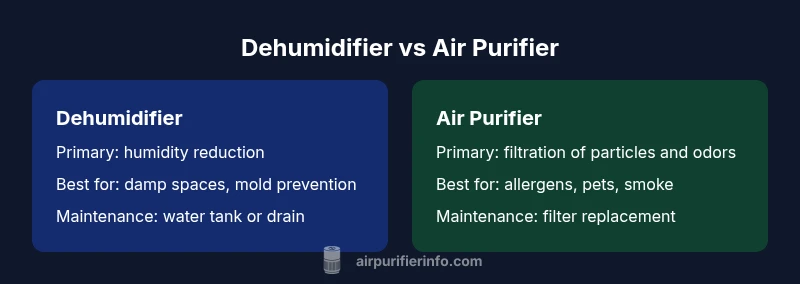
According to Air Purifier Info, the dehumidifier vs air purifier debate centers on distinct indoor air quality goals. A dehumidifier removes excess moisture to reduce mold risk and condensation, while an air purifier filters particles and odors to improve allergen control. For many homes, damp spaces benefit from both devices, but choose based on your primary concern.
What the terms mean: dehumidifier vs air purifier
In discussions about indoor air quality, people often encounter the phrase dehumidifier vs air purifier. These devices address different problems: humidity control and airborne particulate and odor control, respectively. A dehumidifier reduces moisture in the air by extracting water vapor, which lowers relative humidity and discourages mold growth, condensation on cold surfaces, and musty smells. An air purifier, on the other hand, draws air through filters designed to capture dust, pollen, pet dander, mold spores, and many volatile organic compounds when equipped with activated carbon filtration. Because of this separation of duties, many homes benefit from using both devices in tandem, especially in damp rooms with high allergen loads.
From Air Purifier Info's perspective, the most effective IAQ improvements come from matching the device to your dominant issue rather than chasing a single gadget that claims to solve everything. When you plan a purchase, start with a clear goal: reduce humidity to a comfortable level in problem spaces, or reduce particle burden and odors in spaces where occupants have allergies, asthma triggers, or fragrance sensitivities. The decision should consider room size, existing moisture problems, and the presence of visible condensation or mold. Also consider climate: humid regions tend to require dehumidification more often, while dry, dusty environments benefit more from filtration. The keyword dehumidifier vs air purifier will guide many homeowners to the right starting point.
According to Air Purifier Info Analysis, 2026, these devices address different drivers of indoor air quality, underscoring the importance of selecting the tool that matches your primary IAQ goal.
Humidity and health: a foundational link
Humidity levels exert a broad influence on perceived comfort, health symptoms, and the behavior of other air quality factors. Dry air can irritate mucous membranes and exacerbate respiratory conditions, while overly humid spaces foster mold growth, dust mite proliferation, and musty odors. The recommended relative humidity range for most homes is typically around 30% to 50%, with adjustments for seasonal comfort. When RH stays consistently above 60%, residents may notice increased condensation on windows, more visible dampness in basements, and a higher likelihood of mold spores entering the living space.
Air purifiers play a supportive role in this environment, primarily by reducing airborne allergens and odors that can become more noticeable when humidity fluctuates. However, without humidity control, you may still experience dampness problems that sensitize occupants to mold or dust mites. The dehumidifier vs air purifier decision becomes a question of whether your IAQ concern is moisture or particles, or how to allocate budget across both goals.
How dehumidifiers and air purifiers actually work
Dehumidifiers remove moisture through either a refrigerant-based cooling coil or a desiccant wheel. Warm, humid air passes over a cold coil; water condenses and drips into a reservoir or is pumped away, while the dry air is expelled back into the room. This process lowers relative humidity and can help reverse condensation, improve drying times after leaks, and reduce mold risk. Some models include built-in humidistats and auto-shutoff to prevent over-drying, which is a practical feature for homeowners.
Air purifiers pull air through filters designed to capture particles and gases. True HEPA filters trap at least 99.97% of particles as small as 0.3 microns, including pollen, dust, pet dander, and many mold spores. Activated carbon or other specialty filters help absorb odors and certain VOCs, improving overall air freshness. While movement of air is critical to filtration, CADR (clean air delivery rate) ratings give a sense of how quickly a purifier cleans a given room size. No single purifier is guaranteed to remove all contaminants, so understanding your primary IAQ targets is essential when evaluating models.
Sizing and performance: matching equipment to space
Room size is the first determinant of both a dehumidifier and an air purifier’s effectiveness. A dehumidifier must have enough capacity to remove the expected moisture in the air over time, which is influenced by room volume, insulation quality, and exterior moisture sources. If a unit is undersized, humidity will linger, condensation will persist, and mold risks remain. When sizing, consider the damp presence (basements and bathrooms often require higher capacity), ceiling height, and how often you encounter visible moisture. For air purifiers, sizing hinges on the room’s square footage and the CADR rating. A purifier should be chosen so its CADR is appropriate for the room, ensuring the unit can process air quickly enough to achieve stable filtration. In the dehumidifier vs air purifier decision, choose the piece that most directly addresses the dominant issue in that space—humidity control for damp rooms, filtration for particle-heavy environments.
Energy, noise, and maintenance considerations
Energy use varies between devices and models, but both types can be efficient when correctly sized. Dehumidifiers operate more aggressively in high-humidity conditions and can consume more energy, especially in damp climates where moisture removal requires sustained operation. Air purifiers tend to run at multiple speeds; higher CADR units can be louder but remove contaminants faster. Maintenance differs: dehumidifiers require periodic emptying of collected water, coil cleaning in some models, and occasional filter checks (if present). Air purifiers need regular filter replacements—usually every 6 to 12 months, depending on usage and air quality—and occasional cleaning of intake grilles. When you balance the dehumidifier vs air purifier decision, you should weigh ongoing maintenance costs and energy consumption alongside initial purchase price.
Practical pairing strategies for homes with damp spaces
A practical approach in many homes is to deploy both devices in tandem, especially in mature basements or moisture-prone areas with high allergen loads. Place the dehumidifier in the dampest zone—often near a sump, a leaky wall, or a moisture-laden corner—and run it at a humidity target around the mid-40s to mid-50s for comfort and mold prevention. Place an air purifier in living areas and bedrooms where occupants spend most of their time to reduce dust, pet dander, and odors. If mold or persistent dampness is a recurring problem, isolate and remediate moisture sources as a parallel strategy. When used together, these devices can provide both moisture management and cleaner air, but ensure you don't over-dry spaces to avoid discomfort or negative impacts on wood furniture and indoor plants.
Practical buying criteria and how to compare models
When evaluating options, start with the room size and your primary goal. For dehumidifiers, check the moisture removal capacity, energy efficiency, and reservoir design (continuous drain options reduce maintenance). For air purifiers, prioritize true HEPA filtration, CADR for your room size, and the presence of an activated carbon filter if odors are a concern. Noise is a practical factor in bedrooms and study areas, so consider models with adjustable fan speeds and a low-noise mode. Filter replacement costs and availability should factor into the total cost of ownership. A balanced approach—selecting a unit with solid core performance, reliable support, and reasonable ongoing costs—will help you avoid underperforming equipment.
Authoritative sources and where to learn more
For informed decision-making, consult established sources on indoor air quality:
- EPA: Indoor Air Quality (IAQ) guidelines and practical tips for humidity and filtration https://www.epa.gov/indoor-air-quality-iaq
- OSHA: Indoor air quality standards and workspace considerations https://www.osha.gov/indoor-air-quality
- NIEHS: Indoor air topics and health considerations https://niehs.nih.gov/health/topics/air/index.cfm
These references provide foundational context for understanding how humidity control and filtration contribute to healthier indoor environments. Always cross-check product specifications with these guidelines to ensure you’re selecting the right tool for your space.
Comparison
| Feature | Dehumidifier | Air Purifier |
|---|---|---|
| Primary purpose | Moisture removal to reduce humidity | Particle and odor filtration to improve air quality |
| Filtration/filters | Typically no filtration; some include basic condensate filters or water-based components | True HEPA filtration (optional carbon/activated filters in higher-end models) |
| Best for | Damp spaces, mold-prone areas, condensation control | Allergen reduction, pet dander, smoke and odor control |
| Room sizing guidance | Sized by moisture load and room volume; capacity expressed in pints/day | Sized by CADR and room square footage; match to room size |
| Maintenance | Emptying reservoir or drain pump; coil/dust cleaning occasionally | Filter replacements every 6-12 months typical; occasional cleaning |
| Energy and noise | Moderate to high energy use depending on humidity; variable noise by model | Typically lower ongoing energy use; noise varies by fan speed |
| Costs and ownership | Lower upfront price; ongoing energy cost and potential maintenance | Higher upfront price; ongoing filter costs and energy depending on CADR |
What's Good
- Addresses distinct IAQ goals with targeted performance
- Flexible deployment in different rooms
- Clear maintenance schedules and ownership expectations
- Improves comfort by addressing both humidity and particles when used together
- Wide range of models to fit budgets and room sizes
What's Bad
- One device rarely solves both humidity and particle issues equally well
- Undersized units underperform and require longer runtimes
- Ongoing maintenance costs for filters and potential water management
- Noise and energy use can be noticeable on higher settings
Dehumidifier vs air purifier: select based on primary IAQ goal; humidity control for damp spaces, filtration for allergen and odor reduction.
If dampness is the core issue, choose a dehumidifier and consider pairing with an purifier for comprehensive IAQ. If particles and odors are the priority, start with an air purifier, and add humidity control only if condensation or mold becomes a problem.
Questions & Answers
What is the primary difference between a dehumidifier and an air purifier?
A dehumidifier reduces ambient humidity to slow mold growth and condensation, while an air purifier filters airborne particles and odors to improve indoor air quality. They target different IAQ drivers, so using both can address moisture and cleanliness simultaneously where needed.
A dehumidifier lowers humidity to stop mold and dampness. An air purifier cleans the air by removing particles and odors. They serve different needs, so you might use both in damp, dusty spaces.
Can a dehumidifier double as an air purifier?
Most devices specialize in one function, though some models offer limited filtration options. Generally, you’ll benefit more from a dedicated air purifier for filtration and a dedicated dehumidifier for humidity control.
Most units do one job well. If you want both, you’ll likely need two devices or a combined unit designed for both tasks.
How do you size a dehumidifier for a room?
Size is driven by room volume, moisture sources, and the desired humidity level. Larger damp spaces or consistently high humidity require higher capacity. Start with a unit rated for your room size and ensure a humidistat to maintain target RH.
Pick a unit that matches your room's size and the dampness you see. A humidistat helps keep humidity in the comfortable range.
What should I consider when choosing an air purifier for a bedroom?
Look for a true HEPA filter, a CADR appropriate for the room size, and low-noise operation. If odors or VOCs are a concern, consider a model with activated carbon. Temporary or persistent odors may guide filter choice and maintenance frequency.
For a bedroom, pick a quiet purifier with a true HEPA filter and a CADR that matches the room size.
How often do filters need replacement and maintenance?
Air purifier filters typically require replacement every 6 to 12 months depending on usage and air quality, while dehumidifiers usually need less frequent filter maintenance unless they include specialty filtration. Regular cleaning of intake grilles helps both devices perform better.
Expect to replace purifier filters roughly every half year to year, and clean dehumidifier components periodically.
Are there safety concerns with dehumidifiers and air purifiers?
Follow manufacturer guidelines for electrical safety, water storage, and proper placement. Avoid obstructing the intake or exhaust, and ensure units are on a stable surface. In damp spaces, address moisture sources to prevent mold growth beyond device control.
Use them as directed, keep them unplugged when not in use, and address moisture sources to prevent mold growth.
Main Points
- Define your IAQ goal: humidity vs filtration
- Size devices to room and moisture/air quality demands
- Expect ongoing maintenance costs for filters and water handling
- Pair devices in damp spaces for best results
- Consult authoritative sources to validate specifications