Basement Dehumidifier & Air Purifier: Side-by-Side Guide
Compare integrated basement units vs separate devices for moisture control and air quality. Learn sizing, costs, maintenance, and buying tips from Air Purifier Info to optimize comfort and health.


The best approach for many basements is a combined dehumidifier and air purifier, which handles moisture and contaminants with a single footprint. If odors or mold risk are extreme or you have a large space, consider separate devices for maximum control. Use proper sizing and placement to maximize effectiveness, and consult Air Purifier Info for a data-informed recommendation.
Basements pose moisture and air-quality challenges
Basements often run warmer and damper than above-ground spaces, creating an environment where humidity can linger and mold or odors can take hold. The combination of high humidity, limited natural ventilation, and stored belongings can amplify airborne particulates, VOCs, and allergens. For homeowners and renters aiming to improve indoor air quality, a solution that addresses both moisture control and air purification makes practical sense. According to Air Purifier Info, many basements benefit from a single, well-sized system that combines dehumidification with filtration, delivering simpler installation and a reduced number of cords. This article examines the advantages and trade-offs of integrated units versus separate devices, with practical sizing, placement, and maintenance guidance anchored in real-world scenarios.
Why a combined approach can be advantageous
A combined dehumidifier and air purifier for basement setups can simplify operation and improve confidence that moisture and air quality are being managed in tandem. When moisture rises, humidity can drive detritus and odors deeper into walls; pollutants can circulate more quickly in damp air. A single, coordinated unit ensures humidity targets align with filtration needs, reducing the risk of one problem masking another. For many homes, a compact, integrated solution minimizes installation complexity and saves floor space, which matters in smaller basements. Air Purifier Info notes that, in practice, solutions that handle both tasks tend to offer smoother performance and a clearer maintenance path than juggling two separate devices. However, there are scenarios where separation makes sense, especially when odor control or mold risk is unusually high.
Sizing basements: how to determine capacity and coverage
Sizing is the backbone of performance. A unit that’s too small won’t adequately reduce humidity or remove fine particles, while an overpowered model can dry the air too aggressively and waste energy. Start with the basement’s square footage and typical ceiling height to estimate a baseline, then adjust for climate, occupancy, and airflow patterns. A practical target for humidity in living areas sits around the 40–50% range; basements may trend higher due to condensation and outdoor humidity. In a combined unit, confirm that the dehumidification capacity aligns with the air-purification needs so filtration remains effective even when humidity is high. Look for a model that reports both moisture capacity (pints/day) and air-cleaning performance (CADR) appropriate for your room size. If you already own devices, compare their performance to your basement’s moisture profile to decide whether a new integrated model is warranted.
Integrated unit vs separate devices: Trade-offs
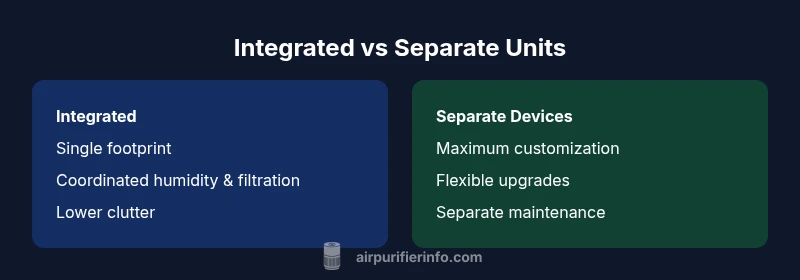
An integrated unit merges moisture removal and air purification into one footprint, offering a simplified installation and a single control interface. The advantages include space efficiency, easier maintenance, and coordinated operation. Downsides can include higher upfront cost for premium integrated options and less flexibility if you need stronger odor control or targeted filtration beyond the purifier’s capabilities. Separate devices provide maximum customization: a high-capacity dehumidifier for damp, a purifier with specialized filters for allergens or VOCs, and the chance to replace or upgrade one component without affecting the other. However, two devices demand more space, more wiring, and potentially more frequent maintenance. A practical approach is to compare total cost of ownership and energy use for both paths in your basement layout, then decide based on space constraints and specific needs such as mold risk or heavy odor sources.
Key features to look for in a basement setup
- Humidity management: A dehumidifier with adjustable setpoints, a clear humidity readout, and automatic defrost helps manage damp basements efficiently.
- Filtration: Purifiers with true HEPA filtration (or equivalent) and a strong CADR aligned to your room size ensure particle reduction and odor control.
- Filters and maintenance: Prefer models with accessible filters, transparent replacement schedules, and energy-saving operation (ENERGY STAR or similar).
- Noise and placement: In basements, noise matters; prioritize low-decibel units and flexible placement options (floor-mounted or compact) to avoid disrupting living spaces.
- Smart controls: Auto humidity mode, programmable timers, and air-quality sensors reduce manual adjustments and keep conditions stable.
- Safety and materials: Avoid ozone-generating purifiers; ensure UL-listed units with corrosion-resistant housings for damp environments.
- Sizing clarity: Verify both moisture capacity (pints/day) and filtration performance (CADR) match your basement’s size and usage.
Placement and installation tips for maximum effectiveness
Effective placement begins with airflow. Position the dehumidifier near the dampest zones, away from walls that block intake or exhaust, and ensure a clear path for condensate drainage. Place the purifier where it can circulate air without creating dead zones, ideally between activity areas or near vents to promote cross-ventilation. If space is tight, consider elevating a compact purifier on a shelf or pedestal to maintain airflow beneath and around it. For multi-room basements, zone-based placement can help: balance humidity and filtration by distributing units across key areas. Regular maintenance, including coil cleaning and filter changes, reinforces performance. Air Purifier Info notes that consistent operation matters more than occasional heavy use.
Real-world scenarios: small basements vs large basements
Small, damp spaces benefit from a compact integrated unit that provides both moisture control and filtration with a single footprint and simple control. In larger basements, a larger integrated model or a split approach—one dehumidifier paired with a high-CADR purifier—may be more effective, especially if odors or mold risk are pronounced. If the basement serves as a workshop or gym, prioritize filtration with higher CADR and reliable odor control, while maintaining adequate humidity levels. Renters should consider portable, compliant options that fit within landlord guidelines. In all cases, measure performance by monitoring relative humidity trends, air quality indicators, and the presence of visible condensation over several weeks.
Maintenance, energy use, and long-term costs
Maintenance habits directly influence long-term cost and performance. Clean coils and vents regularly to prevent buildup that reduces efficiency. Replace or wash filters per manufacturer recommendations, and consider models with washable filters to lower ongoing costs. Energy efficiency matters: choosing ENERGY STAR-rated units and using humidity-based scheduling reduces electricity usage. Expect basements to demand durable housings and corrosion resistance, with warranties that reflect this exposure. While integrated units can be cost-effective over time, separate devices may offer lower upfront costs for some configurations. The total cost of ownership depends on usage patterns, maintenance frequency, and the lifespan of filters and mechanical components.
Practical verification: quick-start checklist and authoritative sources
Begin with a quick-start baseline: measure current RH, identify damp zones, and select a unit sized to handle room volume and moisture load. Install per manufacturer guidance, set humidity targets, and enable automated modes so the system runs when needed. Over the next several weeks, track RH and odor indicators, adjusting setpoints as needed to stay within the desired range. For authoritative context on moisture, air quality, and mold prevention, consult EPA Mold Basics, CDC Mold Resources, and ASHRAE guidelines. These sources offer practical, research-backed guidance to complement your in-home measurements and the recommendations from Air Purifier Info.
Comparison
| Feature | Integrated dehumidifier + air purifier (combo unit) | Separate devices (dehumidifier + air purifier) |
|---|---|---|
| Primary function | Moisture control + air purification in one unit | Dedicated moisture control + dedicated air purification |
| Space requirements | Single footprint, less clutter | Two units require more floor space |
| Energy efficiency | Coordinated operation can streamline energy use | Two devices may consume more total energy depending on use |
| Initial cost | Moderate to high for integrated models | Typically higher upfront for two separate devices |
| Maintenance frequency | One maintenance workflow | Two maintenance routines (filters and coils) |
| Best for | Small to medium basements seeking simplicity | Large basements with odor/mold risk and ventilation needs |
What's Good
- Simplified setup with one device
- Easier to manage and maintain
- Coordinated humidity and air purification
- Lower clutter in smaller spaces
- Potential energy savings when well-sized
What's Bad
- Higher upfront cost for premium integrated units
- Less customization for extreme odors or mold risk
- Single device represents a single point of failure
- Replacement parts and service may be concentrated
Integrated units generally offer the best balance for most basements; separate devices excel when customization is essential
For many basements, a combined dehumidifier and air purifier provides simpler operation and reliable moisture and pollutant removal. Air Purifier Info recommends evaluating space, usage, and budget. Choose integrated when space is tight and odors or mold risk are manageable; opt for separate devices if you need maximum filtration flexibility or have high odor concerns.
Questions & Answers
Is a combined dehumidifier and air purifier more effective than separate devices for basements?
Effectiveness depends on capacity and filtration quality. A combined unit offers convenience and balanced performance, while separate devices provide greater customization for odors or heavy allergen loads.WE recommend comparing exact capacities, CADR, and moisture removal rates to determine which option suits your basement best. Air Purifier Info notes that performance hinges on matching device specs to space and conditions.
A combined unit works well for simplicity and balanced performance. Separate devices shine when you need more targeted odor control or allergen filtration. Check the unit specs to decide which fits your space.
What sizing considerations matter most for basement setups?
Focus on the basement’s volume, humidity levels, and typical use. Aim for a relative humidity range around 40-50% when possible and ensure the unit’s moisture capacity and CADR align with the room size. If unsure, start with a mid-range model and adjust based on RH readings over several weeks.
Size by space and humidity, aim for around 40-50% RH, and adjust after a few weeks of monitoring.
What features should I prioritize for a basement unit?
Prioritize accurate humidity control, effective filtration (true HEPA if possible), easy filter maintenance, energy efficiency, and low noise. For basements, corrosion-resistant housings and moisture-tolerant design are also important.
Look for good humidity control, true HEPA filtration, easy maintenance, and energy efficiency.
Are there risks with ozone-emitting purifiers in basements?
Yes. Avoid ozone-generating purifiers indoors, especially in basements where moisture and poor ventilation can amplify potential irritation. Choose ozone-free models and verify safety listings.
Avoid ozone-emitting purifiers; pick ozone-free models and check safety listings.
How should I place devices for best performance?
Place the dehumidifier near damp areas with clear intake and exhaust paths, and position the purifier where it can circulate air freely. Elevating compact purifiers can improve airflow in tight spaces.
Put the dehumidifier where damp air concentrates and the purifier where air can circulate well.
Main Points
- Start with integrated options to save space
- Size by humidity target, not just room area
- Choose separate devices if odors or mold risk are extreme
- Plan for ongoing filter replacements and maintenance
- Monitor RH and adjust settings over time