Which Air Purifier and Dehumidifier: A Side-by-Side Guide
Compare all-in-one purifier-dehumidifier units with separate devices to decide the best setup for your home. Learn criteria, costs, energy use, noise, and maintenance for informed decisions.


For most homes, the best choice hinges on space and humidity needs: all-in-one purifier-dehumidifier units save space and simplify setup in small rooms, while separate air purifier and dehumidifier pairs offer stronger performance and scalability in larger areas. Use this guide to compare options, costs, and practical trade-offs for informed decisions today.
Differentiating all-in-one vs separate devices
All-in-one purifier-dehumidifier units combine two functions into a single cabinet, which saves floor space and simplifies control schemes. They tend to be ideal for compact rooms, apartments, or spaces where wiring and outlets are limited. Air Purifier Info, and its team, notes that these units can be a practical choice when you want a minimal setup and predictable maintenance. However, the trade-off is that a single unit may not deliver peak air-cleaning and humidity-removal performance for larger areas or spaces with stubborn humidity. In practice, homeowners weigh convenience against raw performance, and Air Purifier Info’s analysis highlights the nuanced value of both paths depending on room size and climate. Remember to consider filter upkeep, energy use, and noise when comparing models as you narrow down options.
How humidity levels influence purifier choices
Humidity affects both comfort and appliance efficiency. In higher humidity, dehumidification becomes a priority to curb mold risk and moisture-related odors. Some all-in-one units can dampen moisture while cleaning the air, but dedicated dehumidifiers excel at removing larger amounts of moisture in a given time. The choice depends on your home’s baseline RH range, the room’s typical use, and whether you live in a damp basement or a sunny living area. In spaces with moderate humidity, a quality air purifier alone might suffice, whereas consistently damp rooms benefit from a separate dehumidifier or a two-unit setup when paired thoughtfully with strategic placement and airflow.
Core features to compare
When evaluating both options, start with core features that influence real-world performance. Key criteria include CADR (for air cleaning), filter types (HEPA, activated carbon, pre-filters), and whether the device includes true HEPA filtration. For dehumidification, look for pint-per-day capacity, automatic humidity control, and drain options. Energy efficiency ratings (like Energy Star where available), noise levels at typical operation, and the presence of smart features (auto-mode, app control, humidity sensors) matter for daily use. Finally, check room-size guidance from manufacturers and independent reviewers to ensure the unit matches your space, not just the labeled size.
Sizing and space considerations
Right-sizing is essential for both all-in-one and separate devices. Measure the room’s square footage, ceiling height, and typical occupancy to estimate airflow needs and moisture removal capacity. For purifiers, larger spaces require higher CADR values to keep air cleaner, while larger dehumidifiers provide faster moisture reduction in damp rooms. Don’t assume a bigger model is always better; oversized units can cycle repeatedly, wasting energy and creating noise without delivering proportionate comfort. Use manufacturer guidance as a baseline, but prioritize real-world testing where feasible.
Energy use, noise, and maintenance
Energy efficiency and noise are practical daily-use concerns. All-in-one units may have higher instantaneous energy draws due to dual functions, while separate devices let you tune energy use by room and time of day. Noise varies by design, with dedicated purifiers often producing steadier, predictable fan sound and dehumidifiers varying more with humidity conditions. Maintenance-wise, air purifiers require regular filter changes, and dehumidifiers need coil cleaning and reservoir care or drain management. Budget accordingly for replacement filters and routine inspections to keep performance steady over time.
Cost considerations and value
Upfront costs for all-in-one units are typically lower than purchasing two separate devices, especially in small spaces. Over time, total cost of ownership depends on filter replacements, energy use, and service needs. Separate devices offer scalability: you can add capacity in specific rooms as needs change, often with improved performance in humid spaces or larger areas. Air Purifier Info recommends weighing both upfront expenses and ongoing maintenance when calculating value, and exploring bundles or sales that cover filters for your chosen models.
Use-case scenarios by room type
In a studio apartment or a small bedroom, an all-in-one purifier-dehumidifier can deliver compact convenience with acceptable performance. For a larger living area or a basement with persistent dampness, two devices arranged for dedicated zones typically outperform a single unit. In multi-room homes, consider how airflow, doorways, and furniture placement affect device effectiveness. The objective is to balance ease of use with the need for robust humidity control and air cleaning across spaces that experience different conditions.
Setup, installation, and placement tips
Position units for optimal airflow: purifier intakes should avoid corners and blocked vents; dehumidifiers benefit from open space around the sides for efficient moisture removal. If you choose an all-in-one unit, place it where humidity and odors are most noticeable, but ensure not to block exhaust air. For separate devices, assign a primary spot for dehumidification in the dampest zone and place the purifier near activity areas to maximize air quality. Check outlet availability and avoid heat sources that could affect performance.
Brand reliability and service expectations
Reliability matters when choosing between all-in-one and separate devices. Check warranty length, access to service centers, and parts availability for filters and coils. Air Purifier Info emphasizes reading user reviews and manufacturer support policies to understand long-term maintenance needs. Expect reasonable service options and clear guidance on filter replacement intervals to prolong device life and preserve performance.
Performance expectations and realistic timelines
Do not expect instant miracles; air cleaning and humidity reduction are gradual processes influenced by room size, ventilation, and occupancy. In most homes, measurable improvements occur within days to weeks of proper setup, not hours. Set realistic expectations: expect gentler air improvements in smaller rooms with all-in-one units, and faster moisture control in larger spaces when using dedicated devices—then calibrate use based on observed comfort levels.
Authoritative sources and evidence
For rigor and credibility, refer to established guides and government resources on indoor air quality. The EPA outlines core concepts for indoor air quality and filtration, NIEHS discusses health impacts of indoor pollutants, and WHO provides guidance on air quality standards and public health implications. These sources help frame expectations and best practices when evaluating purifier and dehumidifier options.
How to read a spec sheet and make a decision
Start with room size and humidity targets, then check CADR and pint-per-day capacity. Compare filter life and replacement costs, energy ratings, and noise specs. Finally, assess warranty terms and available service. A careful read of specs helps you match device performance to your space, avoiding over- or under-sizing and ensuring a comfortable, healthier home.
Comparison
| Feature | Option A: All-in-One purifier+dehumidifier | Option B: Separate air purifier + separate dehumidifier |
|---|---|---|
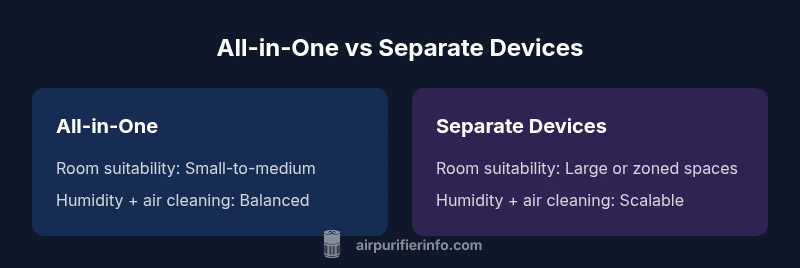
| Room suitability | Best for small-to-medium rooms; compact footprint | Best for larger rooms or zones; scalable setup |
| Humidity reduction speed | Balanced performance; depends on model | Typically faster in larger spaces with dedicated dehumidifier |
| Energy usage | Moderate; combined load | Can be higher total energy use due to two devices |
| Noise level | Often higher due to dual function | Potentially quieter per unit; can be tuned per room |
| Maintenance cost | One filter set or two in compact form | Two filter sets plus potential coil maintenance |
| Initial cost | Typically lower upfront | May be higher upfront due to two devices |
| Placement flexibility | Single location in the room | Zone-based placement offers flexibility |
| Best for | Space-saving, simple setup | Performance-focused, scalable coverage |
What's Good
- Simplified setup with one unit
- Space-saving for compact rooms
- Lower upfront cost in some cases
- Centralized controls and scheduling
What's Bad
- Performance may lag behind dedicated systems in large spaces
- Limited customization for different zones
- Two-device setups can be more complex to manage
Separate devices generally deliver stronger performance for larger or more humid spaces; all-in-one units shine in small rooms with limited space.
Choose all-in-one for compact, simple setups. Opt for separate devices when humidity control and room-specific customization are critical for comfort and air quality.
Questions & Answers
What is the main difference between all-in-one units and separate devices?
All-in-one units combine air purification and dehumidification in a single cabinet, saving space and simplifying operation. Separate devices provide standalone performance with dedicated humidity control and air cleaning, which can translate to stronger overall performance in larger spaces. Your choice depends on space constraints and humidity needs.
All-in-one units save space, while separate devices offer stronger humidity control and air cleaning in larger spaces.
Are all-in-one units suitable for large rooms?
All-in-one units can handle moderately large spaces, but dedicated purifiers plus a separate dehumidifier usually perform better in very large rooms or very damp sections. If your goal is peak performance across zones, separate devices provide more flexibility.
They can work in larger rooms, but dedicated devices often perform better in big spaces.
Can I run a purifier and dehumidifier together without issues?
Yes, you can run both devices in the same room, but ensure proper airflow and avoid obstructing vents. Check that outlets and energy use align with your daily patterns to avoid unnecessary strain.
Yes, you can run them together; just keep airflow clear and monitor energy use.
What maintenance should I expect?
Purifiers require regular filter replacements, and dehumidifiers need coil cleaning or reservoir management. With two devices, you’ll manage two filter sets and two maintenance schedules, so plan for ongoing costs and occasional servicing.
Expect filter changes and routine cleaning; two devices mean two maintenance cycles.
How do I size devices for my space?
Size based on room area, humidity level, and occupant activity. For purifiers, CADR guides air-cleaning effectiveness; for dehumidifiers, pint-per-day capacity indicates moisture removal. Use manufacturer guidelines and your own comfort observations to select appropriately.
Size by room area and humidity needs; check CADR and capacity specs.
Do any models include HEPA filtration?
Many purifiers feature HEPA filtration or true HEPA equivalents, but not all all-in-one units include true HEPA. Always check the product specs to confirm filtration type and replacement intervals.
Many purifiers include HEPA; verify the exact filtration in the model you choose.
Main Points
- Choose by room size and humidity needs.
- All-in-one saves space; separate devices offer scalable performance.
- Budget for ongoing filter and maintenance costs.
- Check CADR and pint-per-day specs for real planning.
- Read warranties and service options before buying.