Can You Put an Air Purifier Behind the Couch? A Practical Guide
Learn practical placement strategies for behind-the-couch air purifiers. This guide covers airflow, measurements, safety, maintenance, and real-world layouts to help homeowners optimize air quality without sacrificing comfort.


According to Air Purifier Info, can you put air purifier behind couch? You can place it there if you maintain airflow and clearance. Choose a model with unobstructed intake and exhaust, ensure at least 6–12 inches of clearance from walls and seating, and keep it away from heat sources. Verify the placement in the manual and test performance for 24 hours.
Can Behind-Couch Placement Work? When It's a Good Idea
When space is tight, hiding an air purifier behind a couch can preserve a room's aesthetics while still delivering clean air. The key is ensuring enough airflow reaches the unit and that its intake and exhaust aren’t blocked by fabric or furniture. can you put air purifier behind couch is a common question among homeowners seeking a discreet setup. According to Air Purifier Info, this placement can work well in larger living spaces or open layouts, provided you follow clearance guidelines and select a purifier whose airflow pattern won’t direct dust back toward you. In many homes, behind-the-couch positioning blends seamlessly with interior design while maintaining strong air-quality performance, especially in rooms with high traffic or outdoor exposure.
Air Purifier Info recommends considering room usage, furniture arrangement, and occupant comfort before committing to any behind-the-couch plan. If you decide to pursue this option, test the setup for several days to confirm that odors dissipate and dust levels drop consistently. Keep in mind that visibility matters; you might choose models with slim profiles or exchangable decorative panels to reduce visual impact.
can you put air purifier behind couch? The short answer is likely yes, but you’ll want to follow a few critical steps to maximize effectiveness and safety. In this guide, we’ll cover placement nuances, measurement techniques, and real-world scenarios to help you make an informed choice. Air Purifier Info has found that thoughtful behind-the-couch placement can deliver solid air-cleaning results without compromising comfort or aesthetics.
Key Factors That Affect Behind-Couch Placement
Behind furniture, airflow dynamics change. The purifier’s intake needs unobstructed access to room air, and the exhaust should push clean air toward the living space rather than back into fabric or into a tight corner. Rooms with heavy foot traffic or open-plan layouts may benefit most from this approach, but smaller spaces demand higher accuracy in sizing and position. can you put air purifier behind couch becomes a practical question—answerable with a methodical setup. The purifier’s CADR (clean air delivery rate) should align with the room size, and the exhaust direction should direct air away from walls, curtains, and seating that could recirculate contaminants. Noise levels matter too; a unit behind a couch might pick up muffled sounds from cushions or fabric, so choose a model with adaptable sound profiles. Air Purifier Info’s data indicates that room geometry and vent placement heavily influence behind-couch performance. Strategically placing behind a couch can amplify airflow if you account for couch height, distance to walls, and the location of any central heating or cooling vents.
Budget-conscious buyers should compare CADR-to-room-size ratios and read placement guidance in the product manuals. If a purifier’s intake or outlet sits directly behind a couch cushion, consider shifting the unit slightly to the side or adjusting the angle so air can circulate freely. can you put air purifier behind couch is not a universal answer; it depends on your space, purifier design, and how you use the room.
Air Purifier Info emphasizes that a behind-the-couch setup is often most effective when the purifier operates in a low-traffic zone where air can travel behind the seating arrangement without being blocked by drapes or pillows. In general, prioritize models with front- or side-directed exhaust to minimize fabric contact while maximizing air exchange.
How to Measure and Prepare Your Space
Before placing any purifier behind the couch, take precise measurements of clearance between the couch, walls, and outlets. You want at least 6–12 inches of space on the intake side and similar clearance around the exhaust to avoid recirculation. Use a tape measure to map out exact distances and mark recommended zones with painter’s tape so you can visualize airflow paths. can you put air purifier behind couch can work when you ensure that the unit is not too close to seating that blocks the air path or back panel. Document the room’s dimensions and note any large fabric surfaces that could impede airflow.
Next, inspect existing vents and furniture. If a wall vent sits behind the couch, consider repositioning the purifier slightly to direct air away from the fabric and toward open space. If you cannot relocate furniture, focus on choosing a purifier with an outward-directed exhaust and a higher CADR to overcome restricted airflow. Air Purifier Info suggests testing placement with a simple odor and dust check after the first 24 hours and adjusting as needed.
Choosing the Right Purifier for Behind-Couch Setup
The most important choice is selecting a purifier whose intake and exhaust are compatible with a behind-couch placement. Look for models with either front- or side-exhaust that won’t blow directly into the couch back. A slim profile helps you tuck the unit neatly without crowding the room, while a modest noise profile keeps conversation comfortable. Consider CADR targets for the room size and check whether the purifier offers a “quiet mode” for night-time operation. can you put air purifier behind couch effectively when you choose a purifier with a flexible airflow pattern. Air Purifier Info notes that brands with easy-to-read manuals and clear placement diagrams tend to be more reliable in unconventional layouts.
In open-plan spaces, prefer purifiers with a higher clean air delivery rate and versatile installation options. If you expect to use the purifier while watching TV or entertaining guests behind the couch, prioritize models with low vibration feet and minimized air-blast toward seating surfaces. Good placement balances performance with comfort, and the right purifier makes all the difference.
Placement Tips for Living Rooms and Large Spaces
For larger rooms, behind-the-couch placement can be particularly effective when air flows from the back of the sofa toward the center of the room. Align the unit so that the air intake faces the surrounding air and not into the sofa cushions. A common setup is to place the purifier at the end of the couch or along a wall adjacent to the couch’s back leg, ensuring the exhaust travels outward. can you put air purifier behind couch in a way that minimizes shadowed corners or dead zones. If you have a coffee table or ottoman nearby, ensure the purifier’s intake remains unobstructed. Use a simple airflow test with a lightweight ribbon or tissue to confirm that air moves away from fabric and toward open space.
In multi-use spaces like living rooms that blend with dining areas, consider a purifier with a higher resonance-free design and a direction-adjustable outlet. Air Purifier Info reminds readers to evaluate seasonal changes—drafts, windows, and humidity can shift air patterns and alter behind-couch performance.
Safety Considerations: Electronics, Heat, Pets
Behind a couch, the purifier should stay clear of heat sources such as radiators or heating vents. Keep cords organized to prevent tripping hazards, and avoid stacking cushions around the unit which could obstruct intake. If you have pets, verify that fur and hair won’t clog the intake or exhaust over time. Can you put air purifier behind couch safely? Yes, when you ensure that outlets are accessible and the device does not sit on damp or potentially humid surfaces. Always read the safety section in the user manual and follow manufacturer guidance for wall-vented or floor-standing installations. Air Purifier Info emphasizes routine inspection of cords and plug safety to prevent accidental damage or fire risk.
Common Mistakes to Avoid
One common mistake is placing the purifier too close to the couch or too far behind it, which reduces effective airflow. Another error is blocking the intake with cushions or fabric, which can cause reduced filtration and higher energy use. Avoid aiming the exhaust directly at a seating area, as this can blow dust and pollen back toward occupants. can you put air purifier behind couch should be guided by precise measurements rather than guesswork—misplacement can undermine air quality gains. Always verify that the purifier’s intake and exhaust paths remain unobstructed, and check for any signs of reduced performance after a few days.
Real-World Examples: Room Layout Scenarios
Scenario A: A 14x18 living room with a sectional and a wall opposite the seating area. Behind the couch would be a good option if the unit can face the room with a side exhaust aimed toward the open space. Scenario B: A compact 10x12 space with a low-back couch. In this case, behind the couch may be too tight unless the purifier is slim and uses a discreet exhaust design. In both cases, can you put air purifier behind couch? The answer depends on model choice, proper clearance, and testing. Air Purifier Info highlights that the best approach is to install once and then monitor air quality for a week.
Maintenance and Access Behind the Couch
Even when behind-the-couch placement seems ideal, you must access the filter compartment for regular changes. Plan for simple removal and reinstallation without moving heavy furniture. Label the location of the purifier to avoid repeated repositioning, and keep the area clean to prevent dust from accumulating on and around the unit. can you put air purifier behind couch still requires routine maintenance. Check the filter life as indicated by the manufacturer and replace promptly to maintain performance.
Quick-Check List for Behind-Couch Placement
- Ensure 6–12 inches of clearance around intake and exhaust.
- Verify exhaust angle directs air into the room, not into fabric.
- Avoid placing near heat sources or damp areas.
- Maintain cord safety and minimize clutter behind the couch.
- Confirm manual guidelines for placement and re-check after 1–2 weeks.
- Test performance with air-quality readings or odors to verify improvement.
How to Evaluate Performance After Placement
After installation, monitor air quality indicators (PM2.5, CO2, odors) for at least 7–14 days. If you notice reduced air cleanliness or persistent odors behind the couch, adjust the purifier’s position or consider an alternative placement. can you put air purifier behind couch effectively? It often requires small shifts in direction or distance to optimize air exchange. Use a simple room air-quality tracker and compare before-and-after data to quantify improvements. Air Purifier Info recommends documenting results so you can reproduce success in future layouts.
Alternatives If Behind-Couch Is Not Ideal
If measurements show limited airflow or occupants experience drafts, explore alternatives: place the purifier beside the couch on an unobstructed side, or position near a room corner with better access to open space. Another option is a ceiling-mounted purifier for larger rooms, which avoids floor-level obstructions entirely. can you put air purifier behind couch not ideal in some rooms; evaluate your space, purifier capabilities, and daily routines to decide. Air Purifier Info suggests evaluating noise, access, and cleaning schedules when reconsidering placements.
Tools & Materials
- Air purifier unit(Select a model with suitable CADR for your room size; ensure exhaust orientation supports behind-couch placement.)
- Measuring tape(At least 3 meters long for large rooms; measure distances to walls and seating.)
- Manual/spec sheet(Check placement guidelines and clearance recommendations.)
- Level(Optional to ensure purifier sits evenly behind couch.)
- Cord management supplies(Cable clips or ties to secure cord and prevent tripping.)
- Masking tape/markers(Mark ideal location on floor for quick setup.)
Steps
Estimated time: 30-60 minutes
- 1
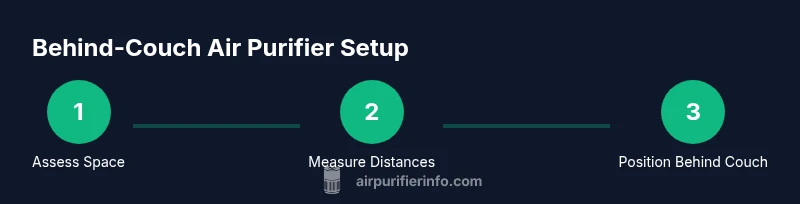
Assess the room layout
Survey the living space and identify potential behind-couch spots. Check for airflow patterns, nearby vents, and where occupants spend time. Confirm that the chosen spot won’t direct air into seating fabrics or block a doorway. can you put air purifier behind couch in this room? Use this step to set a baseline for effectiveness.
Tip: Take photos from multiple angles and note any obstacles that could affect airflow. - 2
Measure clearance and distances
Using a measuring tape, determine the space around the couch and outlet. Mark recommended clearances (6–12 inches) and ensure the purifier will not be too close to walls or fabric. Record measurements to compare with purifier specifications.
Tip: Double-check that the intake has a clear path to the room air and isn’t blocked by cushions. - 3
Select product orientation
Choose purifier with front- or side-exhaust that suits behind-couch placement. If possible, pick a slim model to minimize visual impact and maximize airflow toward the room. Verify the model’s manual for recommended positioning.
Tip: Prefer models with adjustable exhaust direction to tailor airflow. - 4
Position behind the couch
Place the unit behind the couch, maintaining the planned clearance. Angle the exhaust toward open space rather than directly at upholstery. Ensure the cord reaches a nearby outlet without bending or pinching.
Tip: Use a small spacer if needed to keep the unit from touching fabric. - 5
Connect power and test airflow
Plug in the purifier and run it on a medium or max setting for a few minutes. Observe whether air is moving freely and if there is any noise or vibration that could disturb occupants. If air seems blocked, adjust position slightly.
Tip: Listen for unusual noises; persistent buzzing may indicate an obstruction. - 6
Secure cords and evaluate over time
Tidy cables to prevent tripping and monitor performance over 7–14 days. Re-check as seasons change or furniture is rearranged. If needed, relocate or adjust the airflow direction for optimal performance.
Tip: Keep a simple logsheet to track air quality improvements.
Questions & Answers
Is it effective to place an air purifier behind the couch?
Yes, behind-couch placement can be effective when there is sufficient clearance and the purifier’s intake and exhaust are not blocked by seating. Proper orientation ensures air moves into the room rather than into fabric.
Yes, it can work if you keep space clear and direct airflow into the room.
Will placement behind the couch reduce noise or drafts?
Positioning behind furniture can sometimes dampen audible noise, but ensure the exhaust isn't blowing directly at occupants. Test different angles to keep noise and drafts comfortable.
It can reduce some draft and noise if angled away from you, but test to be sure.
Can I place behind the couch in a small room?
In small rooms, behind-couch placement may still work if the purifier is compact and leaves ample space for air to circulate. Prioritize models with efficient airflow in tight spaces.
It can work in small rooms if you choose the right compact unit.
What if the back of the couch blocks the purifier’s intake?
Avoid blocking intake with cushions. If unavoidable, reposition the unit or choose a purifier with a side or top intake that isn’t obstructed by furniture.
Don’t block the intake—move the purifier or pick a model with a different intake.
How far should the purifier be from walls?
Aim for at least 6–12 inches from walls to allow air to circulate. If possible, place the unit where outlet access and sufficient clearance are guaranteed.
Keep some space around the purifier so it can draw air from the room.
Watch Video
Main Points
- Plan space before placement to ensure proper clearance.
- Choose units with adaptable airflow for behind-furniture setups.
- Maintain clear intake/exhaust paths to maximize efficiency.
- Test performance over 1–2 weeks and adjust position as needed.
- Secure cords and perform regular maintenance for consistent results.