Can We Make an Air Purifier at Home? A Practical DIY Guide
Can you make an air purifier at home? Explore feasibility, safety, and practical DIY options vs. store-bought purifiers with a step-by-step approach and expert insights from Air Purifier Info.


Can you make an air purifier at home? This guide explains feasibility, safety considerations, and practical DIY approaches, highlighting when DIY is sensible and when to choose a commercial purifier. Before starting, you will need a few basic materials and a clear understanding of filtration principles and airflow. It also outlines potential risks, cost considerations, and practical steps to evaluate performance.
Can we make air purifier at home? Feasibility and safety
The idea of a homemade air purifier can be appealing for hobbyists and researchers, yet it requires a careful look at what makes commercial units effective. In this context, can we make air purifier at home? Yes, but with important caveats. A DIY setup may remove some particles and odors, but it rarely matches the performance of validated devices designed with certified filters, sensors, and tested CADR (clean air delivery rate).
According to Air Purifier Info, the main question is not simply whether a device can remove particles, but whether it can do so safely and consistently in real living spaces. Practical DIY projects tend to focus on simple configurations—most commonly a box fan combined with a pleated filter—primarily for learning, experimentation, or temporary relief in well-ventilated rooms. The safety concerns are real: moving machinery, unsealed housings, and inadequate filtration can create a false sense of security or even hazards. For homeowners and renters, the decision often hinges on space, dust and odor load, the level of allergen exposure, and how long you are willing to tolerate higher noise or lower filtration efficiency. This article will explore feasibility, provide practical guidelines, and compare DIY approaches with store-bought purifiers, so you can make an informed choice rather than guessing.
How air purifiers work: core principles
Air purifiers rely on three core elements: filtration media, airflow management, and adsorption for odors. Filtration captures particles such as dust, pollen, and pet dander using pleated filters with a high MERV rating. Activated carbon media adsorbs odors and many VOCs, though it is not a comprehensive chemical purifier. The airflow path and resulting CADR determine how much clean air the device delivers per unit time. When you evaluate any purifier design, look for a tested CADR and a clear filtration specification. In can we make air purifier at home, the goal is to balance filtration efficiency with safe, quiet operation and structural integrity. DIY efforts often emphasize sealed housings, minimal leaks, and a filter configuration that can be inspected and replaced easily. The practical takeaway: you can learn a lot from DIY projects, but expect trade-offs in peak performance and reliability compared with certified units.
Common DIY approaches you might consider
There are several common DIY purifier configurations that hobbyists explore. The simplest is a box fan paired with a pleated filter, forming a basic air-cleaning module. Variants add a secondary filter stage or a taped frame to reduce air gaps. Some DIYers build a wooden or cardboard enclosure to reduce direct contact with the fan blades, while others mount the assembly inside a cabinet or closet for space efficiency. While these approaches can reduce dust and odors in small spaces, they do not replace the reliability and validated performance of commercially tested purifiers. If you proceed, document measurements, replace filters regularly, and never use a DIY purifier in critical environments such as before sleeping in high-occupancy rooms or in spaces requiring high-grade air quality.
Filtration media and airflow: balancing efficiency and noise
Filtration media choice drives both performance and noise. A sealed, well-fitted pleated filter (MERV 13 or higher where compatibility allows) improves particle capture, but thicker media increases airflow resistance and can raise energy use and noise. Activated carbon media helps with odors and some VOCs, yet it should be paired with proper filtration because the carbon layer alone does not trap fine particles. Airflow depends on the fan’s power and the housing design; if there are gaps, unfiltered air will bypass the media, reducing overall effectiveness. When can we make air purifier at home is the central question: are you prioritizing cost savings or reliability? The practical answer is to design for tight seals, verify that air moves through the media, and accept that a DIY unit may be best used in low-stakes spaces or as a learning exercise rather than a primary air-cleaning device for a busy household.
Safety and safety warnings when building at home
Safety should be your first concern. DIY purifiers involve moving electrical components, potential heat buildup, and exposure to dust during filter changes. Use insulated attachments, maintain proper clearance around the unit, and avoid forcing air through compromised seals. Do not run a DIY purifier with damaged cables or no guard on the fan intake or outlet, and never place it near water or heat sources. Always unplug before disassembly, wear eye protection when cutting materials, and ensure the device is kept away from children and pets when not supervised. These warnings apply even to simple designs; the impulse to experiment should never override basic electrical and fire safety practices.
How to evaluate a DIY purifier's performance
Evaluating performance without formal testing requires simple, repeatable checks. Observe air movement and filtration by watching how quickly dust settles in a controlled room after turning on the device, or use smoke-like indicators such as a small, safe incense stick from a distance to ensure airflow passes through the media. Track the device's noise level at typical operating speeds and consider the power draw for longer use. Do not rely on these DIY checks to replace formal CADR testing; use them as a baseline to understand limitations and to guide improvements. Air Purifier Info analysis notes that DIY setups vary widely in performance and are not a substitute for certified units in spaces with significant dust, heavy odors, or allergy concerns.
When to buy vs DIY: a practical framework
A practical framework helps decide whether to buy or DIY. If you have high exposure to dust, strong odors, or a household member with asthma or other respiratory sensitivities, a certified purifier with CADR data and validated filtration is typically the safer choice. For learning, experimentation, or to provide a stopgap in a well-ventilated room, a DIY approach can be instructive and cost-saving. Consider your space size, the expected air quality, noise tolerance, and how frequently you plan to use the device. If you need consistent performance in a bedroom or living area, a commercial purifier is generally the better option. Air Purifier Info recommends weighing practical needs against capabilities, and using DIY methods as a stepping stone rather than a complete replacement for professional-grade devices.
Alternatives and tested kits: what to choose if you want DIY vibes
If you prefer a hands-on project but seek more reliable performance than a bare-bones box fan, look for DIY kits that offer modular frames and filter cartridges with documented replacement schedules. Kits designed for hobbyists typically include pre-measured media, a frame, and clear assembly guidelines, helping to minimize air gaps and improve safety. These options strike a balance between learning and practical results, providing better control over filter fit and enclosure quality. Regardless of the path you choose, maintain a habit of replacing media on schedule and inspecting seals for wear. The goal is to improve indoor air quality with a responsible, repeatable approach rather than to create a high-risk device that merely breathes in the same air at a lower cost.
Tools & Materials
- Box fan (preferably with a grille or guard)(20x20 inches or similar. Ensure the guard is intact and safe to operate.)
- MERV-13 or pleated air filter(Sized to fit the fan inlet, common options are 20x20 or 20x25 inches.)
- Frame material (wood, plywood, or sturdy foam board)(To create a sealed housing around the filter.)
- Adhesives (duct tape or hot glue)(Seal edges to prevent air leaks.)
- Zip ties or Velcro(Secure the filter and frame assembly.)
- Safety gear (gloves, safety glasses)(Protection during cutting and assembly.)
- Utility knife or saw(Cutting frame material to fit the design.)
- Ruler or measuring tape(Accurate sizing to ensure filter fit.)
- Screwdriver or drill(Optional for mounting the fan to a frame.)
- Sealant or weather stripping(Optional for minimizing air leaks.)
Steps
Estimated time: 2-3 hours
- 1
Define space and safety baseline
Choose a location with stable surface and good ventilation. Assess the room size against your intended purifier output and ensure a non-combustible base for the device. Document the objective and safety checks before starting.
Tip: Record a simple checklist of safety risks (fire, obstruction, moisture) and review it as you progress. - 2
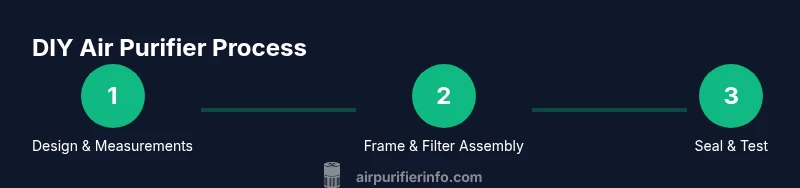
Select a design and measurements
Decide whether to use a simple box fan with a filter or a two-stage design. Measure the filter size to ensure it matches the fan inlet, and plan for a sealed housing that minimizes gaps. A well-planned layout reduces air bypass and improves performance.
Tip: Double-check your measurements; even a small misfit can create leaks that reduce filtration efficiency. - 3
Build or assemble the frame
Cut frame material to size and assemble into a rectangular housing that can hold the filter securely. Use tape or fasteners to hold pieces together without creating sharp edges. Ensure there is room for the fan and any wiring.
Tip: Leave access space for filter replacement and inspection. - 4
Attach the filtration media
Mount the filter so that air flows through the media before reaching the fan. Seal all seams to prevent leaks. Confirm there is no direct bypass path around the filter.
Tip: Make sure the filter is oriented correctly (arrows toward the fan) and firmly held in place. - 5
Seal gaps and secure assembly
Apply weather stripping or tape along all joints to minimize air leaks. Use zip ties to secure the filter and ensure the entire unit remains rigid during operation.
Tip: Perform a quick visual check to verify there are no wide gaps. - 6
Test airflow and safety
Power up the unit in a safe, ventilated area and observe the airflow. Listen for abnormal noises and check for overheating signs. If available, perform a smoke test in a controlled manner to verify air is passing through the media.
Tip: If you notice excessive heat or unusual smells, power down immediately and inspect wiring and seals.
Questions & Answers
Is it safe to build a DIY air purifier at home?
Safety depends on design and build quality. Use proper insulation, sealed joints, and protective guards for moving parts. Do not operate near water or heat sources, and disconnect power before any adjustments.
Yes, with careful design and proper safety precautions you can build a DIY purifier, but never neglect electrical and fire safety.
Can a DIY purifier clean air as well as a commercial unit?
DIY purifiers can reduce dust and odors in small spaces but typically do not match the performance of certified units with validated CADR data. Use DIY as learning or short-term support rather than a long-term replacement in high-usage areas.
DIY setups can help, but they usually cannot match store-bought units for heavy use or high traffic rooms.
What filtration media should I use in a DIY purifier?
A pleated filter with a good MERV rating (13 or higher, depending on compatibility) is recommended for particles. Activated carbon helps with odors and some VOCs but should not be the sole filtration medium for fine particles.
Use a high-quality pleated filter for particles, with carbon for odors as a supplement.
How noisy is a DIY purifier likely to be?
Noise depends on the fan speed and housing design. Higher filtration efficiency typically increases back pressure, which can raise motor noise. If noise is a concern, consider a fan with variable speed or sound-dampening housing.
Expect some noise, especially at higher speeds; choose belt or motor options with quieter operation if possible.
Will a DIY purifier remove VOCs effectively?
DIY purifiers with carbon media can adsorb some VOCs, but overall VOC removal is limited without a multi-stage design and proper airflow. For significant VOC concerns, rely on certified purifiers with validated filters and professional guidance.
Carbon media helps with odors and some VOCs but is not a complete solution for all chemicals.
Is it cost-effective to DIY an air purifier?
DIY projects can reduce initial costs but require ongoing filter replacement and potential risk mitigation. For households with high air quality needs, commercial purifiers may offer better value over time due to proven performance and warranties.
It can be cheaper upfront, but maintenance and reliability matter in the long run.
Watch Video
Main Points
- DIY purifiers are learning tools, not replacements for certified units
- Seal frameworks thoroughly to minimize air leaks
- Balance filtration media with airflow to avoid excessive noise and heat
- Regular filter replacement is essential for ongoing performance
- Assess space and air quality needs before choosing DIY vs store-bought